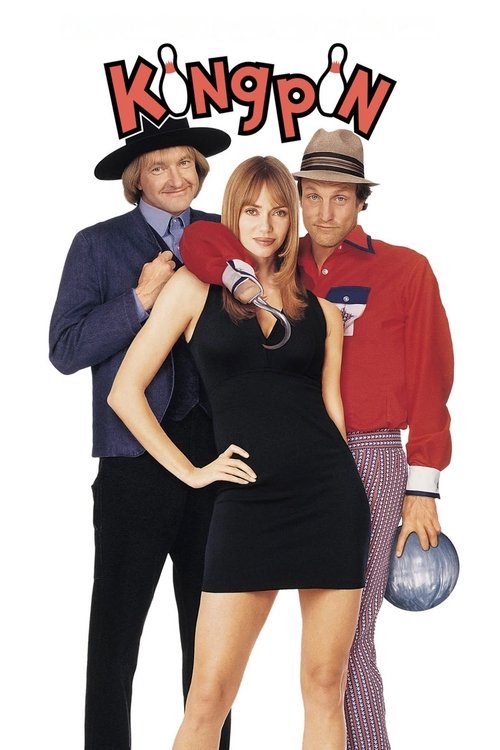
Kingpin (1996)
Directed by Bobby Farrelly
No — Kingpin is not woke, scoring 4 out of 100 on our wokeness meter.
Kingpin arrives from 1996, a Farrelly brothers sports comedy in which Woody Harrelson loses a hand to a bowling ball return and spends seventeen years as a scheming alcoholic before finding salvation in the form of an Amish prodigy.
Consciousness Markers
A minor subplot involves the Boorg family farm facing bank foreclosure, and Roy ultimately gifts his endorsement earnings to save it, but this is a sentimental plot device rather than a critique of capital.
The cast is overwhelmingly white, with Randy Quaid's Amish character serving as the only nominal 'other'; there is no deliberate diverse or inclusive casting.
The ending offers a mild moral about Ishmael's decency changing Roy and Claudia for the better, but it is delivered as sentimental resolution rather than preachy sermonizing.
No LGBTQ+ characters, themes, or subtext appear anywhere in the film.
The film trades heavily in crude, mean-spirited gags about strippers, an elderly landlady coerced into sex, and a woman defined largely by the men pursuing her; it is actively anti-feminist in spirit.
Race is never a subject or theme; the film's world is uniformly white and unconcerned with racial dynamics.
There is no environmental or climate content whatsoever.
The comedy derives much of its humor from mocking physical appearance, disability (Roy's hook hand), hair loss, and comb-overs, the opposite of body-positive messaging.
Ishmael's naivety stems from his sheltered Amish upbringing, not any neurodivergent condition, and the film makes no such themes explicit.
The film is a contemporary sports comedy with no historical revisionism of any kind.
Why it received this score
Kingpin arrives from 1996, a Farrelly brothers sports comedy in which Woody Harrelson loses a hand to a bowling ball return and spends seventeen years as a scheming alcoholic before finding salvation in the form of an Amish prodigy. The comic architecture is of its era and unapologetic about it. Humor is mined from a rubber prosthetic, a comb-over, a hook where a hand should be, an elderly landlady who extracts sexual payment for overdue rent, and a stripper subplot played for leer. The film does not pretend to a social conscience. It is a machine for laughs built on the bodies of the unfortunate, and it works about half the time, which by the standards of the genre is a respectable yield.
We search the film for the modern markers and find the shelves bare. The cast is uniformly white and the film never once notices. Race is not a subject. Neither is sexuality. The women exist as prizes, obstacles, or punchlines, and Claudia's function is to be fought over by men behaving badly in her presence. The single flicker of civic feeling arrives when the Boorg family farm faces foreclosure, and it is extinguished by a sentimental gesture: Roy donates his endorsement money and saves the property. That is charity, not an argument about capital. It is the plot's way of manufacturing a hero out of a man who spent two hours being a scoundrel.
The closing minutes offer a mild homily about Ishmael's decency rubbing off on the cynical, which lands as warm resolution and not as instruction. Nothing here lectures. Nothing here preaches. Kingpin is a rude, mean-spirited, occasionally hilarious relic that predates the cultural turn it would now be asked to satisfy. It fails every contemporary test of representation and sensitivity, and it does so without malice aforethought, which is its own kind of artifact. File it under the anthropology of 1996.
Analysis generated by our Consciousness Algorithm


Synopsis
After bowler Roy Munson swindles the wrong crowd and is left with a hook for a hand, he settles into impoverished obscurity. That is, until he uncovers the next big thing: an Amish kid named Ishmael. So, the corrupt and the hopelessly naive hit the circuit intent on settling an old score with Big Ern.
Questions about Kingpin
Is Kingpin woke?
No — Kingpin is not woke, scoring 4 out of 100 on our wokeness meter. That earns it a verdict of Ultra Based.
Does Kingpin have any woke elements?
Very few. None of the 10 markers reaches 30, the level where a marker counts as present; the highest is Eat the Rich at 10.
How does Kingpin compare to other 1996 movies?
It ranks #66 of the 93 films from 1996 we've scored; their average is 11. The wokest is Bound (60).
How is the Woke Score calculated?
An AI-assisted process researches the film and its reception, scores it 0–100 on ten markers, then combines those into one 0–100 Woke Score. It measures a specific set of 2020s cultural themes, not film quality.