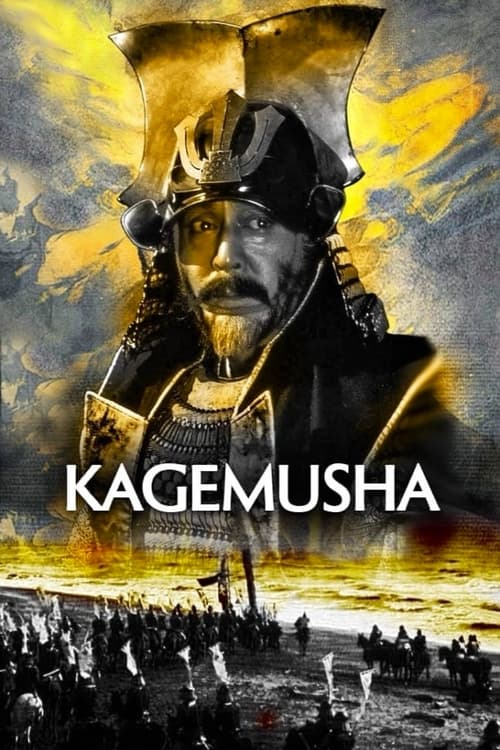
Kagemusha (1980)
Directed by Akira Kurosawa
No — Kagemusha is not woke, scoring 0 out of 100 on our wokeness meter.
Kagemusha arrives from 1980, which is to say from a time before the current arrangements.
Consciousness Markers
All-Japanese cast appropriate to a 16th-century Japanese historical epic; no modern diversity casting or commentary.
No LGBTQ+ characters, themes, or subtext.
Female characters exist within feudal roles, but the film advances no feminist critique or agenda.
Depicts inter-clan Japanese warfare without modern racial-justice framing.
No environmental or climate themes.
Feudal power struggles are not framed as a critique of capitalism or wealth.
No body-positivity themes or messaging.
No neurodivergence themes or representation.
Uses historical figures and the Battle of Nagashino, but not to revise history along modern ideological lines.
No modern moral lecturing; it is a historical epic.
Why it received this score
Kagemusha arrives from 1980, which is to say from a time before the current arrangements. Akira Kurosawa gives us a petty thief spared from crucifixion because he happens to resemble Takeda Shingen, the aging warlord whose death must be concealed from rival clans for three years. The thief learns the lord's gestures, his voice, his stillness. Then he becomes him, or close enough to fool an army. It is a film about power, illusion, and the slow erasure of a man inside a borrowed station. Tatsuya Nakadai plays both the lord and the double, which is either economy or a quiet joke about how little separates the two.
The picture is entirely uninterested in instructing us. Its cast is Japanese because the Sengoku period was Japanese. Its women occupy feudal roles and the film offers no correction of that arrangement. No character pauses to explain the moral architecture of the clan system, and nobody is drafted in to represent a category. There is no environmental allegory, no indictment of wealth, no sermon on the body, no lesson about the mind. The Battle of Nagashino arrives with volleys of arquebus fire and no commentary beyond the obvious horror of cavalry riding into gunfire. The film's only argument is that a man can be replaced by his own shadow, and that the shadow will die for it.
We are left with a historical epic that trusts its audience to reach their own conclusions, a habit now nearly extinct. It ends with a dead impostor reaching for a fallen banner in a river, and it does not tell us what to feel. A clean vintage, cellared well, free of additives. On the current scale it registers nothing at all, and we record that figure with something close to reverence.
Analysis generated by our Consciousness Algorithm


Synopsis
A feudal epic presenting the tale of a petty thief who is recruited to impersonate Shingen, an aging warlord, in order to avoid attacks by competing clans. The impostor becomes comfortable living his life among nobility, but his responsibilities to his station grow more demanding the longer he occupies it.
Questions about Kagemusha
Is Kagemusha woke?
No — Kagemusha is not woke, scoring 0 out of 100 on our wokeness meter. That earns it a verdict of Ultra Based.
Does Kagemusha have any woke elements?
No. All 10 markers score zero.
How does Kagemusha compare to other 1980 movies?
It ranks #32 of the 37 films from 1980 we've scored; their average is 10. The wokest is Nine to Five (42).
How is the Woke Score calculated?
An AI-assisted process researches the film and its reception, scores it 0–100 on ten markers, then combines those into one 0–100 Woke Score. It measures a specific set of 2020s cultural themes, not film quality.