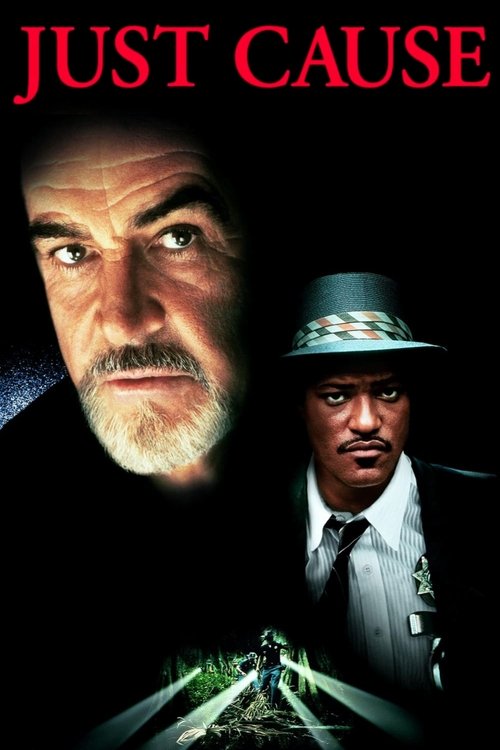
Just Cause (1995)
Directed by Arne Glimcher
No — Just Cause is not woke, scoring 16 out of 100 on our wokeness meter.
Just Cause arrives from 1995 with the sober bearing of a legal thriller that believes it has something to say about the death penalty, and for roughly one act it nearly does.
Consciousness Markers
The film features prominent Black actors in major roles — Laurence Fishburne as the condemned inmate Bobby Earl Ferguson, Blair Underwood as the detective, and Ruby Dee as the grandmother — which was notable for a 1995 studio thriller, though the casting serves the plot rather than a diversity mandate.
The narrative involves a Black man on death row and a coerced confession, touching on race and the justice system, but the twist reveals he is genuinely guilty, defusing any systemic-racism critique into conventional thriller mechanics.
The protagonist is a liberal Harvard professor opposed to capital punishment, giving the first act a mild moralizing tone about the death penalty, though the film abandons argument for twist-driven suspense.
Kate Capshaw's Laurie Armstrong is a prosecutor with a backstory, but she functions largely as a plot device and eventual victim rather than a vehicle for any feminist thesis.
No LGBTQ+ characters, themes, or subtext appear anywhere in the film.
No environmental or climate themes are present.
No critique of wealth, capitalism, or class structures appears in the film.
No body-positivity themes or messaging are present.
No neurodivergence themes or characters are depicted.
The film is a fictional crime thriller with no historical revisionism.
Why it received this score
Just Cause arrives from 1995 with the sober bearing of a legal thriller that believes it has something to say about the death penalty, and for roughly one act it nearly does. Sean Connery plays Paul Armstrong, a Harvard professor who abandoned the courtroom on principle and is dragged back to Florida to defend a condemned Black man. Laurence Fishburne, Blair Underwood, and Ruby Dee occupy the major supporting roles, a configuration that carried some weight for a studio picture of the era, though the film treats their presence as casting, not as argument. The machinery is conventional: a coerced confession, a small-town police force with a secret, a serial killer who speaks in riddles.
The film gestures toward the justice system's treatment of Black defendants, then quietly withdraws the gesture. The condemned man is not innocent, which converts a potential indictment of the machinery into a twist. Race becomes atmosphere, not thesis. Armstrong's opposition to capital punishment supplies a mild sermonizing tone in the opening stretch, and the film drops the argument the moment suspense proves more useful. Kate Capshaw's prosecutor gets a backstory and little else. She exists to be endangered, and the screenplay never asks her to be anything more.
No environmental conscience appears, no economic grievance, no body-positive or neurodivergent thread, no historical revisionism, no queer subtext. The remainder is a competent, grimly watchable thriller that mistakes a final-act bloodbath in the swamps for resolution. The cast deserved a better script. The script, to its credit, knew exactly which decade it was made in and which one it was not.
Analysis generated by our Consciousness Algorithm
Part of


Synopsis
A Harvard professor is lured back into the courtroom after twenty-five years to take the case of a young black man condemned to death for the horrific murder of a child.
Questions about Just Cause
Is Just Cause woke?
No — Just Cause is not woke, scoring 16 out of 100 on our wokeness meter. That earns it a verdict of Ultra Based.
Does Just Cause have any woke elements?
1 of the 10 markers register at 30 or above, led by Representation Casting (45). On Representation Casting: The film features prominent Black actors in major roles — Laurence Fishburne as the condemned inmate Bobby Earl Ferguson, Blair Underwood as the detective, and Ruby Dee as the grandmother — which was notable for a 1995 studio thriller, though the casting serves the plot rather than a diversity mandate.
How does Just Cause compare to other 1995 movies?
It ranks #24 of the 108 films from 1995 we've scored; their average is 12. The wokest is Total Eclipse (60).
How is the Woke Score calculated?
An AI-assisted process researches the film and its reception, scores it 0–100 on ten markers, then combines those into one 0–100 Woke Score. It measures a specific set of 2020s cultural themes, not film quality.