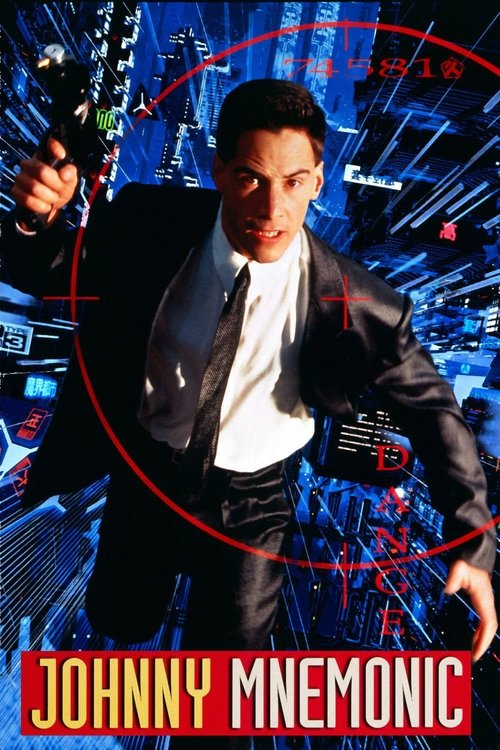
Johnny Mnemonic (1995)
Directed by Robert Longo
No — Johnny Mnemonic is not especially woke, scoring 23 out of 100 on our wokeness meter.
Johnny Mnemonic arrives from 1995 wearing its dystopia like an ill-fitting suit.
Consciousness Markers
The plot explicitly centers on Pharmakom withholding a cure for NAS to profit from ongoing treatments, while the LoTeks are an anti-establishment resistance against corporate control.
The cast is notably multicultural for a 1995 cyberpunk film, including Takeshi Kitano, Ice-T, and Denis Akiyama, but this reflects genre convention and international market casting rather than a modern representation agenda.
The film carries an anti-corporate message about profiting from disease, but it is delivered through action plotting rather than sustained preaching or direct address.
Jane is a capable cybernetically enhanced bodyguard, but she remains a sidekick and romantic interest without any explicit feminist critique or agenda.
No LGBTQ+ themes, characters, or subtext are present in the film.
The film includes yakuza and multiethnic LoTek characters, but race is not examined or commented upon in any conscious way.
The fictional nerve attenuation syndrome is caused by electromagnetic radiation from technology, not by climate change or ecological crisis.
No body positivity themes or messaging are present.
No neurodivergence themes or characters are present.
The film is a futuristic cyberpunk story and does not engage in historical revisionism.
Why it received this score
Johnny Mnemonic arrives from 1995 wearing its dystopia like an ill-fitting suit. The year is 2021, the internet has become a virtual playground, and a disease called nerve attenuation syndrome has turned the population into an underclass of the chronically unwell. Above them sit the megacorporations, and one of them, Pharmakom, has a cure it will not release because mitigation treatments pay better. This is the film's spine, and it is a sturdy one. The LoTeks, a scrappy resistance squatting in the ruins, exist to broadcast the cure and burn the head office down. The critique of pharmaceutical profit is real, and it is embedded in the machinery of the plot, not stapled on as a speech.
The casting is cosmopolitan in a way that feels like international sales strategy. Takeshi Kitano appears for the Japanese market, Ice-T for the downtown crowd, and a rotating cast of character actors fill out the margins. Jane, played by Dina Meyer, is a cybernetically enhanced bodyguard who can handle herself, though the screenplay keeps her close to the role of companion. Any feminist reading stops at the surface. There are no queer currents, no body-positive gestures, no neurodivergent characters, and no ecological anxiety. The plague here comes from electromagnetism, not the climate. The film has no interest in rewriting the past, being too busy inventing a future.
The surviving film is a mild, action-shaped sermon about corporate greed, recut by the studio into something closer to a conventional thriller. The irony that Gibson and Longo intended was removed, leaving the message to travel through gunfights and a dolphin with naval implants. As a piece of progressive consciousness, it is a modest vintage: one genuine note of anti-corporate anger, a few competent women and minorities standing around it, and little else. We drink it because it is there.
Analysis generated by our Consciousness Algorithm


Synopsis
In a dystopian 2021, Johnny is a data trafficker who has an implant that allows him to securely store data too sensitive for regular computer networks. On one delivery run, he accepts a package that not only exceeds the implant's safety limits—and will kill him if the data is not removed in time—but also contains information far more important and valuable than he had ever imagined. On a race against time, he must avoid the assassins sent to kill him and remove the data before it, too, ends his life.
Questions about Johnny Mnemonic
Is Johnny Mnemonic woke?
No — Johnny Mnemonic is not especially woke, scoring 23 out of 100 on our wokeness meter. That earns it a verdict of Based.
Does Johnny Mnemonic have any woke elements?
1 of the 10 markers register at 30 or above, led by Eat the Rich (55). On Eat the Rich: The plot explicitly centers on Pharmakom withholding a cure for NAS to profit from ongoing treatments, while the LoTeks are an anti-establishment resistance against corporate control.
How does Johnny Mnemonic compare to other 1995 movies?
It ranks #12 of the 108 films from 1995 we've scored; their average is 12. The wokest is Total Eclipse (60).
How is the Woke Score calculated?
An AI-assisted process researches the film and its reception, scores it 0–100 on ten markers, then combines those into one 0–100 Woke Score. It measures a specific set of 2020s cultural themes, not film quality.