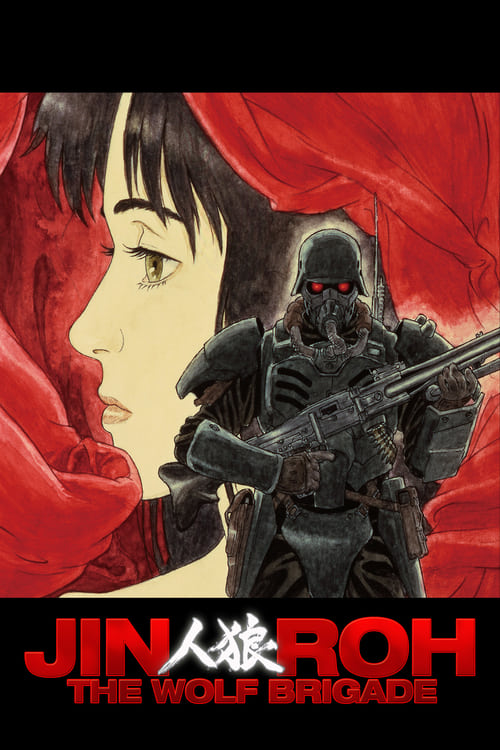
Jin-Roh: The Wolf Brigade (1999)
Directed by Hiroyuki Okiura
No — Jin-Roh: The Wolf Brigade is not woke, scoring 6 out of 100 on our wokeness meter.
Jin-Roh: The Wolf Brigade arrives from 1999 with a powered exoskeleton, a sewer full of corpses, and no interest in telling its audience how to feel about any of it.
Consciousness Markers
The film uses an alternate-history premise (a Nazi-victorious timeline, postwar occupation) as a fictional genre device rather than reinterpreting real events through a modern ideological lens.
Despite its political subject matter, the film is deliberately atmospheric and understated, favoring mood and allegory over direct moral instruction to the audience.
The voice cast is entirely Japanese, fully appropriate for a Japanese-set production; there is no diversity-driven casting agenda or race-swapping of established characters.
No LGBTQ characters, relationships, or themes appear anywhere in the story, which centers on a paramilitary operative and a coerced female courier.
Female characters (Nanami, Kei) exist as tragic figures manipulated by male-dominated institutions, but the film carries no feminist thesis or empowerment framing.
The film unfolds in an alternate-history Japan and treats political factions and state violence, but it never engages with racial justice or racial consciousness as a subject.
No environmental or climate-related content whatsoever; the conflict is entirely political and institutional.
The Sect is described as an anti-government left-wing group, but the film is a bleak study of state power and interservice rivalry rather than a wealth-redistribution or 'eat the rich' polemic.
No body-image, size, or self-acceptance themes are present in the narrative or character design.
Fuse's freezing and trauma are treated as psychological injury and conditioning, not as a neurodivergence-affirming theme.
Why it received this score
Jin-Roh: The Wolf Brigade arrives from 1999 with a powered exoskeleton, a sewer full of corpses, and no interest in telling its audience how to feel about any of it. The film concerns Kazuki Fuse, a member of the Kerberos counterterrorist unit who freezes when ordered to execute a young courier, watches her detonate herself instead, and then drifts into the orbit of a woman claiming to be her sister. That woman is a plant. The whole arrangement is a bureaucratic knife fight between rival police divisions, and everyone involved is a tool of someone slightly higher on the org chart. It is a grim, patient, beautifully hand-drawn piece of animation, and it is almost entirely unconcerned with the social questions that occupy our current cinema.
The cast is Japanese, the setting is an alternate-history Japan where Germany won the war and then attempted to modernize its former conquest, and the political factions are institutional, not identitarian. There is no racial thesis here, no environmental lament, no wealth-redistribution sermon, no celebration of body diversity, and no framework of neurodivergence to explain Fuse's freezing, which the film treats as conditioning and trauma. Two women appear, Nanami and Kei, and both are used and discarded by men with clipboards, but the film offers no empowerment reading of their fates. It is too busy being bleak.
Where the film gestures toward historical reimagining, it does so as genre furniture. The Nazi-victorious timeline is a device for staging a paranoid thriller about internal security, not a revision of real events in service of a modern argument. The sermonizing is minimal. Mamoru Oshii's screenplay prefers atmosphere, allegory, and the Little Red Riding Hood motif to direct moral instruction, and Hiroyuki Okiura directs with a stillness that lets the violence land quietly. The result is a film that keeps its distance from the present cultural moment. It is a wolf in a nice suit, and it does not lecture us about the suit.
Analysis generated by our Consciousness Algorithm

Synopsis
A member of an elite paramilitary counter-terrorism unit becomes traumatized after witnessing the suicide bombing of a young girl and is forced to undergo retraining. However, unbeknownst to him, he becomes a key player in a dispute between rival police divisions, as he finds himself increasingly involved with the sister of the girl he saw die.
Questions about Jin-Roh: The Wolf Brigade
Is Jin-Roh: The Wolf Brigade woke?
No — Jin-Roh: The Wolf Brigade is not woke, scoring 6 out of 100 on our wokeness meter. That earns it a verdict of Ultra Based.
Does Jin-Roh: The Wolf Brigade have any woke elements?
Very few. None of the 10 markers reaches 30, the level where a marker counts as present; the highest is Revisionist History at 10.
How does Jin-Roh: The Wolf Brigade compare to other 1999 movies?
It ranks #72 of the 103 films from 1999 we've scored; their average is 14. The wokest is Boys Don't Cry (60).
How is the Woke Score calculated?
An AI-assisted process researches the film and its reception, scores it 0–100 on ten markers, then combines those into one 0–100 Woke Score. It measures a specific set of 2020s cultural themes, not film quality.