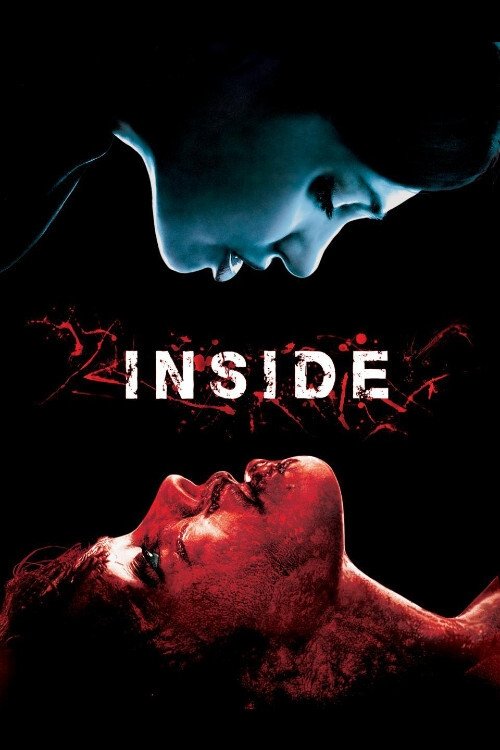
Inside (2007)
Directed by Julien Maury
No — Inside is not woke, scoring 7 out of 100 on our wokeness meter.
Inside arrives with a reputation as a crowbar to the nerves, and it earns that reputation without asking for our approval.
Consciousness Markers
The directors deliberately swapped the killer's sex to upend the slasher cliché of a man stalking women, and the film centers on two women and maternity, but it offers no feminist thesis or messaging; it is a craft subversion, not an agenda.
The cast is a standard French ensemble for the era, mostly white, with no diversity-casting agenda or commentary attached to any role.
No LGBTQ+ characters, themes, or subtext whatsoever; the conflict is a cisgender woman hunting another cisgender woman over maternity.
No racial themes, commentary, or social consciousness of any kind; race is entirely unaddressed.
No environmental or climate content.
No economic critique or class commentary; the violence is purely personal and pathological.
Pregnancy is central, but it is treated as a vessel for horror and grief, not as body-positive affirmation; the film is grotesque about the body rather than celebratory.
No neurodivergent characters or themes; the antagonist's pathology is framed as grief and madness, not neurodivergence.
No historical revisionism; it is a contemporary home-invasion slasher with no engagement with history.
A lean, brutal slasher with no moralizing, messaging, or didactic speeches; the film's intent is pure visceral terror.
Why it received this score
Inside arrives with a reputation as a crowbar to the nerves, and it earns that reputation without asking for our approval. A pregnant widow named Sarah spends Christmas Eve alone, then spends the rest of the night being stabbed at, shot at, and chased through her own house by a woman who wants the child. The film is lean, wet, and merciless. Its pleasures are craft pleasures: the timing of a door, the sound of scissors, the willingness to make the body a site of dread. There is no broader social program tucked into the gore.
To its credit, the directors made a deliberate swap: the stalker is a woman, and the film orbits two women and the raw fact of maternity. That choice bends a tired slasher convention, and it gives Béatrice Dalle and Alysson Paradis something feral to play. But the move is structural, not argumentative. The film does not build a case about gender, power, or motherhood. It uses those materials to tighten the screws. Pregnancy here is a horror device, a vulnerable vessel and a countdown clock, not a platform for affirmation. The body is opened, punctured, and treated as meat. Nobody learns a lesson about self-acceptance.
The film carries no social argument beyond the immediate cruelty of the premise. It is not a vehicle for instruction, and it offers no apology for the blood. The antagonist wants a replacement for the child she lost, and the movie wants us to feel the awfulness of that want. There are no speeches, no moral instruction, no therapeutic vocabulary. Inside is a nasty piece of work. It knows exactly what it is doing.
Analysis generated by our Consciousness Algorithm


Synopsis
Months after a tragic accident, Sarah, a young pregnant woman, must spend Christmas Eve alone in her house before giving birth the next day. But in the middle of the night, a creepy visitor knocks at her door willing to do anything to get what they want, setting off a night of pure terror.
Questions about Inside
Is Inside woke?
No — Inside is not woke, scoring 7 out of 100 on our wokeness meter. That earns it a verdict of Ultra Based.
Does Inside have any woke elements?
Very few. None of the 10 markers reaches 30, the level where a marker counts as present; the highest is Feminist Agenda at 12.
How does Inside compare to other 2007 movies?
It ranks #108 of the 201 films from 2007 we've scored; their average is 12. The wokest is Like Stars on Earth (92).
How is the Woke Score calculated?
An AI-assisted process researches the film and its reception, scores it 0–100 on ten markers, then combines those into one 0–100 Woke Score. It measures a specific set of 2020s cultural themes, not film quality.