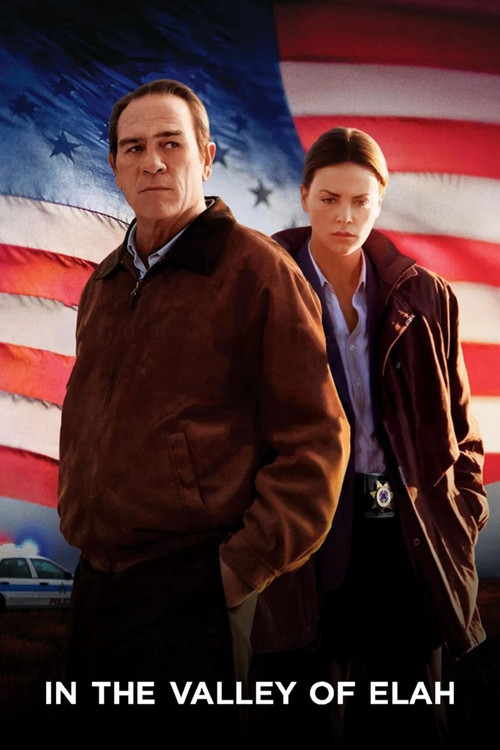
In the Valley of Elah (2007)
Directed by Paul Haggis
No — In the Valley of Elah is not woke, scoring 15 out of 100 on our wokeness meter.
Paul Haggis's In the Valley of Elah arrives as a somber procedural about a retired military policeman searching for his missing son, and it carries itself with the grim purpose of a man who has read the room and decided the room needs a lecture.
Consciousness Markers
Critics widely faulted Haggis for heavy-handedness, with the Washington Post calling it 'agitprop' and the LA Times noting characters 'delivering a Very Important Message to the world.'
Charlize Theron's Detective Sanders is a single mother repeatedly belittled by her male colleagues, giving the film a mild workplace-sexism thread, but it is a procedural device rather than a feminist thesis.
The cast is overwhelmingly white, anchored by Tommy Lee Jones, Charlize Theron, Susan Sarandon, and James Franco; a handful of Latino supporting roles (Ortiz, the squad) exist naturally without comment.
The film fictionalizes a real 2003 murder case to deliver an antiwar statement about Iraq, but it does not rewrite or reframe established history in the modern activist sense.
Race is essentially absent as a theme; the Iraqi child and abused insurgent figure as war-crime imagery rather than a racial-consciousness argument.
No LGBTQ+ characters, themes, or subtext appear anywhere in the film.
No environmental or climate content whatsoever.
The film critiques the military and the Iraq War, not capitalism or economic hierarchy.
No body-positivity themes or content.
PTSD is a central theme, but it is framed as combat trauma and moral injury, not as neurodivergence or neurodiversity.
Why it received this score
Paul Haggis's In the Valley of Elah arrives as a somber procedural about a retired military policeman searching for his missing son, and it carries itself with the grim purpose of a man who has read the room and decided the room needs a lecture. The murder mystery is competently assembled. The messaging is delivered by megaphone. Critics at the time reached for the word agitprop, and the Washington Post was not wrong. Characters here do not converse so much as testify, each scene another deposition in a case the filmmaker has already decided. The film glances at the Iraq War, prisoner abuse, and combat trauma, and it does so with the earnestness of a civics teacher who suspects nobody did the reading.
On the cultural ledger, the picture is thinner than its reputation suggests. The cast is overwhelmingly white and anchored by Tommy Lee Jones, Charlize Theron, and Susan Sarandon, with a few Latino supporting players drifting through without comment. Theron's Detective Sanders is a single mother needled by male colleagues, a thread of workplace sexism that functions as plot machinery instead of argument. Race is essentially absent as a subject. The Iraqi child and the tortured insurgent exist as war-crime imagery, not as a racial thesis. There is no romantic subtext of any stripe, no environmental conscience, no economic critique, and no engagement with neurodiversity, though PTSD sits at the center of everything.
What the film does carry is a fictionalized real murder case bent toward an antiwar conclusion, a modest act of narrative license that stops well short of rewriting history. It is a serious work about serious things, which is not the same as a lecture. It is, however, also a lecture.
It closes on a father flying his son's flag upside down, a gesture of grief that the film trusts us to interpret without assistance. That restraint is welcome. It arrives roughly ninety minutes too late.
We file this one under sincere grievance rather than cultural insurgency. It means well, it says so repeatedly, and it leaves the ledger almost untouched.
Thematic tags: true_story. The film is based on the real 2003 murder of Richard T. Davis, though names and locations were changed. It won no Academy Awards, spawned no sequels, remade nothing, adapted no book, featured no superheroes, and never reached number one at the domestic box office, having grossed a modest $6.7 million against a $23 million budget. Tommy Lee Jones received a Best Actor nomination and went home empty-handed, as did everyone else involved.
Analysis generated by our Consciousness Algorithm


Synopsis
A career officer and his wife work with a police detective to uncover the truth behind their son's disappearance following his return from a tour of duty in Iraq.
Questions about In the Valley of Elah
Is In the Valley of Elah woke?
No — In the Valley of Elah is not woke, scoring 15 out of 100 on our wokeness meter. That earns it a verdict of Ultra Based.
Does In the Valley of Elah have any woke elements?
1 of the 10 markers register at 30 or above, led by Lecture Energy (55). On Lecture Energy: Critics widely faulted Haggis for heavy-handedness, with the Washington Post calling it 'agitprop' and the LA Times noting characters 'delivering a Very Important Message to the world.'
How does In the Valley of Elah compare to other 2007 movies?
It ranks #50 of the 201 films from 2007 we've scored; their average is 12. The wokest is Like Stars on Earth (92).
How is the Woke Score calculated?
An AI-assisted process researches the film and its reception, scores it 0–100 on ten markers, then combines those into one 0–100 Woke Score. It measures a specific set of 2020s cultural themes, not film quality.