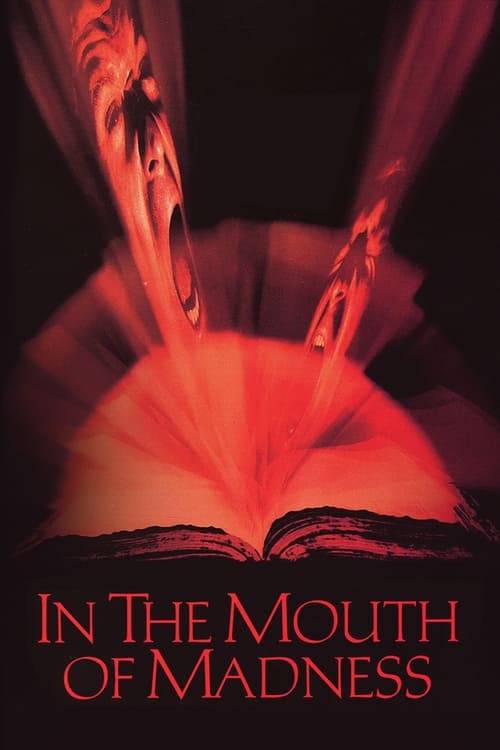
In the Mouth of Madness (1995)
Directed by John Carpenter
No — In the Mouth of Madness is not woke, scoring 5 out of 100 on our wokeness meter.
John Carpenter's In the Mouth of Madness arrives from 1995 carrying the dust of a dozen New England towns that never existed, and it asks a question the pulps have been asking for a century: what happens when enough people believe a story?
Consciousness Markers
The cast is overwhelmingly white, with Julie Carmen and Bernie Casey in supporting roles; their presence is incidental to the story rather than a deliberate diversity statement.
The film gestures at postmodern ideas about fiction, belief, and reality, but it dramatizes them through horror set-pieces rather than preaching at the audience.
The publishing industry is depicted as a cynical machine that will market the apocalypse for profit, but this is a satirical flourish rather than a sustained anti-capitalist thesis.
Linda Styles is a competent editor who gets a share of screen time, but the film makes no feminist argument and she is ultimately a victim of the male author's cosmic design.
No LGBTQ+ characters, themes, or subtext appear anywhere in the film.
Race is never addressed or thematized; the film's concerns are entirely metaphysical and psychological.
No environmental or climate themes are present.
No body-positivity themes; the film's bodies are mutating monsters.
Insanity is a Lovecraftian horror device about the collapse of reality, not a depiction of neurodivergence as identity or social concern.
The film invents a fictional cosmology but does not revise or reinterpret real historical events.
Why it received this score
John Carpenter's In the Mouth of Madness arrives from 1995 carrying the dust of a dozen New England towns that never existed, and it asks a question the pulps have been asking for a century: what happens when enough people believe a story? Sam Neill plays an insurance investigator who believes nothing, which is the correct posture for a man about to be unmade by a paperback. The film is an open tribute to H.P. Lovecraft, from the asylum frame narrative to the ancient evil beneath the church. There is little here that a modern cultural auditor would flag. The cast is overwhelmingly white, with Julie Carmen and Bernie Casey in supporting turns the story simply absorbs. Race is never raised as a subject, and the film's preoccupations are entirely metaphysical. No LGBTQ+ presence. No environmental grievance. No argument about bodies or minds. The bodies in question are mutating into monsters, and the minds are dissolving into the old ones' design.
Linda Styles, the editor played by Carmen, is competent and gets a fair share of the running time, though the film makes no case for her beyond utility. She ends as a victim of a male author's cosmic plot. The publishing industry takes some ribbing: Arcane will market the apocalypse if the apocalypse sells, and the joke lands. It is a satirical flourish, not a thesis. Carpenter is more interested in the collapse of the real than in the sins of capital, and he stages that collapse with creatures, tunnels, and an axe. The ideas about fiction and belief are present, but they are dramatized instead of announced. Nobody stops the movie to explain postmodernism to us. That restraint is, in its way, a small mercy.
What we have, then, is a horror picture that is cerebral without being preachy, weird without being coy, and largely indifferent to the social questions that occupy the current moment. It was a box office failure, it was received with a shrug, and it has since accumulated a cult. Time has been kind to its monsters and its mood. The final image, a man laughing in a cinema as his own life replays on screen, remains one of the better endings of its decade. A modest achievement, soberly considered. The classification is straightforward.
Analysis generated by our Consciousness Algorithm


Synopsis
An insurance investigator visits a small town while looking into the strange disappearance of a popular horror novelist. He soon finds that the impact of the author’s books is far more than inspirational.
Questions about In the Mouth of Madness
Is In the Mouth of Madness woke?
No — In the Mouth of Madness is not woke, scoring 5 out of 100 on our wokeness meter. That earns it a verdict of Ultra Based.
Does In the Mouth of Madness have any woke elements?
Very few. None of the 10 markers reaches 30, the level where a marker counts as present; the highest is Lecture Energy at 12.
How does In the Mouth of Madness compare to other 1995 movies?
It ranks #69 of the 108 films from 1995 we've scored; their average is 12. The wokest is Total Eclipse (60).
How is the Woke Score calculated?
An AI-assisted process researches the film and its reception, scores it 0–100 on ten markers, then combines those into one 0–100 Woke Score. It measures a specific set of 2020s cultural themes, not film quality.