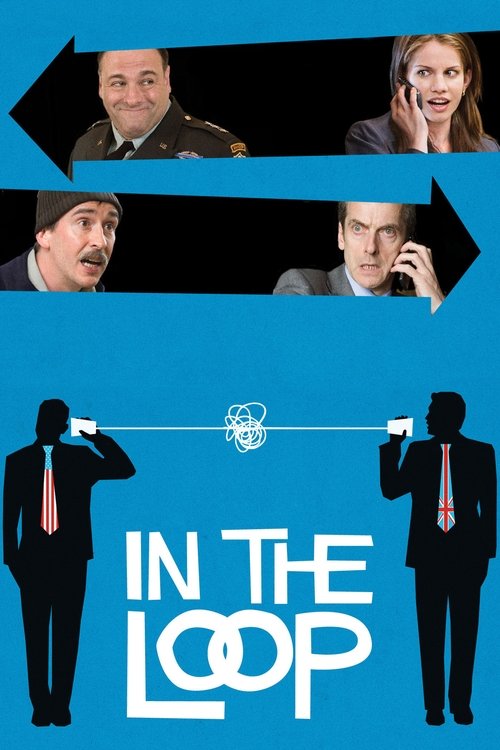
In the Loop (2009)
Directed by Armando Iannucci
No — In the Loop is not woke, scoring 7 out of 100 on our wokeness meter.
Armando Iannucci's In the Loop comes to us from 2009, a feature-length spin-off of The Thick of It, and it concerns the machinery of a war that nobody in the room wishes to be blamed for starting.
Consciousness Markers
The cast features women in several substantive roles (Mimi Kennedy's Karen Clark, Anna Chlumsky's Liza Weld, Gina McKee's Judy Molloy), but this is natural ensemble casting for a 2009 political satire rather than a deliberate diversity push.
The film is a scathing, foul-mouthed satire that skewers political incompetence, but it mocks rather than moralizes—its cynicism is far from the preachy, instructive tone the marker describes.
Karen Clark and Liza Weld are women who drive the anti-war subplot, but the film never frames their roles through a feminist lens or commentary on gender.
The film satirizes political warmongering and bureaucratic cynicism, not capitalism or economic inequality; any anti-establishment edge is aimed at government, not class or markets.
No LGBTQ+ characters or themes appear anywhere in the film.
Despite dealing with a Middle East war, the film engages no racial or identity politics whatsoever; it is entirely about institutional maneuvering among white Western officials.
No environmental or climate themes are present.
No body positivity themes or content.
No neurodivergence themes or content.
While loosely inspired by the run-up to the Iraq War, the film is an original satire of fictional officials, not a revisionist reframing of historical events.
Why it received this score
Armando Iannucci's In the Loop comes to us from 2009, a feature-length spin-off of The Thick of It, and it concerns the machinery of a war that nobody in the room wishes to be blamed for starting. Officials on both sides of the Atlantic maneuver, leak, and fabricate. Malcolm Tucker swears with the fluency of a man who has made profanity a load-bearing structural element. The film is a comedy, and a dark one, and it has no interest in instructing us how to feel about any of it. Time has not softened its edges, and it has not granted it any new ones.
The cast includes women with genuine agency in the plot. Karen Clark and Liza Weld drive an entire anti-war subplot, and the film treats their competence as unremarkable, which is either quiet progress or simply sound ensemble writing from 2009. Their gender is never the subject. The film's anger points at government, at spin, at the cowardice of men who climb mountains of conflict because a phrase sounded good on the radio. It does not point at markets, class, or capital. That is a different species of fury, and this film does not have it.
The absences tell the rest of the story. A narrative about a Middle East intervention engages no racial politics at all. No LGBTQ+ characters appear anywhere. Nothing about climate, body image, neurodivergence, or the reframing of recorded history intrudes on the proceedings. The satire bites hard, but it mocks instead of moralizes, which keeps the sermonizing to a minimum. The result is a brisk, foul-mouthed procedural about people failing upward. Call it cynical. The film would take that as a compliment, and it would be right to.
Analysis generated by our Consciousness Algorithm


Synopsis
The US President and the UK Prime Minister are planning on launching a war in the Middle East, but—behind the scenes—government officials and advisers are either promoting the war or are trying to prevent it.
Questions about In the Loop
Is In the Loop woke?
No — In the Loop is not woke, scoring 7 out of 100 on our wokeness meter. That earns it a verdict of Ultra Based.
Does In the Loop have any woke elements?
Very few. None of the 10 markers reaches 30, the level where a marker counts as present; the highest is Representation Casting at 18.
How does In the Loop compare to other 2009 movies?
It ranks #137 of the 230 films from 2009 we've scored; their average is 14. The wokest is Home (79).
How is the Woke Score calculated?
An AI-assisted process researches the film and its reception, scores it 0–100 on ten markers, then combines those into one 0–100 Woke Score. It measures a specific set of 2020s cultural themes, not film quality.