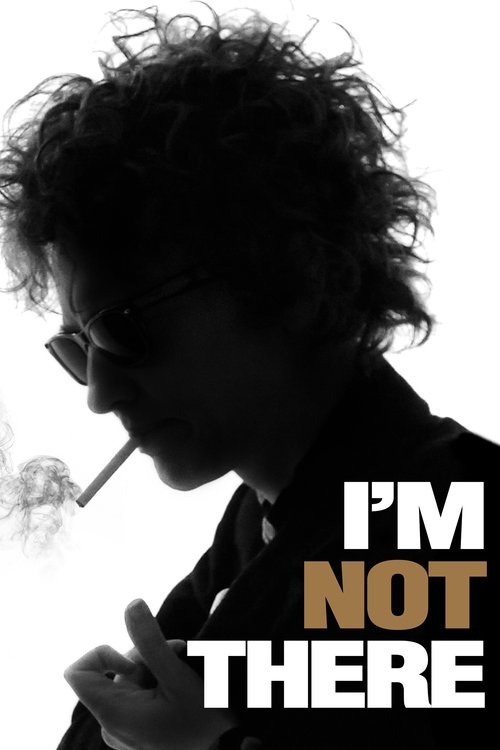
I'm Not There (2007)
Directed by Todd Haynes
No — I'm Not There is not especially woke, scoring 22 out of 100 on our wokeness meter.
Todd Haynes takes the most documented American singer of the twentieth century and hands him to six actors, none of whom is named Bob Dylan, and asks us to accept that this is the most honest approach available.
Consciousness Markers
A Black child actor (Marcus Carl Franklin) is cast as a Dylan persona, and a woman (Cate Blanchett) plays the male rock-star persona Jude Quinn — deliberate, comment-worthy cross-race and cross-gender casting choices.
The Black Panther Party (Bobby Seale, Huey Newton) appears, Jude's songs are noted as recruitment tools, and the young Black 'Woody Guthrie' sings of unionism — racial material is present but not the film's organizing concern.
The music-industry machinery — managers signing Jude to 83 shows without consent, the 'selling out' backlash, the commodification of the artist — carries a mild anti-commercial critique.
Claire Clark is a substantial female presence and Robbie's 'women can never be poets' remark is framed critically, but the film offers no sustained feminist thesis.
The film deliberately fractures and fictionalizes a real biography, confusing fact with fantasy, but this is artistic deconstruction rather than a social-justice rewriting of history.
The film carries drag and gender-bending elements (Blanchett's androgynous Jude Quinn) and comes from an openly gay director steeped in queer cinema, though no explicit LGBTQ+ narrative is centered.
The film is an experimental, allusive mood piece rather than a preachy one; it refracts rather than lectures, offering little direct moral instruction.
No environmental or climate themes appear anywhere in the film.
No body-image or body-positivity content is present.
No neurodivergence themes are present.
Why it received this score
Todd Haynes takes the most documented American singer of the twentieth century and hands him to six actors, none of whom is named Bob Dylan, and asks us to accept that this is the most honest approach available. The film fractures a biography into personae and lets the pieces drift. Cate Blanchett plays Jude Quinn, a rock martyr in dark glasses with a sharper jawline than any of her co-stars, and the performance carries a gender trouble the film never bothers to explain, which is to its credit. Marcus Carl Franklin, a Black child, rides the rails calling himself Woody Guthrie. These are deliberate choices, staged for the audience to notice, and they land as quiet provocation.
The social content sits in the margins. The Black Panthers drift through a hotel corridor, and a journalist observes that Jude's songs have become recruitment tools, a detail the film notes and then sets down. Robbie Clark, the actor playing a folk singer, tells his wife that women can never be poets, and we are meant to find him small for saying it. The music business receives a gentle skewering: a manager books eighty-three shows without asking, and the audience howls about selling out. None of this organizes the film. It is texture, not thesis.
What the film does not have is a sermon. It refracts where it could lecture, and its moral instruction is thin, almost absent. There is no environmental lament, no body politics, no inquiry into the wiring of the mind. The historical record is scrambled on purpose, though the scrambling serves an artistic idea instead of an argument. Haynes is after something stranger: identity as a series of escapes. The result is a mood piece that respects its subject by refusing to pin him down, and it mostly declines to tell us what to think, which is nearly a novelty.
Analysis generated by our Consciousness Algorithm


Synopsis
Six actors portray six personas of music legend Bob Dylan in scenes depicting various stages of his life, chronicling his rise from unknown folksinger to international icon and revealing how Dylan constantly reinvented himself.
Questions about I'm Not There
Is I'm Not There woke?
No — I'm Not There is not especially woke, scoring 22 out of 100 on our wokeness meter. That earns it a verdict of Based.
Does I'm Not There have any woke elements?
2 of the 10 markers register at 30 or above, led by Representation Casting (45) and Racial Consciousness (35). On Representation Casting: A Black child actor (Marcus Carl Franklin) is cast as a Dylan persona, and a woman (Cate Blanchett) plays the male rock-star persona Jude Quinn — deliberate, comment-worthy cross-race and cross-gender casting choices.
How does I'm Not There compare to other 2007 movies?
It ranks #28 of the 201 films from 2007 we've scored; their average is 12. The wokest is Like Stars on Earth (92).
How is the Woke Score calculated?
An AI-assisted process researches the film and its reception, scores it 0–100 on ten markers, then combines those into one 0–100 Woke Score. It measures a specific set of 2020s cultural themes, not film quality.