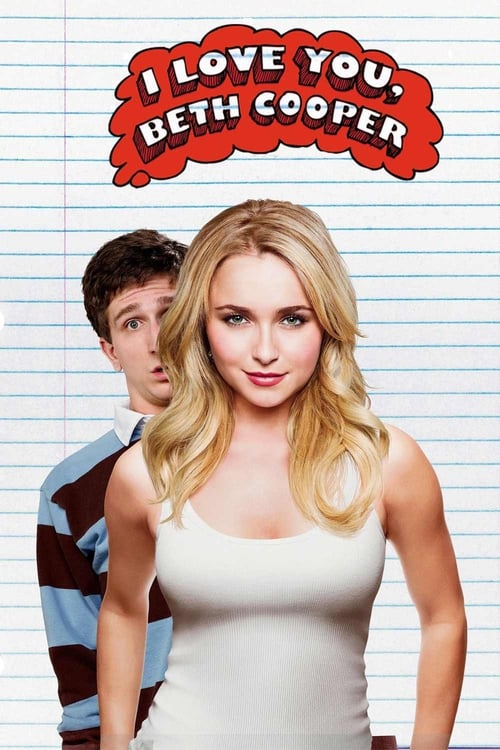
I Love You, Beth Cooper (2009)
Directed by Chris Columbus
No — I Love You, Beth Cooper is not especially woke, scoring 25 out of 100 on our wokeness meter.
"I Love You, Beth Cooper" arrives in 2009 as a Chris Columbus production, which is to say a film about teenagers made by a man who appears to have heard about teenagers from a distant relative.
Consciousness Markers
The central emotional arc involves the protagonist urging his best friend to come out, giving the film a significant, if somewhat clumsy, focus on LGBTQ+ themes.
Beth Cooper is portrayed as a complex, powerful, and highly capable character who defies the typical 'bimbo' trope, even if she is still a cheerleader.
The film centers on a group of diverse high schoolers, including a closeted gay character, which is a modest step forward for teen representation in 2009.
Rich Munsch's highly specific, socially awkward, and quote-heavy behavior suggests traits that align with neurodivergent characteristics, though it is never explicitly stated.
The film operates within the standard framework of affluent American high school life and offers no critique of economic structures.
The film lacks any didactic speeches or heavy, overtly educational social commentary delivered in a lecture format.
The film contains no discernible commentary or representation regarding race or racial dynamics.
The plot is entirely focused on high school social drama and contains no environmental messaging or concerns.
There is no focus on body image, diverse body types, or challenging conventional beauty standards.
As a fictional teen comedy, the film does not engage with historical events or attempt to revise established narratives.
Why it received this score
"I Love You, Beth Cooper" arrives in 2009 as a Chris Columbus production, which is to say a film about teenagers made by a man who appears to have heard about teenagers from a distant relative. Denis Cooverman, valedictorian, uses his graduation speech to declare his love for the head cheerleader and to instruct his best friend Rich to come out. That second item is the film's quiet engine, a coming-out arc delivered first as a running gag and then, in the final act, with unexpected tenderness. The handling is clumsy and extracts laughs at Rich's expense, yet the friendship between the two boys carries a warmth the rest of the picture cannot manage. On the representation ledger this counts for something, modest and imperfect.
Beth Cooper resists the bimbo template. She is a reckless driver, a briber of gas station clerks, a capable force who is named after a KISS song. The film grants her complexity while still dressing her in the cheerleader uniform, which is the compromise this genre makes with itself. Rich Munsch, meanwhile, quotes movie titles with director and year attached, a behavioral tic the screenplay treats as comedy but which reads today as an unlabeled neurodivergent portrait. Nobody in the film names it. Nobody names much of anything.
Where the film is silent, it is thoroughly silent. Race goes unremarked. The environment does not intrude. Money exists only as an excuse to wreck a house. Body image is not a subject. History is not a subject. There is no sermon, no lesson, no lecture, just a long night of property damage and a boom box joke borrowed from a better film. The result is a picture with a few progressive instincts buried under a great deal of noise. It is not a moral failure. It is simply tired, and it lost to a seventh-place opening weekend without much complaint from anyone.
{"thematic_tags": ["book_adaptation"]}
Analysis generated by our Consciousness Algorithm


Synopsis
A valedictorian's declaration of love for a high-school cheerleader launches a night of revelry, reflection and romance for a group of graduating seniors.
Questions about I Love You, Beth Cooper
Is I Love You, Beth Cooper woke?
No — I Love You, Beth Cooper is not especially woke, scoring 25 out of 100 on our wokeness meter. That earns it a verdict of Based.
Does I Love You, Beth Cooper have any woke elements?
3 of the 10 markers register at 30 or above, led by LGBTQ+ Themes (65), Feminist Agenda (40) and Representation Casting (30). On LGBTQ+ Themes: The central emotional arc involves the protagonist urging his best friend to come out, giving the film a significant, if somewhat clumsy, focus on LGBTQ+ themes.
How does I Love You, Beth Cooper compare to other 2009 movies?
It ranks #32 of the 230 films from 2009 we've scored; their average is 14. The wokest is Home (79).
How is the Woke Score calculated?
An AI-assisted process researches the film and its reception, scores it 0–100 on ten markers, then combines those into one 0–100 Woke Score. It measures a specific set of 2020s cultural themes, not film quality.