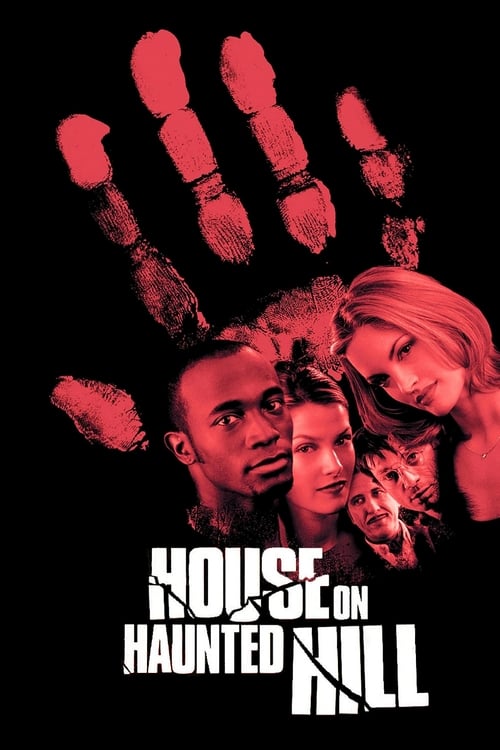
House on Haunted Hill (1999)
Directed by William Malone
No — House on Haunted Hill is not woke, scoring 9 out of 100 on our wokeness meter.
House on Haunted Hill arrives as a 1999 remake of a 1958 William Castle gimmick picture, and it conducts itself accordingly.
Consciousness Markers
The cast is notably multiracial for a 1999 horror film, with Taye Diggs in a prominent co-lead role, but the diversity is presented as unremarkable ensemble casting with no commentary or identity-driven framing.
Ali Larter's Sara is a resourceful survivor and Famke Janssen's Evelyn is a scheming femme fatale, but the film offers no feminist thesis or gender-politics commentary; these are stock horror archetypes.
The plot involves a wealthy amusement-park mogul luring guests with cash, and one academic reads a faint critique of 'wealthy drones,' but the film's greed motif is a genre device rather than an anti-capitalist argument.
Taye Diggs plays a Black ex-baseball player, but his race is never referenced and the film engages no racial themes whatsoever.
The film is a gory haunted-house thrill ride with no moralizing, messaging, or didactic speeches directed at the audience.
No LGBTQ+ characters, themes, or subtext appear anywhere in the film.
There is no environmental or climate content in the film.
No body-positivity themes or messaging are present.
The film depicts a psychiatric asylum and schizophrenic patients, but as monstrous horror spectacle and torture imagery rather than as neurodivergent-affirming representation.
The asylum's medical-torture backstory is loosely drawn from Nazi experiments, but this is exploitative horror texture, not a revisionist reframing of history.
Why it received this score
House on Haunted Hill arrives as a 1999 remake of a 1958 William Castle gimmick picture, and it conducts itself accordingly. A theme-park magnate offers a million dollars to strangers willing to survive a night inside a decommissioned psychiatric hospital. Geoffrey Rush chews the scenery behind a pencil moustache. The building locks itself. People are dismembered. The whole enterprise is a haunted-house ride with a blood tank in the basement, and it makes no apology for being one.
The cast is more integrated than 1999 horror typically bothered with, and Taye Diggs occupies a genuine co-lead as an ex-ballplayer. The film never mentions his race, which is either progress or indifference depending on the afternoon. Famke Janssen schemes as a femme fatale and Ali Larter survives on her wits, but these are stock figures, not arguments. The greed motif, a mogul luring guests with cash, brushes against a critique of wealth without ever committing to one. An academic somewhere read the picture as a warning that art is not a game for wealthy drones, which may be the most generous sentence ever written about a movie featuring a killer zoetrope.
On the remaining questions the film is silent. No LGBTQ content, no environmental sermon, no body-positive messaging, no affirming portrait of neurodivergence despite its asylum setting, where madness functions as set dressing for torture. The Nazi-adjacent medical experiments supply atmosphere, not historical argument. Nobody lectures the audience. Nobody explains what to think. The picture kills most of its cast, hands the survivors a stack of checks, and then shows the villains being tortured for eternity in black and white. There are worse ways to spend ninety minutes, and considerably fewer honest ones.
Analysis generated by our Consciousness Algorithm


Synopsis
An amusement park mogul offers a random group of diverse people $1 million to spend the night in a decrepit former mental institution.
Questions about House on Haunted Hill
Is House on Haunted Hill woke?
No — House on Haunted Hill is not woke, scoring 9 out of 100 on our wokeness meter. That earns it a verdict of Ultra Based.
Does House on Haunted Hill have any woke elements?
Very few. None of the 10 markers reaches 30, the level where a marker counts as present; the highest is Representation Casting at 28.
How does House on Haunted Hill compare to other 1999 movies?
It ranks #54 of the 103 films from 1999 we've scored; their average is 14. The wokest is Boys Don't Cry (60).
How is the Woke Score calculated?
An AI-assisted process researches the film and its reception, scores it 0–100 on ten markers, then combines those into one 0–100 Woke Score. It measures a specific set of 2020s cultural themes, not film quality.