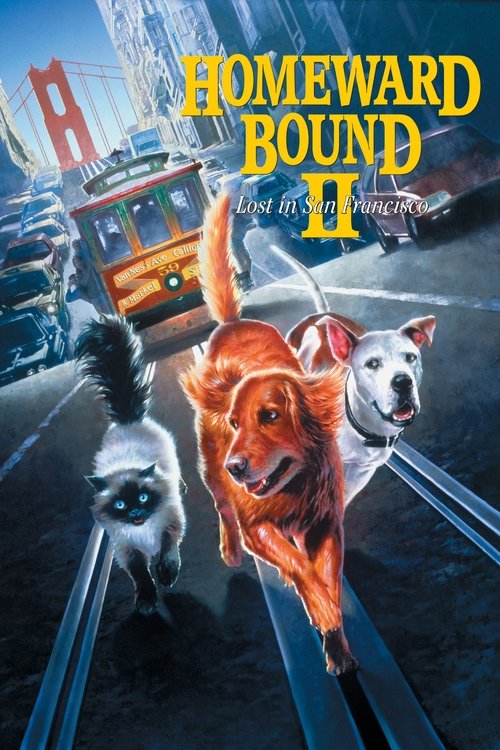
Homeward Bound II: Lost in San Francisco (1996)
Directed by David R. Ellis
No — Homeward Bound II: Lost in San Francisco is not woke, scoring 6 out of 100 on our wokeness meter.
Homeward Bound II: Lost in San Francisco arrives three years after its predecessor and roughly three years after the death of Don Ameche, whose shoes Ralph Waite fills with the resigned dignity of a man narrating a dog.
Consciousness Markers
The voice cast includes Black performers Tisha Campbell-Martin and Sinbad in prominent roles, but their presence is unremarked and natural to the ensemble rather than a statement of representation.
The film offers gentle moral lessons about trust, loyalty, and belonging, but they are delivered through sentiment and adventure rather than preachy sermonizing.
Sassy the cat and Delilah the Kuvasz are given some agency, but the film's gender dynamics are entirely conventional, with Delilah functioning primarily as a romantic prize for Chance.
Riley's distrust of humans and the sinister 'Blood Red Van' that hauls strays to 'the Lab' gesture faintly at animal-testing critique, but the film never frames this as a systemic or economic indictment.
No LGBTQ+ characters, themes, or subtext appear anywhere in this 1996 Disney family film.
The film engages no racial themes; the stray-animal social hierarchy is about species and domestication, not race.
No environmental or climate messaging is present; a discarded cigarette starts a house fire, but this is a plot device, not an ecological statement.
No body-positivity themes or messaging are present.
No neurodivergent characters or themes are depicted or referenced.
The film is a fictional animal adventure with no historical subject matter to revise.
Why it received this score
Homeward Bound II: Lost in San Francisco arrives three years after its predecessor and roughly three years after the death of Don Ameche, whose shoes Ralph Waite fills with the resigned dignity of a man narrating a dog. The premise has not moved: a Golden Retriever, a Himalayan cat, and an American Bulldog must cross hostile ground to reach the family that loves them. This time the ground is San Francisco, and the hostility is supplied by a street gang of strays, a pair of bullies named Ashcan and Pete, and a vehicle the animals call the Blood Red Van, which hauls captured dogs to a place called the Lab. Sinbad and Tisha Campbell-Martin appear in the voice cast, both performing capably and without commentary, which is how such things were done in 1996.
The film's social imagination extends as far as a dog named Riley who distrusts humans because a family once abandoned him at Christmas. That is a story about individual cruelty, not a system, and the screenplay treats it as a wound to be healed by loyalty and a good chase. Delilah, a Kuvasz voiced by Carla Gugino, is granted some independence before being folded into the third act as a prize for Chance, which is the oldest arrangement in the animal-adventure playbook. Sassy gets the better lines and the better instincts; she rescues a kitten from a burning house while the dogs handle the boy. A discarded cigarette starts that fire, though the film draws no ecological conclusion from it.
There is craft here, and the craft is modest. The lessons concern trust, belonging, and the wisdom of coming home, delivered through sentiment and slapstick instead of sermon. No racial argument is made, no climate argument, no argument about bodies or brains or capital, only a brisk ninety minutes of animals outrunning their circumstances. The result is a sequel that knows its audience, respects it mildly, and asks nothing of it beyond attention. For a Disney family picture of the mid-nineties, that is a complete and honorable ambition.
Analysis generated by our Consciousness Algorithm
Part of


Synopsis
When the pets accidentally get separated from their vacationing owners, Chance, Shadow, and Sassy navigate the mean streets of San Francisco, trying to find their home across the Golden Gate Bridge. But the road is blocked by a series of hazards, both man and beast.
Questions about Homeward Bound II: Lost in San Francisco
Is Homeward Bound II: Lost in San Francisco woke?
No — Homeward Bound II: Lost in San Francisco is not woke, scoring 6 out of 100 on our wokeness meter. That earns it a verdict of Ultra Based.
Does Homeward Bound II: Lost in San Francisco have any woke elements?
Very few. None of the 10 markers reaches 30, the level where a marker counts as present; the highest is Representation Casting at 20.
How does Homeward Bound II: Lost in San Francisco compare to other 1996 movies?
It ranks #58 of the 93 films from 1996 we've scored; their average is 11. The wokest is Bound (60).
How is the Woke Score calculated?
An AI-assisted process researches the film and its reception, scores it 0–100 on ten markers, then combines those into one 0–100 Woke Score. It measures a specific set of 2020s cultural themes, not film quality.