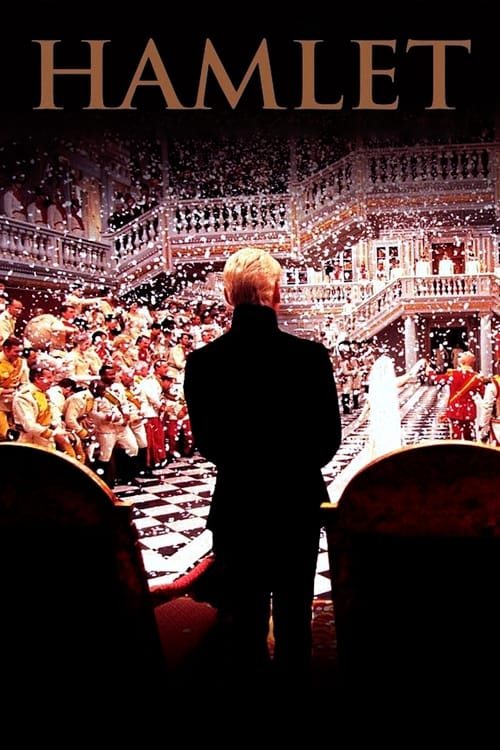
Hamlet (1996)
Directed by Kenneth Branagh
No — Hamlet is not woke, scoring 0 out of 100 on our wokeness meter.
Kenneth Branagh's Hamlet arrives at four hours and two minutes, unabridged, shot on 70mm, and populated by what appears to be every working actor in the British Isles.
Consciousness Markers
The cast is overwhelmingly white and drawn from traditional British Shakespearean ranks; the lone Black actor in a minor role does not constitute modern representation casting as a deliberate marker.
There are no LGBTQ+ themes, characters, or subtexts in this adaptation.
Gertrude and Ophelia are Shakespearean figures treated within the play's tragic framework, not through a modern feminist agenda.
The film does not engage with race, racial identity, or racial justice themes.
There is no environmental or climate-related messaging.
The film is concerned with royal succession, revenge, and mortality, not anti-capitalist critique.
There is no body-positivity theme or commentary on body image.
Hamlet's feigned madness and Ophelia's grief-driven breakdown are dramatic devices, not modern neurodivergence representation.
The 19th-century setting is an aesthetic choice for a Shakespeare adaptation, not a revisionist historical argument.
The soliloquies are theatrical and philosophical within the play, not modern social-issue lecturing.
Why it received this score
Kenneth Branagh's Hamlet arrives at four hours and two minutes, unabridged, shot on 70mm, and populated by what appears to be every working actor in the British Isles. Billy Crystal turns up. So do Jack Lemmon, Gérard Depardieu, Robin Williams, Judi Dench, and Charlton Heston, the last of whom is asked to play a player king and does so without complaint. The enterprise is enormous and sincere, and the 19th century setting is applied to the Elsinore interiors like wallpaper in a heritage hotel.
The concerns here are grief, a hasty marriage, delayed revenge, and the mechanics of royal succession. A prince feigns madness to survive a court that is watching him. A young woman is broken by the same machinery and drowns. These are tragic devices, and the film treats them as such. There is no gesture toward contemporary identity, no ecological lament, no reading of the Danish crown as a stand-in for late capitalism. Race goes unremarked. The cast is white and drawn from the repertory tradition, and the lone Black actor plays a sentry, which is to say he plays a sentry. Ophelia's collapse is grief, not a case study in anything.
This is a museum piece in the best sense: four hours of Elizabethan verse delivered with total conviction to an audience that stayed home. It grossed under five million dollars against a budget of eighteen. Four Oscar nominations, no wins. The film has no sermon to deliver and no modern grievance to air, and after a long diet of pictures that do, the silence registers as a kind of mercy. We score it accordingly, with the quiet gratitude of a sommelier handed a vintage that has not been adulterated. Zero.
Analysis generated by our Consciousness Algorithm


Synopsis
Hamlet, Prince of Denmark, returns home to find his father murdered and his mother now marrying the murderer... his uncle. Meanwhile, war is brewing.
Questions about Hamlet
Is Hamlet woke?
No — Hamlet is not woke, scoring 0 out of 100 on our wokeness meter. That earns it a verdict of Ultra Based.
Does Hamlet have any woke elements?
No. All 10 markers score zero.
How does Hamlet compare to other 1996 movies?
It ranks #84 of the 93 films from 1996 we've scored; their average is 11. The wokest is Bound (60).
How is the Woke Score calculated?
An AI-assisted process researches the film and its reception, scores it 0–100 on ten markers, then combines those into one 0–100 Woke Score. It measures a specific set of 2020s cultural themes, not film quality.