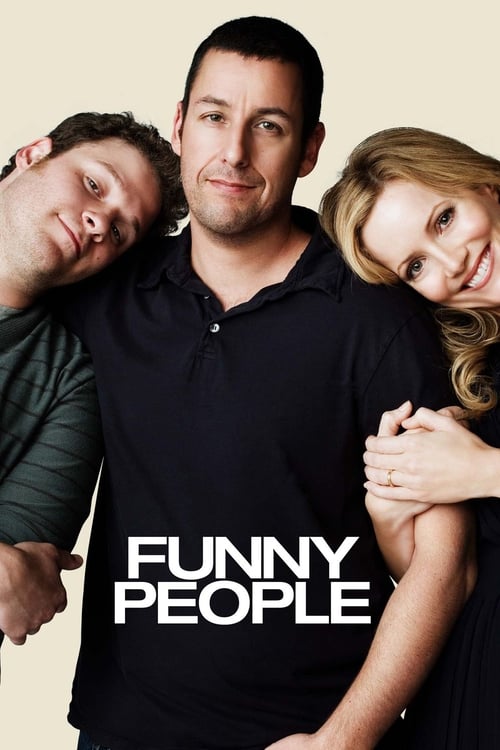
Funny People (2009)
Directed by Judd Apatow
No — Funny People is not woke, scoring 10 out of 100 on our wokeness meter.
Judd Apatow's third feature arrives with a premise that sounds like a dare: a wealthy movie star, George Simmons, receives a leukemia diagnosis with an eight percent survival rate, then spends two and a half hours learning almost nothing.
Consciousness Markers
The cast includes diverse performers such as Aziz Ansari, RZA, and Aubrey Plaza in supporting roles, but their presence is not framed as a statement or central to the film's identity.
The film includes some emotional speeches about life and friendship, but it does not deliver preachy social or political lectures.
There are no LGBTQ+ themes, characters, or storylines in the film.
The film is centered on male friendship and the male comedy world, with female characters serving primarily as romantic interests or plot devices; no feminist agenda is present.
Race is not a thematic concern, and the film does not engage with racial issues or consciousness.
There is no climate change or environmental theme in the film.
While the film touches on the emptiness of fame and wealth, it does not advance an anti-capitalist or eat-the-rich message.
There is no body positivity theme or messaging in the film.
There is no exploration or representation of neurodivergence in the film.
The film is a fictional contemporary story and does not revise or reinterpret historical events.
Why it received this score
Judd Apatow's third feature arrives with a premise that sounds like a dare: a wealthy movie star, George Simmons, receives a leukemia diagnosis with an eight percent survival rate, then spends two and a half hours learning almost nothing. The film is long, indulgent, and oddly moving, which is roughly the Apatow house style. He casts Adam Sandler as a version of Adam Sandler, and the result plays as a study of male friendship conducted entirely among men who tell jokes for a living.
On the matter of contemporary social consciousness, this is a period piece from a vanished era. The supporting cast includes Aziz Ansari, RZA, and Aubrey Plaza, all doing solid work, and the movie never once pauses to congratulate itself for their presence. That is representation without a thesis. Leslie Mann's Laura exists to be wanted by two men, and the screenplay shows no interest in her interior life beyond that function. There are no queer characters, no engagement with race as a subject, no environmental concerns, no meditation on bodies or neurotypes, and no revision of the historical record. The rich are miserable here, which is not the same as a critique of wealth.
What remains is a modest amount of sermonizing about living well and telling the truth. George delivers a few heartfelt monologues, and Ira eventually calls him out for learning nothing from his near-death experience. The film means it. It simply does not mean it about anything larger than one man's bad behavior. A generous grade for sincerity, a stingy one for agenda. The classification is straightforward: comedy, drama, and the box office, where it opened at number one before quietly failing to recoup its budget.
Analysis generated by our Consciousness Algorithm
Part of


Synopsis
Famous and wealthy funnyman George Simmons doesn't give much thought to how he treats people until a doctor delivers stunning health news, forcing George to reevaluate his priorities with a little help from aspiring stand-up comic Ira.
Questions about Funny People
Is Funny People woke?
No — Funny People is not woke, scoring 10 out of 100 on our wokeness meter. That earns it a verdict of Ultra Based.
Does Funny People have any woke elements?
Very few. None of the 10 markers reaches 30, the level where a marker counts as present; the highest is Representation Casting at 20.
How does Funny People compare to other 2009 movies?
It ranks #101 of the 230 films from 2009 we've scored; their average is 14. The wokest is Home (79).
How is the Woke Score calculated?
An AI-assisted process researches the film and its reception, scores it 0–100 on ten markers, then combines those into one 0–100 Woke Score. It measures a specific set of 2020s cultural themes, not film quality.