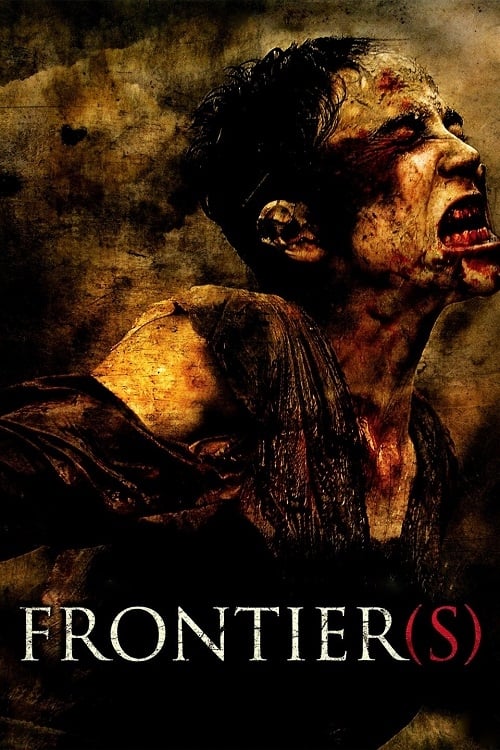
Frontier(s) (2007)
Directed by Xavier Gens
No — Frontier(s) is not especially woke, scoring 21 out of 100 on our wokeness meter.
Frontier(s) arrives from 2007, a French-Swiss entry in the New French Extremity cycle, and it announces its politics early.
Consciousness Markers
The film is explicitly built around race riots, a far-right election, and a neo-Nazi family preying on Arab youths, making racial and fascist politics central to its premise, though framed through exploitation horror rather than progressive advocacy.
The protagonists are a gang of Muslim Arab youths from the Paris banlieues, giving the film a demographically diverse lead ensemble, though this reflects the natural French social context rather than a deliberate diversity mandate.
The innkeepers Gilberte and Klaudia are a same-sex pair who seduce the male travelers, and 'bisexuality' is a listed keyword, but the queerness is deployed as exploitation-horror texture rather than as affirming representation.
Yasmine functions as the 'last woman standing' survivor who dispatches the neo-Nazi family, but this is a standard slasher trope rather than a feminist thesis.
Critics noted 'slapdash aspirations toward message-making' regarding the far right, but the film is overwhelmingly a gore spectacle rather than a preachy sermon.
The gang commits a robbery for cash, but the film's antagonism is toward fascism and neo-Nazism, not capitalism; no eat-the-rich critique is present.
No environmental or climate themes appear anywhere in the film.
No body-positivity themes; the film's treatment of bodies is purely visceral horror and gore.
No neurodivergence themes or characters are present.
The presence of a surviving WWII-era Nazi is a horror conceit, not a revisionist reframing of historical events.
Why it received this score
Frontier(s) arrives from 2007, a French-Swiss entry in the New French Extremity cycle, and it announces its politics early. A far-right candidate has reached the second round of a presidential election, Paris is burning, and a gang of Muslim Arab youths from the banlieues flee the capital after a robbery gone wrong. They hole up at a rural inn run by a family of neo-Nazis, and the film proceeds to do to them what the ballot box could not. The racial and fascist machinery here is not subtext. It is the load-bearing wall. That the leads are Arab and the villains are literal surviving Nazis gives the film a political charge a hundred safer productions would envy, delivered through meat hooks and table saws.
Elsewhere the film's social consciousness is thinner than its reputation suggests. The innkeepers Gilberte and Klaudia are a same-sex pair who seduce the male travelers before turning on them, which places queerness on the menu as seasoning for the slaughter. Yasmine survives to the final reel and dispatches the patriarch's brood with an axe and her teeth, a sturdy last-woman-standing maneuver the slasher template has issued for decades. There is no thesis behind it, only the reliable arithmetic of who gets to walk out. The gang robs a bank for cash, but the film's contempt is reserved for fascism, not for capital, so any eat-the-rich reading is a stretch.
The ledger runs dry in places. No climate anxiety drifts through these woods. No character pauses to celebrate their body, unless we count the cannibalism. No neurodivergent arc presents itself, and the presence of a practicing Nazi who has been hiding since 1945 is a horror conceit, not a revisionist account of the war. The remainder is a gore spectacle with a message stapled to its opening act, and critics at the time noticed the staple marks. The result is a nasty, efficient machine that gestures at the French far right and then gets back to the dismemberment. We classify it accordingly: politically loaded, ideologically unserious, and best approached with a strong stomach and modest expectations.
Analysis generated by our Consciousness Algorithm

Synopsis
A gang of young thieves flee Paris during the violent aftermath of a political election, only to hole up at an Inn run by neo-Nazis.
Questions about Frontier(s)
Is Frontier(s) woke?
No — Frontier(s) is not especially woke, scoring 21 out of 100 on our wokeness meter. That earns it a verdict of Based.
Does Frontier(s) have any woke elements?
2 of the 10 markers register at 30 or above, led by Racial Consciousness (45) and Representation Casting (35). On Racial Consciousness: The film is explicitly built around race riots, a far-right election, and a neo-Nazi family preying on Arab youths, making racial and fascist politics central to its premise, though framed through exploitation horror rather than progressive advocacy.
How does Frontier(s) compare to other 2007 movies?
It ranks #34 of the 201 films from 2007 we've scored; their average is 12. The wokest is Like Stars on Earth (92).
How is the Woke Score calculated?
An AI-assisted process researches the film and its reception, scores it 0–100 on ten markers, then combines those into one 0–100 Woke Score. It measures a specific set of 2020s cultural themes, not film quality.