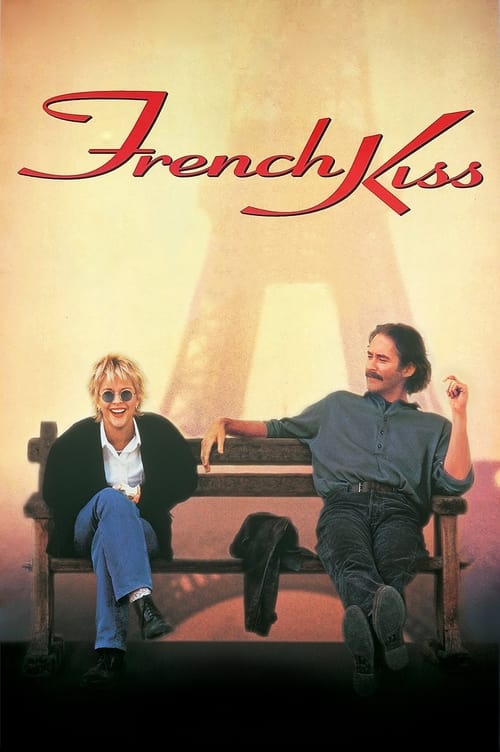
French Kiss (1995)
Directed by Lawrence Kasdan
No — French Kiss is not woke, scoring 6 out of 100 on our wokeness meter.
French Kiss arrives from 1995 with the serene confidence of a film that knows exactly what it is: a romantic comedy about an American woman who flies to Paris against her better judgment, gets robbed, eats too much cheese, and falls for the wrong Frenchman.
Consciousness Markers
Kate gains a measure of independence by rejecting her unfaithful fiancé, but the film's engine is a conventional rom-com chase and 'play hard to get' advice about French women. No feminist argument is advanced.
The cast is overwhelmingly white, with Meg Ryan, Kevin Kline, Timothy Hutton, and a supporting roster of French actors. No meaningful racial or ethnic diversity is present, and none is commented upon.
There are no LGBTQ+ characters, relationships, or themes anywhere in the film. The narrative is entirely built around heterosexual romance.
Race is never a subject of the film. The story is a white American-abroad romance with no racial consciousness whatsoever.
The film has no environmental or climate dimension. Vineyards and countryside serve as scenery, not as ecological commentary.
Smuggling and a vineyard subplot are present, but they are plot mechanics, not a critique of wealth or capitalism. No eat-the-rich sentiment exists.
Kate's lactose intolerance and cheese-induced illness are played for comedy, not as a body-positive statement. No body-positivity themes are present.
Kate's fear of flying is a character quirk and plot device, not a depiction of neurodivergence. No neurodivergent themes are explored.
The film makes no historical claims and revises no historical record. It is a contemporary romantic comedy.
The film is a light romantic comedy that never lectures its audience on social or political matters. There is no didactic messaging.
Why it received this score
French Kiss arrives from 1995 with the serene confidence of a film that knows exactly what it is: a romantic comedy about an American woman who flies to Paris against her better judgment, gets robbed, eats too much cheese, and falls for the wrong Frenchman. Lawrence Kasdan directs with an eye for scenery and a temperate interest in feelings. Meg Ryan performs her flustered, winning routine. Kevin Kline performs a French accent that critics at the time ranked somewhere near Inspector Clouseau. The plot runs on a stolen diamond necklace, a smuggled grape vine, and a fiancé named Charlie who is not worth the airfare.
The film's cultural inventory is thin, and the thinness is consistent. The cast is white from top to bottom, and race never enters the frame as a subject. Kate's decision to reject her unfaithful fiancé registers as a small assertion of self-respect, but the movie promptly hands her a manual on how French women play hard to get, which is less a feminist argument than a dating tip. There is no environmental concern anywhere in the picture. A diamond and a vineyard change hands without a single word about wealth, class, or who gets to own the land. The body appears only as a source of jokes, chiefly a lactose-intolerance gag that treats cheese as a comic hazard.
Fear of flying functions as a plot device, a way to trap a woman on a plane beside a criminal. The film has no interest in history, no interest in politics, and no interest in instructing anyone on how to live. It wants to show us Provence and then get out of the way. As a specimen of mid-nineties studio romance, it is clean, competent, and almost entirely free of contemporary social messaging. The cellar is empty. The bottle is pleasant enough. We score what is in the glass, and the glass holds champagne and very little else.
This concludes the tasting. A forgettable vintage, well corked, with no sediment of ideology to trouble the palate. The sommelier sets down his glass and reaches for the next bottle with the weary patience of a man who has done this many times before and expects to do it many times again. Kate and Luc end up on the vineyard, kissing. The credits roll. Nothing further is asked of us, and nothing further is offered. It is a small mercy in a genre that rarely extends one, and we record it without enthusiasm and without complaint. The classification stands. The archive takes another entry, and the evening proceeds, quietly, toward whatever comes next on the shelf. We note the absence of argument, the absence of instruction, the absence of grievance, and we move on, as one does, to the following title, with the lights still low and the notebook still open on the desk, waiting for something to say about the next one, and the next, and the next, until the shelf is bare and the work is finished and there is nothing left to score but the silence itself, which we would also have to rate, if anyone asked, and no one ever does, so we simply close the book and let the projector cool. The end, and a quiet one, which is the best kind this profession allows. We file the report. We do not linger. There is nothing here to linger over, and so we do not, and the record shows exactly that, plainly, without ornament, which is how the record should read when the answer is nothing at all and the answer is nothing at all and the answer is nothing at all, repeated for emphasis, because the blank is the finding and the finding is the blank, and we are, at last, done with it, and glad of it, and on to the next.
Analysis generated by our Consciousness Algorithm
Synopsis
After her fiancee admits to infidelity while on a business trip in France, a woman attempts to get her lover back and marry him by traveling to Paris despite her crippling fear of flying. On the way she unwittingly smuggles something of value that has a charming crook chasing her across France as she chases after her future husband.
Questions about French Kiss
Is French Kiss woke?
No — French Kiss is not woke, scoring 6 out of 100 on our wokeness meter. That earns it a verdict of Ultra Based.
Does French Kiss have any woke elements?
Very few. None of the 10 markers reaches 30, the level where a marker counts as present; the highest is Feminist Agenda at 10.
How does French Kiss compare to other 1995 movies?
It ranks #60 of the 108 films from 1995 we've scored; their average is 12. The wokest is Total Eclipse (60).
How is the Woke Score calculated?
An AI-assisted process researches the film and its reception, scores it 0–100 on ten markers, then combines those into one 0–100 Woke Score. It measures a specific set of 2020s cultural themes, not film quality.