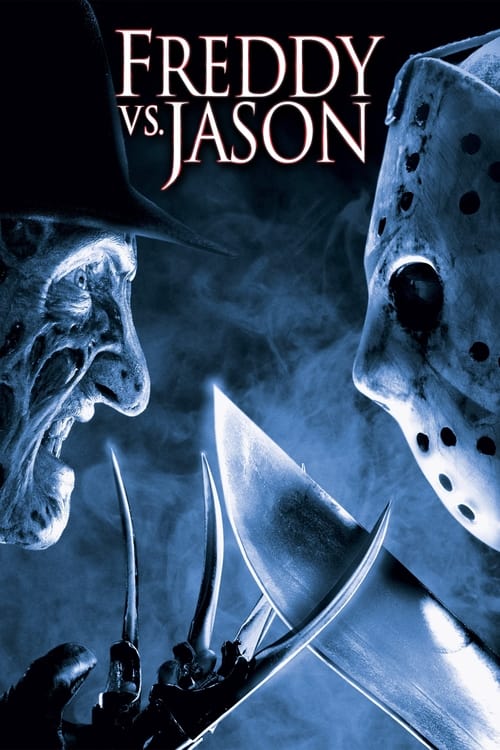
Freddy vs. Jason (2003)
Directed by Ronny Yu
No — Freddy vs. Jason is not woke, scoring 6 out of 100 on our wokeness meter.
Two aging boogeymen are hauled out of storage and made to punch each other for ninety-seven minutes.
Consciousness Markers
Kelly Rowland appears as Kia, a prominent Black female character, but the film's casting is otherwise typical of early-2000s slashers and does not foreground diversity as a theme.
No LGBTQ+ characters, themes, or subtext.
Features a final girl and female survivors, but this is standard slasher convention rather than a feminist agenda.
Race is not addressed; Kelly Rowland's character exists without racial commentary.
No environmental or climate themes.
No critique of capitalism or wealth inequality.
No body positivity themes; the film uses conventional horror aesthetics.
Psychiatric patients appear as plot devices, not as neurodivergent representation.
No historical revisionism; it is a supernatural slasher crossover.
No preachy or lecture-like messaging; it is a straightforward horror versus film.
Why it received this score
Two aging boogeymen are hauled out of storage and made to punch each other for ninety-seven minutes. That is the entire proposition of Freddy vs. Jason, and the film has the good manners not to pretend otherwise. Ronny Yu directs with a certain music-video brio, the cornfield rave is duly demolished, the psychiatric hospital returns from Dream Warriors, and Robert Englund collects a final paycheck as the dream demon with the weary efficiency of a man who knows exactly what he is selling. The mythology is thick, the fan service thicker, and the whole enterprise runs on the simple arithmetic of two mascots meeting at a lake.
Measured against the cultural sensibilities that would dominate the following decade, the film is a near vacuum. There is no courtship of representation as a project, though Kelly Rowland appears as Kia and brings more presence to the role than the screenplay requires. Race goes unremarked. So does everything else. No character wrestles with identity, no villain stands in for corporate greed, no weather event carries a moral. The patients at Westin Hills exist to be drugged and slaughtered, not to illuminate anything about the mind. The women survive in the manner slasher convention has always permitted, which is to say the last girl stands and the rest are furniture. None of this reflects a failure of nerve. It is a film made before anyone thought to ask.
The closest thing to a thesis is the versus in the title. Freddy wants fear, Jason wants bodies, and the screenplay wants a fight. It delivers. We are left with a curious artifact: loud, silly, occasionally ingenious, and entirely innocent of the sermonizing that would soon become standard practice. Some will file it away as a relic. This critic files it as a vacation.
Analysis generated by our Consciousness Algorithm
Part of


Synopsis
Freddy Krueger and Jason Voorhees return to terrorize the teenagers of Elm Street. Only this time, they're out to get each other, too.
Questions about Freddy vs. Jason
Is Freddy vs. Jason woke?
No — Freddy vs. Jason is not woke, scoring 6 out of 100 on our wokeness meter. That earns it a verdict of Ultra Based.
Does Freddy vs. Jason have any woke elements?
Very few. None of the 10 markers reaches 30, the level where a marker counts as present; the highest is Representation Casting at 15.
How does Freddy vs. Jason compare to other 2003 movies?
It ranks #93 of the 150 films from 2003 we've scored; their average is 12. The wokest is Mona Lisa Smile (60).
Is Freddy vs. Jason the most woke Friday the 13th movie?
No. It ranks #4 of the 11 Friday the 13th films we've scored; the wokest is Friday the 13th Part VIII: Jason Takes Manhattan (8).