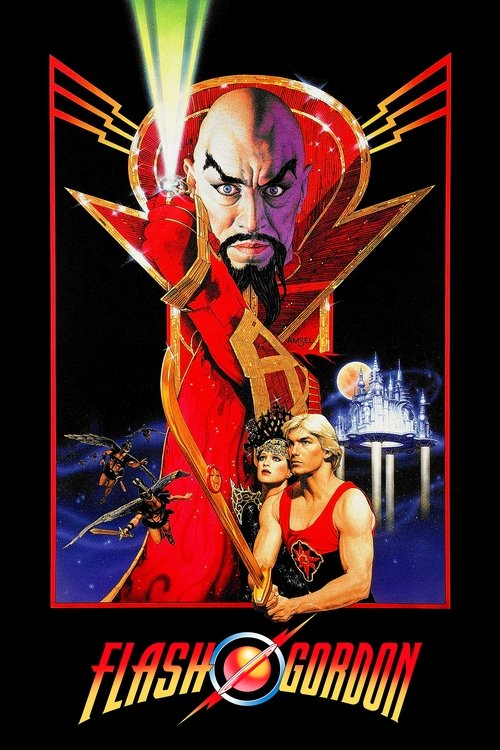
Flash Gordon (1980)
Directed by Mike Hodges
No — Flash Gordon is not woke, scoring 3 out of 100 on our wokeness meter.
The 1980 Flash Gordon arrives from a vanished era of studio excess, when Dino De Laurentiis could hand a comic strip to Mike Hodges, add a Queen soundtrack, and call it an evening.
Consciousness Markers
The cast is overwhelmingly white British and Italian performers; the only notable non-white presence is Deep Roy in a minor comic-relief cameo. No meaningful diverse casting effort.
No LGBTQ+ characters, themes, or subtext of any kind. A 1980 space opera with heterosexual romance as its only relational register.
Dale Arden exists primarily as the object of Ming's desire and a hostage to be rescued; Princess Aura is a lovesick plot device. No feminist agenda whatsoever.
Ming the Merciless is a classic yellow-peril-coded villain, which is the opposite of racial consciousness. No engagement with race as a theme.
Ming engineers natural disasters to menace Earth, but this is villainous spectacle, not an environmentalist message. No climate crusade.
No economic critique. Ming is a tyrant, not a capitalist, and the film's politics are pure comic-strip good-versus-evil.
No body-positivity themes. The film's only body-related anecdote is off-screen casting trivia about an actress being replaced for looking thin.
No neurodivergent characters or themes. Zarkov is an eccentric scientist played for camp, not a depiction of neurodivergence.
A straightforward adaptation of a 1930s comic strip with no historical revisionism. It invents nothing about the past to reinterpret.
The film is deliberately campy, playful, and self-aware rather than preachy. It has no lecture energy; it wants to be fun, not instructive.
Why it received this score
The 1980 Flash Gordon arrives from a vanished era of studio excess, when Dino De Laurentiis could hand a comic strip to Mike Hodges, add a Queen soundtrack, and call it an evening. The film is loud, gaudy, and entirely unserious, a camp artifact that treats its own source material as a joke worth telling at enormous expense. Max von Sydow plays Ming the Merciless with a straight face and a wardrobe that would fund a small nation.
It is also, by the standards of our current accounting, an empty ledger. The cast is a wall of white British and Italian performers, with Deep Roy's brief comic turn as the only non-white face of any note, a casting habit of its moment and not an effort at inclusion. Dale Arden spends the running time being desired and abducted, while Princess Aura exists to fall in love at first sight. Ming's villainy draws on an older, uglier tradition of yellow-peril menace, which is the inverse of racial awareness. The disasters Ming inflicts on Earth are spectacle, not sermon. The politics are comic-strip good against comic-strip evil. Zarkov is an eccentric played for camp. Nobody lectures. Nobody has an agenda. Nobody is trying to teach us anything about ourselves.
That absence is the point. The film's only ambition is giddiness, and it achieves that ambition with a confidence that has aged better than most of its contemporaries. We are left to record a near-total blank across the categories that matter to contemporary classification, and to admit that a blank can be a kind of pleasure. The hawkmen do not have a message. They simply fly.
Analysis generated by our Consciousness Algorithm
Part of

Synopsis
A football player and his mates travel to the planet Mongo and find themselves fighting the tyranny of Ming the Merciless to save Earth.
Questions about Flash Gordon
Is Flash Gordon woke?
No — Flash Gordon is not woke, scoring 3 out of 100 on our wokeness meter. That earns it a verdict of Ultra Based.
Does Flash Gordon have any woke elements?
Very few. None of the 10 markers reaches 30, the level where a marker counts as present; the highest is Representation Casting at 5.
How does Flash Gordon compare to other 1980 movies?
It ranks #28 of the 37 films from 1980 we've scored; their average is 10. The wokest is Nine to Five (42).
How is the Woke Score calculated?
An AI-assisted process researches the film and its reception, scores it 0–100 on ten markers, then combines those into one 0–100 Woke Score. It measures a specific set of 2020s cultural themes, not film quality.