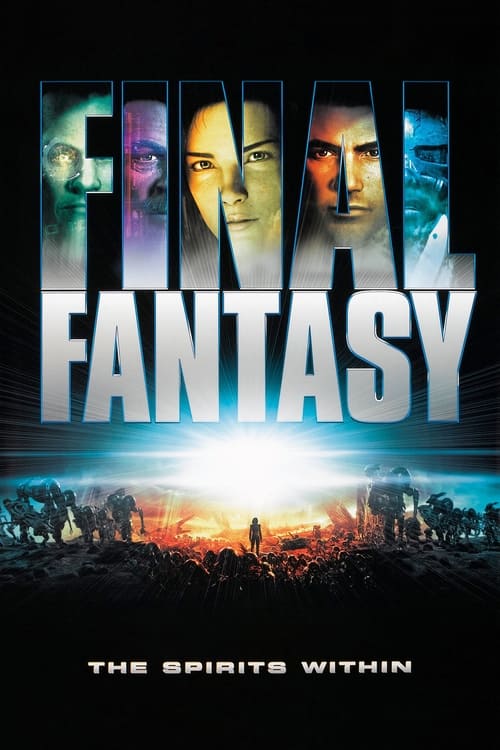
Final Fantasy: The Spirits Within (2001)
Directed by Hironobu Sakaguchi
No — Final Fantasy: The Spirits Within is not woke, scoring 19 out of 100 on our wokeness meter.
In 2001, Square Pictures set out to render a photorealistic human being across a farm of 960 workstations, a campaign that consumed four years, roughly 200 staff, and $137 million before returning $85.1 million at the box office.
Consciousness Markers
The Gaia hypothesis drives the plot — Earth's ecosystem is a living spirit that the Zeus cannon would fatally wound — giving the film a genuine ecological-protection message, though framed spiritually rather than as climate activism.
The voice cast is notably diverse for 2001, with Ming-Na Wen as the lead scientist Aki Ross alongside Ving Rhames and Keith David, but the diversity is incidental rather than a stated representational project.
Aki Ross is a capable female scientist protagonist, and animators deliberately stripped her 'supermodel' look to seem more intelligent, but the film advances no feminist thesis.
The film meditates on life, death, and spirit via the Gaia concept, occasionally verging on the preachy, but it prioritizes action spectacle over sermonizing.
No LGBTQ+ characters, themes, or subtext appear anywhere in the film.
The film engages no racial themes or commentary; its conflict is entirely human-vs-alien.
No economic critique or class commentary is present; the antagonist is a militarist general, not capital.
No body-positivity themes or messaging appear in the film.
No neurodivergent characters or themes are depicted.
The film is set in a fictional 2065 and makes no historical revisionist claims.
Why it received this score
In 2001, Square Pictures set out to render a photorealistic human being across a farm of 960 workstations, a campaign that consumed four years, roughly 200 staff, and $137 million before returning $85.1 million at the box office. The resulting picture, a solemn meditation on the Gaia hypothesis wearing the costume of an alien invasion, remains a curious artifact of a studio betting everything on the wrong horse. Judged against the cultural accounting of our present moment, it is a surprisingly quiet object.
Dr. Aki Ross, voiced by Ming-Na Wen, gathers eight spirits to repel the Phantoms, and the ecological framing carries genuine weight. The Zeus cannon would wound a living Earth, and the film treats that wound as a crime. This grants the picture an authentic environmental conscience, though it arrives wrapped in mysticism instead of policy, closer to pantheism than protest. Aki is competent, central, and notably unglamorized, since the animators stripped her makeup and shortened her hair so audiences would accept her as a scientist. That gesture hints at something without ever building an argument about women in laboratories. The surrounding cast is diverse for its era, with Ving Rhames and Keith David supplying gravitas, and the screenplay never remarks upon it. Representation here is furniture, not platform.
Nearly everything else is missing. No queer presence, no racial inquiry, no class critique, no body politics, no neurodivergent characters, no historical revision. The villain is a militarist general with a very large gun, which amounts to a complaint about the military-industrial complex at most. The script does pause to contemplate life, death, and the spirit, and those pauses occasionally drift toward the pulpit. Mostly it prefers explosions. What remains is a technically audacious curio whose social content extends to a woman in a lab coat and a planet that would prefer not to be shot. It earns its modest tally and no more.
Analysis generated by our Consciousness Algorithm


Synopsis
Led by a strange dream, scientist Aki Ross struggles to collect the eight spirits in the hope of creating a force powerful enough to protect the planet. With the aid of the Deep Eyes Squadron and her mentor, Dr. Sid, Aki must save the Earth from its darkest hate and unleash the spirits within.
Questions about Final Fantasy: The Spirits Within
Is Final Fantasy: The Spirits Within woke?
No — Final Fantasy: The Spirits Within is not woke, scoring 19 out of 100 on our wokeness meter. That earns it a verdict of Ultra Based.
Does Final Fantasy: The Spirits Within have any woke elements?
2 of the 10 markers register at 30 or above, led by Climate Crusade (40) and Representation Casting (30). On Climate Crusade: The Gaia hypothesis drives the plot — Earth's ecosystem is a living spirit that the Zeus cannon would fatally wound — giving the film a genuine ecological-protection message, though framed spiritually rather than as climate activism.
How does Final Fantasy: The Spirits Within compare to other 2001 movies?
It ranks #28 of the 148 films from 2001 we've scored; their average is 12. The wokest is Monster's Ball (60).
How is the Woke Score calculated?
An AI-assisted process researches the film and its reception, scores it 0–100 on ten markers, then combines those into one 0–100 Woke Score. It measures a specific set of 2020s cultural themes, not film quality.