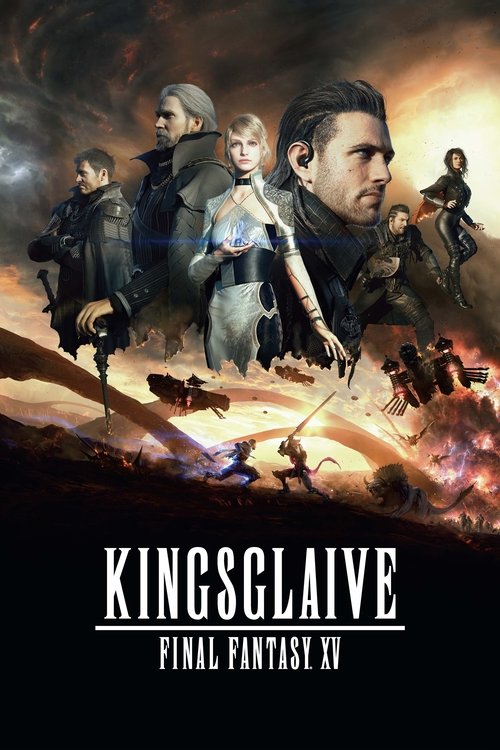
Kingsglaive: Final Fantasy XV (2016)
Directed by Takeshi Nozue
No — Kingsglaive: Final Fantasy XV is not woke, scoring 8 out of 100 on our wokeness meter.
Kingsglaive: Final Fantasy XV arrives as a feature-length commercial for a video game, a perfectly honorable vocation that the film pursues with the solemnity of a state funeral.
Consciousness Markers
The Kingsglaive are explicitly framed as immigrants and refugees from conquered territories, and the cast is predominantly Japanese-designed characters with a mixed English voice cast. However, this diversity is baked into the fantasy worldbuilding rather than deployed as a representational statement.
Lunafreya is given some agency as an Oracle who communes with deities and outwits Luche, but she remains largely a diplomatic prize and object of the plot's marriage arrangement rather than a vehicle for any feminist argument.
The Kingsglaive's resentment at being abandoned by King Regis gestures at immigrant/outsider grievance, but the film treats this as personal and political betrayal rather than a racial-justice commentary.
The film is a straightforward action-fantasy companion piece to a video game, with no preachy or didactic messaging directed at the audience.
No LGBTQ+ characters, relationships, or themes appear anywhere in the film.
No environmental or climate themes are present; the conflict is entirely dynastic and military.
Niflheim is a militaristic empire driven by conquest and the Crystal, not a capitalist critique; no eat-the-rich messaging exists.
No body-positivity themes; the cast is uniformly rendered in idealized CGI action-hero proportions.
No neurodivergent characters or themes are present.
The film is set in a wholly fictional fantasy world with no historical events to revise.
Why it received this score
Kingsglaive: Final Fantasy XV arrives as a feature-length commercial for a video game, a perfectly honorable vocation that the film pursues with the solemnity of a state funeral. The CGI is immaculate, the faces rendered with pore-level devotion, and we are invited to admire the precise texture of Sean Bean's resignation. The plot concerns a magic crystal, a besieged kingdom, and a peace treaty that is obviously a trap, because it is always a trap. We have seen this before. The film knows we have seen this before. It proceeds anyway, with the grim efficiency of a soldier who stopped asking questions several campaigns ago.
The film's social consciousness is modest and mostly structural. The Kingsglaive are immigrants and refugees from conquered territories, granted the king's magic in exchange for their service, and their resentment at being abandoned carries a faint political charge. The film treats this as betrayal, not as a racial-justice argument, so the grievance stays personal and the theme stays quiet. Lunafreya, an Oracle who communes with deities and outmaneuvers at least one traitor, is permitted a measure of agency before being returned to her designated role as a diplomatic prize in a marriage arrangement. This is progress of a very contained sort.
Elsewhere the cupboards are bare. There is no romance beyond the transactional, no environmental lament, no critique of the empire's economics (Niflheim conquers for crystals, not markets), no body-positive counterpoint to the uniformly idealized physiques, and no neurodivergent interiority. The villains are villains because they are villains, a refreshingly uncomplicated position for a film to take. The whole enterprise lectures no one. It simply wants to sell a game, and it does so with tasteful restraint. For that small mercy, we offer a nod of professional respect.
Analysis generated by our Consciousness Algorithm
Part of


Synopsis
The magical kingdom of Lucis is home to the world’s last remaining Crystal, and the menacing empire of Niflheim is determined to steal it. King Regis of Lucis commands an elite force of soldiers called the Kingsglaive. Wielding their king’s magic, they fight to protect Lucis. As the overwhelming military might of the empire bears down, King Regis is faced with an impossible ultimatum – to marry his son, Prince Noctis to Princess Lunafreya of Tenebrae, captive of Niflheim, and surrender his lands to Niflheim rule. Although the king concedes, it becomes clear that the empire will stop at nothing to achieve their devious goals, with only the Kingsglaive standing between them and world domination.
Questions about Kingsglaive: Final Fantasy XV
Is Kingsglaive: Final Fantasy XV woke?
No — Kingsglaive: Final Fantasy XV is not woke, scoring 8 out of 100 on our wokeness meter. That earns it a verdict of Ultra Based.
Does Kingsglaive: Final Fantasy XV have any woke elements?
Very few. None of the 10 markers reaches 30, the level where a marker counts as present; the highest is Representation Casting at 20.
How does Kingsglaive: Final Fantasy XV compare to other 2016 movies?
It ranks #170 of the 285 films from 2016 we've scored; their average is 16. The wokest is 13th (92).
How is the Woke Score calculated?
An AI-assisted process researches the film and its reception, scores it 0–100 on ten markers, then combines those into one 0–100 Woke Score. It measures a specific set of 2020s cultural themes, not film quality.