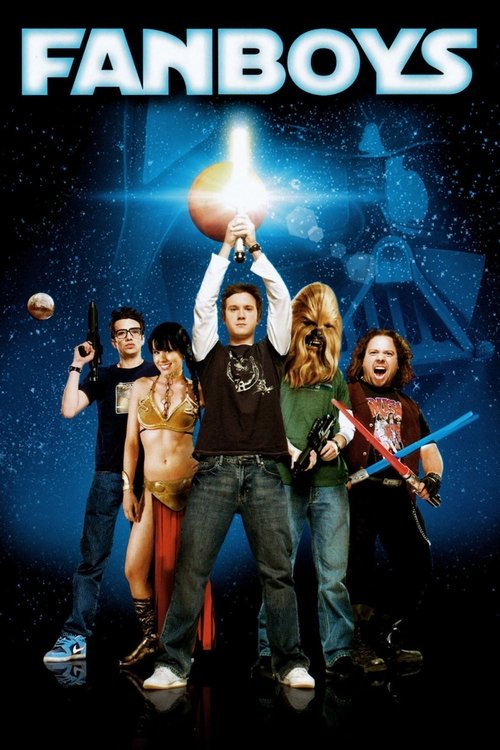
Fanboys (2009)
Directed by Kyle Newman
No — Fanboys is not woke, scoring 5 out of 100 on our wokeness meter.
Fanboys arrives from 2009 with a premise of unusual specificity: four Ohio men in 1999, one of them dying of cancer, drive across the country to break into Skywalker Ranch so their friend can see The Phantom Menace before he goes.
Consciousness Markers
The core cast is a uniformly white male ensemble; minority actors (Danny Trejo, Craig Robinson, Billy Dee Williams) appear only in incidental cameos with no deliberate diversity framing.
Kristen Bell's Zoe is a competent tag-along who insists on joining the quest, but she functions as a token love interest rather than any vehicle for a feminist agenda.
A gay biker bar sequence exists but is played for crude, humiliating laughs; the screenwriter himself later called it homophobic, so it is the opposite of positive LGBTQ+ representation.
No engagement with race, racism, or racial identity whatsoever; the film is entirely preoccupied with Star Wars trivia and fan culture.
No environmental or climate themes of any kind.
No critique of wealth, corporations, or capitalism; the quest is a fan pilgrimage, not an economic parable.
No body-positivity themes; the humor leans on crude physical gags rather than any body-acceptance message.
The characters' obsessive fandom is played for comedy, not framed as neurodivergence or any neurodiversity-affirming narrative.
A fictional road-trip comedy with no historical revisionism.
The film is a raunchy, amiable comedy that never lectures the audience on social or political matters.
Why it received this score
Fanboys arrives from 2009 with a premise of unusual specificity: four Ohio men in 1999, one of them dying of cancer, drive across the country to break into Skywalker Ranch so their friend can see The Phantom Menace before he goes. It is a raunchy road comedy with a soft heart, and it wants nothing from its audience beyond laughter and a working knowledge of expanded universe trivia. The film's devotion is to fandom itself, and fandom, in this telling, amounts to arguments about parsecs and midichlorians conducted at volume.
The picture carries no social program of any kind. Race goes unmentioned and unexamined; the ensemble is uniformly white and male, and the minority performers who do appear (Danny Trejo, Craig Robinson, Billy Dee Williams) turn up as cameos, judges and mechanics and gag delivery systems, with no framing around their presence. Climate, wealth, body image, and neurodiversity are equally absent. The characters' obsessive collecting and trivia hoarding is played for laughs, never as a condition to be understood or accommodated. Kristen Bell's Zoe is the exception that tests the rule: she bails the men out of jail, insists on joining the trip, and proves more capable than any of them, then settles into the role of love interest. Ambition is not agenda.
The one moment where the film engages identity at all is the gay biker bar, where the heroes are forced into a striptease as punishment. The screenwriter has since described the sequence as homophobic by the standards of its own release year, which is a fair assessment. The scene exists to humiliate the protagonists, not to dignify anyone. George Lucas gave the film his blessing, and that remains the highest honor it seeks.
Analysis generated by our Consciousness Algorithm


Synopsis
In 1999, Star Wars fanatics take a cross-country trip to George Lucas' Skywalker Ranch so their dying friend can see a screening of The Phantom Menace before its release.
Questions about Fanboys
Is Fanboys woke?
No — Fanboys is not woke, scoring 5 out of 100 on our wokeness meter. That earns it a verdict of Ultra Based.
Does Fanboys have any woke elements?
Very few. None of the 10 markers reaches 30, the level where a marker counts as present; the highest is Representation Casting at 10.
How does Fanboys compare to other 2009 movies?
It ranks #154 of the 230 films from 2009 we've scored; their average is 14. The wokest is Home (79).
How is the Woke Score calculated?
An AI-assisted process researches the film and its reception, scores it 0–100 on ten markers, then combines those into one 0–100 Woke Score. It measures a specific set of 2020s cultural themes, not film quality.