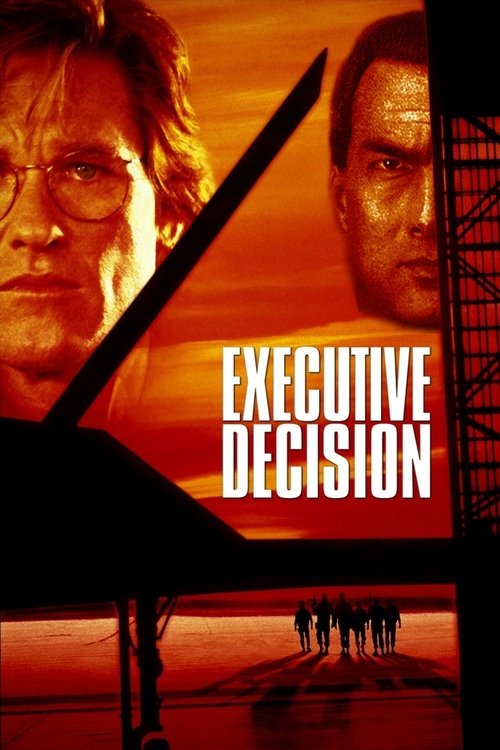
Executive Decision (1996)
Directed by Stuart Baird
No — Executive Decision is not woke, scoring 13 out of 100 on our wokeness meter.
Executive Decision arrives from 1996 with the confidence of a machine that knows exactly what it is for.
Consciousness Markers
The cast is notably multiethnic for a 1996 action thriller (Halle Berry, John Leguizamo, Joe Morton, B.D. Wong), but these are conventional genre roles with no commentary on identity.
Halle Berry's flight attendant Jean is given real agency, aiding the search and helping land the plane, but this is standard action-sidekick competence rather than a feminist thesis.
No LGBTQ+ characters or themes of any kind appear in the film.
The film's antagonists are Arab/Muslim terrorists, and the European release actually scrubbed references to Islam; there is no racial consciousness, only a stock post-Cold-War villain framework.
No environmental or climate themes whatsoever; the threat is a nerve agent, not ecological.
The villains are foreign terrorists and a sleeper agent, not corporate or capitalist malefactors; no economic critique is present.
No body-positive themes or messaging appear in the film.
No neurodivergent characters or themes are present.
The film is a straightforward fictional techno-thriller with no historical revisionism.
The film delivers action and suspense rather than moral instruction; there is no preachy messaging.
Why it received this score
Executive Decision arrives from 1996 with the confidence of a machine that knows exactly what it is for. A 747 leaves Athens, terrorists seize it, and a special operations team is inserted mid-flight through a docking apparatus that the screenplay treats as settled engineering. Stuart Baird, a decorated editor making his directorial debut, keeps the hardware moving. The marketing sold Steven Seagal as a co-lead, then killed him in the first act, which remains the film's single most honest gesture toward the audience. Everything after that is competence, gunfire, and a countdown.
The cast is unusually varied for the period. Halle Berry, John Leguizamo, Joe Morton and B.D. Wong fill out the roster, and the film never pauses to congratulate itself for it. Berry's flight attendant, Jean, does more than scream: she helps search the cabin and later talks a novice pilot through a landing. That is sidekick competence, standard issue for the genre, and it stops well short of a thesis. The antagonists, meanwhile, are Arab terrorists of the post-Cold War template, so generic that the European release simply deleted the religious references. No identity is examined. None is meant to be.
The film's remaining ingredients are a nerve agent, a bomb, and a remote trigger, none of which carry a message. There is no economic critique, no climate anxiety, no body politics, no neurodivergent interiority, no revision of the historical record, and no sermon. The film wants to thrill you and then end. It does both, efficiently, and asks nothing of your conscience on the way out.
Analysis generated by our Consciousness Algorithm
Part of


Synopsis
Terrorists hijack a 747 inbound to Washington D.C., demanding the release of their imprisoned leader. Intelligence expert David Grant suspects another reason and he is soon the reluctant member of a special assault team that is assigned to intercept the plane and hijackers.
Questions about Executive Decision
Is Executive Decision woke?
No — Executive Decision is not woke, scoring 13 out of 100 on our wokeness meter. That earns it a verdict of Ultra Based.
Does Executive Decision have any woke elements?
1 of the 10 markers register at 30 or above, led by Representation Casting (35). On Representation Casting: The cast is notably multiethnic for a 1996 action thriller (Halle Berry, John Leguizamo, Joe Morton, B.D.
How does Executive Decision compare to other 1996 movies?
It ranks #26 of the 93 films from 1996 we've scored; their average is 11. The wokest is Bound (60).
How is the Woke Score calculated?
An AI-assisted process researches the film and its reception, scores it 0–100 on ten markers, then combines those into one 0–100 Woke Score. It measures a specific set of 2020s cultural themes, not film quality.