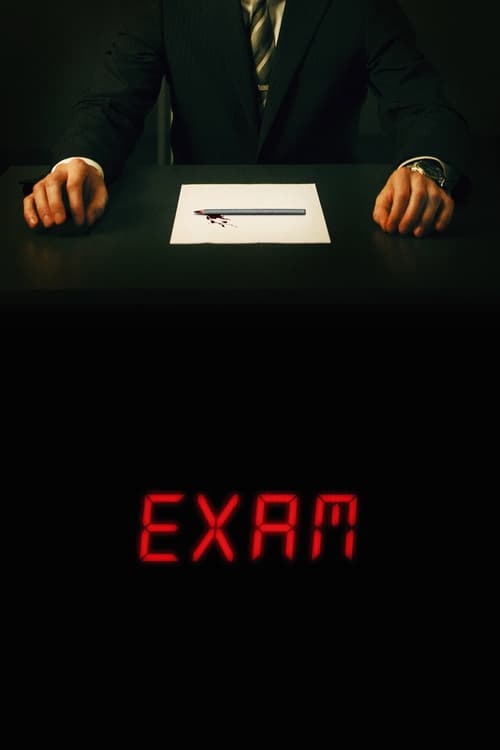
Exam (2009)
Directed by Stuart Hazeldine
No — Exam is not woke, scoring 16 out of 100 on our wokeness meter.
Exam arrives from 2009, a British chamber piece in which eight hopefuls sit in a windowless room, given eighty minutes and a single sheet of paper that turns out to be blank.
Consciousness Markers
The cast is notably diverse for 2009, including Black, Asian, and deaf actors, but the film uses race and disability as identifiers for conflict rather than promoting inclusive representation as a virtue.
The film critiques a powerful pharmaceutical corporation's secretive and ruthless selection process, but ultimately presents the company's goals as benevolent, diluting any strong anti-capitalist message.
A female candidate ultimately wins the job by demonstrating compassion and attention to detail, but the film offers no explicit feminist critique or agenda.
Characters are nicknamed by skin color (Black, Brown) and the director intentionally cast a multiracial group to create tension, yet the film avoids commentary on systemic racism.
The ending features an explanatory monologue from the Invigilator, but the film avoids preachy social commentary.
No LGBTQ+ characters or themes are present.
No environmental or climate-related themes appear.
No body positivity themes or diverse body types are featured.
The deaf character is a physical disability representation, not neurodivergence, and no cognitive differences are explored.
The film is a contemporary thriller with no historical revisionism.
Why it received this score
Exam arrives from 2009, a British chamber piece in which eight hopefuls sit in a windowless room, given eighty minutes and a single sheet of paper that turns out to be blank. Stuart Hazeldine wrote and directed with an unusual degree of control, and his stated intent was to divide the group along race, culture, gender, and worldview. The result is a film that treats human variety as combustible material. Characters are assigned names by appearance: Black, Brown, Blonde, Dark, Deaf. The casting is more diverse than the era demanded, which is something. The purpose, however, is friction, not inclusion. Race functions here as a label on a desk, and disability as a silence the others must work around.
The screenplay does carry a faint scent of corporate skepticism. Biorg, the pharmaceutical giant, runs a selection process built on deception and psychological cruelty, and the candidates spend an hour tearing at each other for a job. That is a critique of something. Yet the film ultimately endorses the company, whose cure for a pandemic is framed as a gift to humanity, and whose only problem is finding a worthy administrator. Any appetite for eating the rich cools by the final reel. The winner is a woman, chosen for her compassion and her eye for detail, though the film never pauses to make an argument about women in power. She simply wins.
The closing monologue from the Invigilator explains the miracle drug and the gift of life, tidying everything with exposition. It lectures, gently. The film is a curiosity from a transitional moment, socially aware in its casting yet incurious about what that casting might mean.
Analysis generated by our Consciousness Algorithm


Synopsis
Eight talented candidates have reached the final stage of selection to join the ranks of a mysterious and powerful corporation. Entering a windowless room, where an armed guard keeps watch, they are given 80 minutes to answer one simple question.
Questions about Exam
Is Exam woke?
No — Exam is not woke, scoring 16 out of 100 on our wokeness meter. That earns it a verdict of Ultra Based.
Does Exam have any woke elements?
1 of the 10 markers register at 30 or above, led by Representation Casting (30). On Representation Casting: The cast is notably diverse for 2009, including Black, Asian, and deaf actors, but the film uses race and disability as identifiers for conflict rather than promoting inclusive representation as a virtue.
How does Exam compare to other 2009 movies?
It ranks #61 of the 230 films from 2009 we've scored; their average is 14. The wokest is Home (79).
How is the Woke Score calculated?
An AI-assisted process researches the film and its reception, scores it 0–100 on ten markers, then combines those into one 0–100 Woke Score. It measures a specific set of 2020s cultural themes, not film quality.