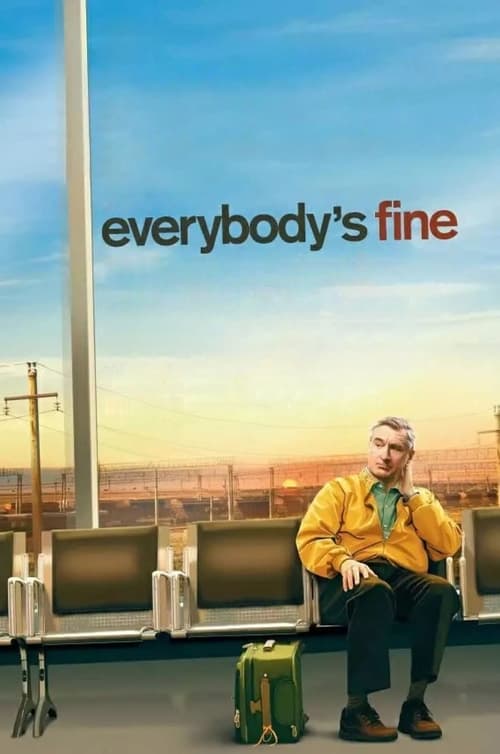
Everybody's Fine (2009)
Directed by Kirk Jones
No — Everybody's Fine is not woke, scoring 15 out of 100 on our wokeness meter.
Kirk Jones offers us a widower named Frank Goode, a retired telephone cable manufacturer who spends ninety-nine minutes riding trains between the disappointments of his adult children.
Consciousness Markers
Rosie is revealed to be bisexual and the mother of Jilly's child, and the film received a GLAAD Media Award nomination. The LGBTQ content is a minor subplot rather than a central theme.
The cast is predominantly white, but includes openly gay actress Kate Moennig and a bisexual character in a minor role. There is no notable racial or broad representational intent.
The film explores family dynamics and parental expectations but does not advance a feminist agenda or critique gender inequality.
There are no racial themes, commentary, or significant non-white characters in the narrative.
The film contains no environmental or climate-related themes.
There is no critique of capitalism, wealth inequality, or corporate power in the story.
The film does not address body image, size acceptance, or related themes.
No characters are depicted with neurodivergent traits or conditions as a thematic element.
The film is a contemporary family drama and does not engage with historical revisionism.
The film offers sentimental family lessons but does not deliver explicit social or political lectures.
Why it received this score
Kirk Jones offers us a widower named Frank Goode, a retired telephone cable manufacturer who spends ninety-nine minutes riding trains between the disappointments of his adult children. Robert De Niro plays him with a heavy, patient sadness. The film wants nothing more than to make us feel something about fathers and the lies families tell to protect each other. It is a remake of a Giuseppe Tornatore picture, and it flopped accordingly, closing after three weeks. There is no shame in that. Sentimentality is a genre, not a crime.
The picture does carry a faint trace of contemporary social awareness. Rosie, the Las Vegas daughter, turns out to be bisexual and the mother of her friend Jilly's child, a revelation delivered in a dream sequence and never really examined afterward. Kate Moennig appears in a minor role. The film earned a GLAAD Media Award nomination for Outstanding Wide Release, and Drew Barrymore collected a Vanguard Award the same year. That is the extent of it. The revelation lands as a plot twist about parental ignorance, not as a statement about anything.
Everything else in the film is resolutely old-fashioned. The cast is white, the concerns are domestic, and the villains are unrealistic expectations. There is no critique of the economy that made Frank's cables and unmade his children's careers. No character wrestles with their body, their neurology, or the climate. The film's final image, a painting of unconnected telephone lines, is a metaphor so gentle it barely raises its voice. We are left with a father who pushed too hard and listened too little. That is the whole sermon, and it is delivered without a pulpit.
Analysis generated by our Consciousness Algorithm


Synopsis
Eight months after the death of his wife, Frank Goode looks forward to a reunion with his four adult children. When all of them cancel their visits at the last minute, Frank, against the advice of his doctor, sets out on a road trip to reconnect with his offspring. As he visits each one in turn, Frank finds that his children's lives are not quite as picture-perfect as they've made them out to be.
Questions about Everybody's Fine
Is Everybody's Fine woke?
No — Everybody's Fine is not woke, scoring 15 out of 100 on our wokeness meter. That earns it a verdict of Ultra Based.
Does Everybody's Fine have any woke elements?
1 of the 10 markers register at 30 or above, led by LGBTQ+ Themes (35). On LGBTQ+ Themes: Rosie is revealed to be bisexual and the mother of Jilly's child, and the film received a GLAAD Media Award nomination.
How does Everybody's Fine compare to other 2009 movies?
It ranks #67 of the 230 films from 2009 we've scored; their average is 14. The wokest is Home (79).
How is the Woke Score calculated?
An AI-assisted process researches the film and its reception, scores it 0–100 on ten markers, then combines those into one 0–100 Woke Score. It measures a specific set of 2020s cultural themes, not film quality.