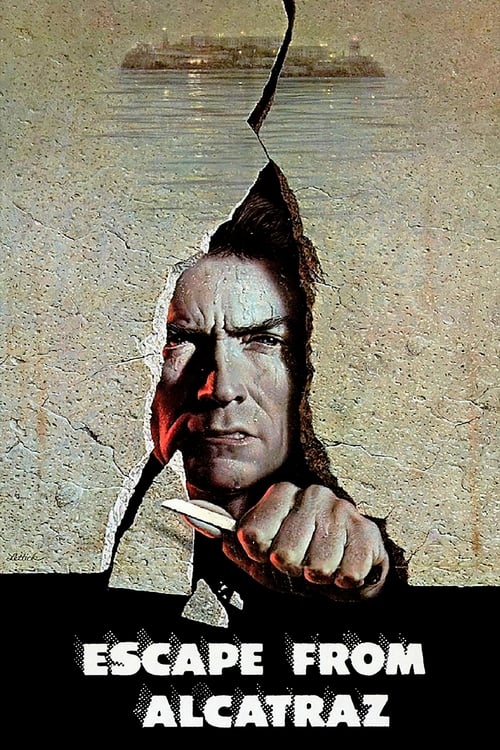
Escape from Alcatraz (1979)
Directed by Don Siegel
No — Escape from Alcatraz is not woke, scoring 0 out of 100 on our wokeness meter.
Escape from Alcatraz arrives from 1979 with the confidence of a film that has no interest in being told what it means.
Consciousness Markers
The cast is overwhelmingly white and male; Paul Benjamin's English and Danny Glover's brief debut are natural period casting rather than modern representation casting.
There are no LGBTQ+ characters, themes, or subtext in the film.
The film has virtually no female characters and makes no feminist argument.
English's backstory carries a racial dimension, but the film does not examine race or racial consciousness in any modern sense.
The prison-island setting is not used for climate commentary.
The conflict is with prison authority and the warden, not with capitalism or economic hierarchy.
There is no body-positive messaging or casting focus.
No character is framed through neurodivergence or mental-health advocacy.
The film takes dramatic liberties with the historical record, but these are conventional narrative inventions rather than modern revisionist history.
The film is sparse and restrained, with no preachy or lecture-like dialogue.
Why it received this score
Escape from Alcatraz arrives from 1979 with the confidence of a film that has no interest in being told what it means. Don Siegel directs Clint Eastwood as Frank Morris, a burglar and escape artist deposited on the Rock, and the camera proceeds with the patience of a mason. We watch spoons become shovels, raincoats become a raft, papier-mâché heads become decoys. The warden is a fictional invention, the chronology is compressed, and the chrysanthemum is pure screenwriting. Those are conventional liberties, not a modern revisionist project. The film wants to show us how men dig through walls, not how history should be re-educated.
On the matter of contemporary social instruction, the cupboard is bare. The cast is overwhelmingly white and male, which suits the period and the institution. Paul Benjamin's English and a fleeting Danny Glover exist as inmates, not as representative gestures. There are no LGBTQ themes, no feminist argument, and almost no women at all. Alcatraz is a prison, not a climate metaphor. The antagonist is the warden and the carceral machine, not capital. No character is framed through body positivity or neurodivergence. Doc's horrific self-mutilation is treated as despair, not as a platform. The dialogue is spare, the performances are flinty, and the film never stops to explain its moral to the audience.
That restraint is the point. This is a thriller built from concrete, steel, and silence, and it has no sermons to deliver. Its cultural awareness belongs to an older Hollywood, one that assumed a prison picture could be about prisoners and walls and the sea. A sommelier of such things would note a dry, austere vintage with no added ideology. The ledger of modern progressive sensibilities remains blank, and the film is content to leave it that way.
Analysis generated by our Consciousness Algorithm
Part of


Synopsis
San Francisco Bay, January 18, 1960. Frank Lee Morris is transferred to Alcatraz, a maximum security prison located on a rocky island. Although no one has ever managed to escape from there, Frank and other inmates begin to carefully prepare an escape plan.
Questions about Escape from Alcatraz
Is Escape from Alcatraz woke?
No — Escape from Alcatraz is not woke, scoring 0 out of 100 on our wokeness meter. That earns it a verdict of Ultra Based.
Does Escape from Alcatraz have any woke elements?
No. All 10 markers score zero.
How does Escape from Alcatraz compare to other 1979 movies?
It ranks #26 of the 33 films from 1979 we've scored; their average is 6. The wokest is Hair (30).
How is the Woke Score calculated?
An AI-assisted process researches the film and its reception, scores it 0–100 on ten markers, then combines those into one 0–100 Woke Score. It measures a specific set of 2020s cultural themes, not film quality.