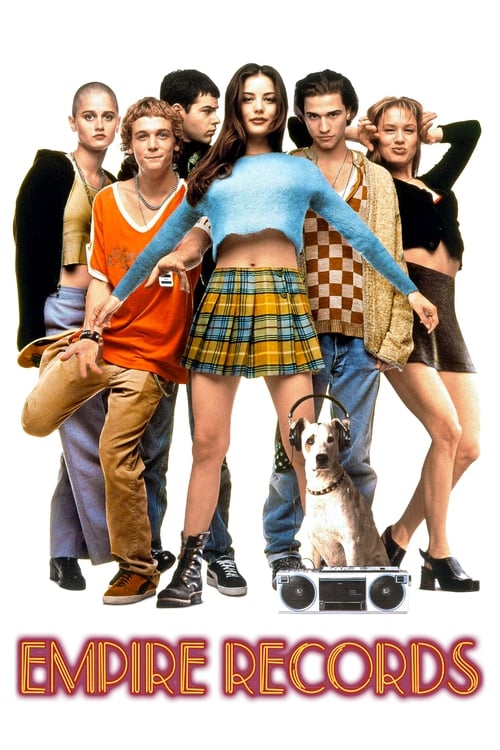
Empire Records (1995)
Directed by Allan Moyle
No — Empire Records is not woke, scoring 12 out of 100 on our wokeness meter.
Empire Records presents a curious artifact of mid-1990s youth cinema.
Consciousness Markers
The central plot is a rebellion against Music Town, a national chain absorbing the independent store, and the staff rally to 'Save the Empire.' This is a genuine indie-vs-corporate, anti-'selling out' sentiment, though it is more small-business nostalgia than systemic economic critique.
Corey, Gina, and Deb are given distinct inner lives and arcs, and Deb's shaved head and near-suicide are treated with some seriousness. However, the film offers no feminist thesis or critique of patriarchy; it is a character-driven teen dramedy.
Empire Records is deliberately lighthearted and goofy, with no preachy messaging or moralizing. Its themes of friendship and resisting corporate takeover are delivered through comedy rather than sermon.
The ensemble cast is almost entirely white, with no meaningful racial diversity and no commentary on representation. The film reflects the default casting norms of mid-1990s teen cinema.
The only nod toward queerness is a throwaway line noting that some Rex Manning fans are 'older women or gay men,' played for mild amusement rather than as a theme. No LGBTQ+ characters or storylines.
There is no engagement with race as a subject. The story is a white, suburban retail fantasy with no racial consciousness whatsoever.
No environmental themes or references appear anywhere in the film.
No body-positivity themes. Deb's head-shaving is framed as a personal crisis, not a statement about beauty standards.
No characters are coded or discussed as neurodivergent, and the film makes no reference to the subject.
The film is a fictional coming-of-age story with no historical revisionism of any kind.
Why it received this score
Empire Records presents a curious artifact of mid-1990s youth cinema. It is a charming, if somewhat unfocused, chronicle of a small business fighting the inevitable corporate encroachment of Music Town. The film’s social consciousness remains rooted firmly in a localized, small-scale rebellion against commercial absorption. We see a genuine sentiment against selling out, though the critique of systemic economic structures remains mercifully minor. The narrative scope is limited to the confines of a suburban retail space, providing little opportunity for the kind of sweeping cultural commentary we are currently accustomed to.
The film’s greatest asset is its commitment to character arcs, especially among the female ensemble. Corey, Gina, and Deb are afforded distinct inner lives, allowing for genuine emotional weight amidst the goofy proceedings. Deb’s personal crisis is handled with a serious touch that elevates the material beyond standard teen comedy. However, this character-driven depth does not extend into the realm of broader progressive sensibilities. The social awareness is strictly internal to the store itself. The progressive sensibilities of the era are evident in the effort to portray complex, relatable personalities, but the lack of diversity or engagement with contemporary social flashpoints keeps the thematic score decidedly low.
Ultimately, this is a nostalgic and sincere piece of work. Its spirit is unburdened by modern preachy messaging. The lighthearted tone ensures that the message of loyalty to a local enterprise is delivered through whimsy rather than sermonizing. It serves as a pleasant, if culturally narrow, memory of a time when the primary concern for a struggling independent store was simply keeping the lights on.
Analysis generated by our Consciousness Algorithm


Synopsis
The employees of an independent music store learn about each other as they try to stop the store from being absorbed by a large chain.
Questions about Empire Records
Is Empire Records woke?
No — Empire Records is not woke, scoring 12 out of 100 on our wokeness meter. That earns it a verdict of Ultra Based.
Does Empire Records have any woke elements?
1 of the 10 markers register at 30 or above, led by Eat the Rich (30). On Eat the Rich: The central plot is a rebellion against Music Town, a national chain absorbing the independent store, and the staff rally to 'Save the Empire.' This is a genuine indie-vs-corporate, anti-'selling out' sentiment, though it is more small-business nostalgia than systemic economic critique.
How does Empire Records compare to other 1995 movies?
It ranks #32 of the 108 films from 1995 we've scored; their average is 12. The wokest is Total Eclipse (60).
How is the Woke Score calculated?
An AI-assisted process researches the film and its reception, scores it 0–100 on ten markers, then combines those into one 0–100 Woke Score. It measures a specific set of 2020s cultural themes, not film quality.