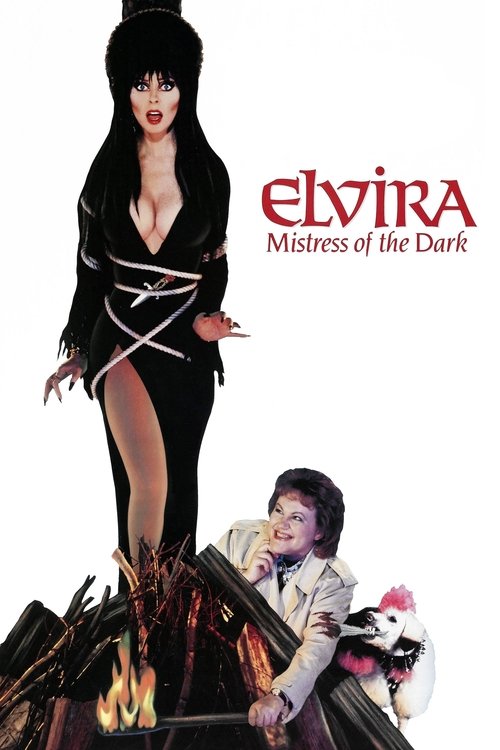
Elvira: Mistress of the Dark (1988)
Directed by James Signorelli
No — Elvira: Mistress of the Dark is not woke, scoring 14 out of 100 on our wokeness meter.
Elvira: Mistress of the Dark arrives from 1988 with a straightforward proposition: a horror hostess with a gift for double entendre inherits a mansion in a Massachusetts town governed by a morality committee, and the resulting collision produces ninety-six minutes of bawdy comedy.
Consciousness Markers
Elvira quits her job after being sexually harassed and defiantly refuses the town's patriarchal morality police, but the film simultaneously trades heavily on her sexualized image, blunting any coherent feminist statement.
The film's camp sensibility and its casting of drag artist Joey Arias as a hitchhiker give it a faint queer-adjacent flavor, but there is no explicit LGBTQ content or theme.
The cast is overwhelmingly white and drawn from Peterson's Groundlings circle; the only notable diversity is a drag performer in a bit part, with no deliberate representation agenda.
The satire of conservative small-town morality is delivered through slapstick and bawdy gags rather than sermonizing, keeping the preachiness low.
Elvira's unapologetic embrace of her own body is central to the character, and the film mocks the town's shame-based attitudes, though it is more bawdy sex-comedy than a body-positivity statement.
The film's conflict is entirely about sexual prudishness versus liberation; race is never a subject or subtext.
No environmental themes or imagery appear anywhere in the film.
The antagonist is a warlock and a prudish town council, not capital; the film has no economic critique whatsoever.
No neurodivergent characters or themes are present.
The film is a contemporary camp comedy with no historical revisionism of any kind.
Why it received this score
Elvira: Mistress of the Dark arrives from 1988 with a straightforward proposition: a horror hostess with a gift for double entendre inherits a mansion in a Massachusetts town governed by a morality committee, and the resulting collision produces ninety-six minutes of bawdy comedy. The cultural inventory here is modest but not empty. Elvira walks away from her television job after the station's new owner makes his intentions physical, and she spends the rest of the picture declining to apologize for her wardrobe to a council of scolds who would prefer she cover up. That defiance is real. It is also inseparable from a marketing strategy built on the same anatomy the town objects to, which leaves the film's gender politics in a state of productive confusion.
The supporting cast comes largely from Cassandra Peterson's Groundlings circle, which means a white ensemble performing white-adjacent comedy, with a drag artist appearing briefly as a hitchhiker and no stated agenda behind the choice. The camp register gives the proceedings a faintly queer texture without ever naming a queer theme. Race goes unmentioned, as does the environment, the economy, and the nervous system. The villain is a warlock with ambitions of world conquest, not a landlord, and the satire targets prudishness alone.
What keeps the sermonizing to a minimum is the film's commitment to slapstick. The morality club absorbs an aphrodisiac and disrobes at a picnic. A fistfight ends with a revelation about a stuffed brassiere. Preachiness is drowned out by the noise. The result is a cult artifact of limited ideological ambition, agreeable, leering, and content to be exactly what it is.
Analysis generated by our Consciousness Algorithm


Synopsis
Arriving in the small town of Fallwell, Massachusetts to claim her inheritance, horror hostess Elvira receives a less than enthusiastic reception from the conservative locals, including her sinister uncle Vincent.
Questions about Elvira: Mistress of the Dark
Is Elvira: Mistress of the Dark woke?
No — Elvira: Mistress of the Dark is not woke, scoring 14 out of 100 on our wokeness meter. That earns it a verdict of Ultra Based.
Does Elvira: Mistress of the Dark have any woke elements?
1 of the 10 markers register at 30 or above, led by Feminist Agenda (35). On Feminist Agenda: Elvira quits her job after being sexually harassed and defiantly refuses the town's patriarchal morality police, but the film simultaneously trades heavily on her sexualized image, blunting any coherent feminist statement.
How does Elvira: Mistress of the Dark compare to other 1988 movies?
It ranks #19 of the 73 films from 1988 we've scored; their average is 10. The wokest is Stand and Deliver (58).
How is the Woke Score calculated?
An AI-assisted process researches the film and its reception, scores it 0–100 on ten markers, then combines those into one 0–100 Woke Score. It measures a specific set of 2020s cultural themes, not film quality.