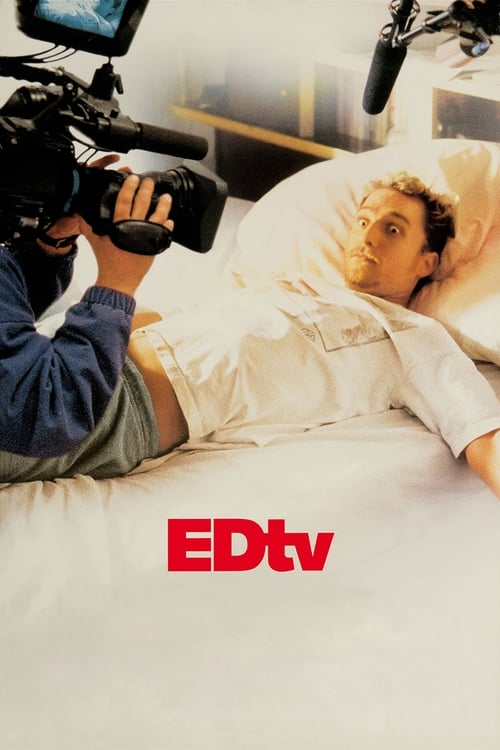
EDtv (1999)
Directed by Ron Howard
No — EDtv is not woke, scoring 11 out of 100 on our wokeness meter.
EDtv arrives in 1999 as Ron Howard's amiable satire of reality television, adapted from a Quebecois film.
Consciousness Markers
The film satirizes a ratings-obsessed network that commodifies a man's private life and strips his family of privacy for profit, offering a mild critique of media capitalism without systemic economic argument.
Cynthia is a driven female producer and the film briefly notes the audience's cruel judgment of Shari's appearance, but this is incidental satire rather than a feminist thesis.
The satire gestures at voyeurism and manufactured fame but delivers its points through comedy and plot rather than preachy moralizing.
The cast is overwhelmingly white, with no meaningful racial or ethnic diversity in principal roles; Ellen DeGeneres's presence is the only notable non-traditional element, and it is not framed as representation.
No LGBTQ+ characters, themes, or subtext appear in the film; DeGeneres's off-screen identity is never reflected in her character.
Race is entirely absent as a subject; the film's satire operates within an all-white milieu with no commentary on racial dynamics.
No environmental or climate themes whatsoever.
No body-positivity themes; the film's humor around Shari's perceived appeal is framed as audience cruelty rather than a body-acceptance message.
No neurodivergent characters or themes are present.
The film is a contemporary satire with no historical subject matter to revise.
Why it received this score
EDtv arrives in 1999 as Ron Howard's amiable satire of reality television, adapted from a Quebecois film. Matthew McConaughey plays Ed, a video store clerk whose life becomes a 24-hour cable product. The film's cultural awareness is modest, rooted in late-90s anxieties about cameras and fame. Its cast is a monument to a specific era of white Hollywood, with Ellen DeGeneres as a conspicuous non-traditional presence. Her off-screen identity never enters the text, and the film makes no effort to frame her casting as anything but a comic hire. On representation, the needle barely lifts.
The satire has a mild anti-capitalist pulse. True TV commodifies Ed's family, strips their privacy, and treats human mess as inventory. Cynthia, the driven producer, gives the film its closest brush with feminist perspective, though her ambition is mostly a plot engine. Shari's treatment by viewers, mocked for not meeting their standards, earns a flicker of sympathy, but the film does not build a body-acceptance argument from it. Race is absent as a subject. The all-white milieu goes unremarked, and no racial consciousness enters the frame. Climate concerns do not exist here. Neurodivergence does not exist here either. The film has no historical revision on its mind.
The film remains a comedy of manners about media appetite. Its lecture energy stays low because it prefers punchlines to sermons. The moral points about voyeurism and manufactured celebrity arrive through plot mechanics, not preaching. The result is a film that feels socially aware in a pre-2015, vaguely liberal way, but it lacks the specific markers of modern progressive orthodoxy. It is a product of its moment, and its moment was not especially concerned with the checklist. The whole enterprise lands as pleasant, dated, and ideologically mild. We can file it under satire, soft.
Analysis generated by our Consciousness Algorithm
Part of


Synopsis
Video store clerk Ed agrees to have his life filmed by a camera crew for a tv network.
Questions about EDtv
Is EDtv woke?
No — EDtv is not woke, scoring 11 out of 100 on our wokeness meter. That earns it a verdict of Ultra Based.
Does EDtv have any woke elements?
Very few. None of the 10 markers reaches 30, the level where a marker counts as present; the highest is Eat the Rich at 25.
How does EDtv compare to other 1999 movies?
It ranks #45 of the 103 films from 1999 we've scored; their average is 14. The wokest is Boys Don't Cry (60).
How is the Woke Score calculated?
An AI-assisted process researches the film and its reception, scores it 0–100 on ten markers, then combines those into one 0–100 Woke Score. It measures a specific set of 2020s cultural themes, not film quality.