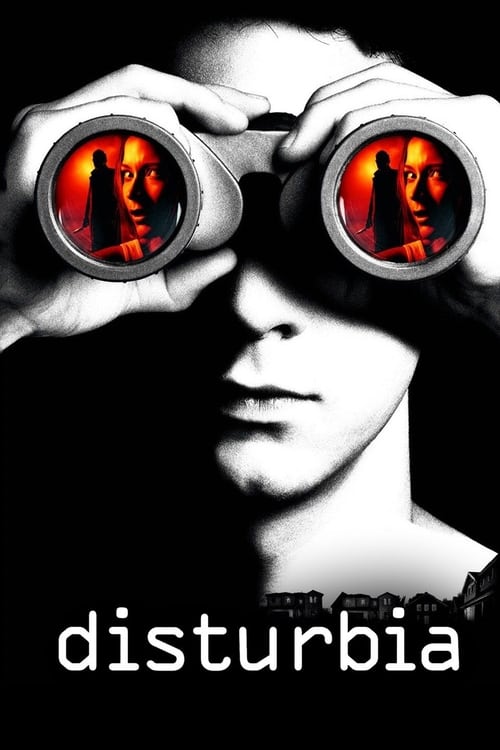
Disturbia (2007)
Directed by D.J. Caruso
No — Disturbia is not woke, scoring 11 out of 100 on our wokeness meter.
Disturbia arrives from 2007, a year when a studio thriller could still be assembled from borrowed parts and released without apology.
Consciousness Markers
The cast includes Aaron Yoo as the best friend and Viola Davis as the investigating detective, both natural and unremarked-upon presences, but the film makes no identity-driven casting gestures and the leads are conventionally white.
Ashley functions primarily as a romantic prize and the mother as a hostage, though Julie's screwdriver stabbing to save her son gives a single token moment of female agency.
There are no LGBTQ+ characters, relationships, or subtext of any kind in the film.
The film features minority actors in supporting roles but engages in no racial themes, commentary, or consciousness whatsoever.
No environmental themes or content of any kind.
The film's only economic gesture is a mother cutting off an Xbox Live subscription as a punishment; there is no critique of wealth, class, or capitalism.
No body-positivity themes; the film's treatment of physical appearance is entirely conventional teen-thriller fare.
Kale's grief, withdrawal, and paranoia are framed as trauma and delinquency, not as neurodivergence or neurodiversity.
The film has no historical subject matter to revise; it is a contemporary-set thriller.
The film is a straightforward suspense entertainment that never pauses to deliver a message or moral instruction to its audience.
Why it received this score
Disturbia arrives from 2007, a year when a studio thriller could still be assembled from borrowed parts and released without apology. The parts here are Rear Window, a court-ordered ankle bracelet, and the ambient paranoia of a suburban street after dark. Kale Brecht loses his father in a car crash, assaults a Spanish teacher, and is confined to a hundred-foot perimeter, where he fills the hours with binoculars and a growing suspicion that the neighbor across the way owns a dented fender and a cellar full of secrets. The film has no interest in telling us anything. It wants to frighten us for ninety minutes and then send us home.
The casting is agreeable without being argumentative. Viola Davis appears as an investigating detective with a handful of scenes and no thesis attached, and Aaron Yoo handles the best-friend duties with the easy competence the role requires. Neither presence is remarked upon, which is the correct approach and also the reason the film registers so faintly on the cultural seismograph. Sarah Roemer's Ashley exists chiefly to be kissed and to arrive at the right moment, though she does distract the killer long enough for Kale to swing a club, and Julie eventually drives a screwdriver into a leg. Two gestures of competence in a hundred minutes. We record them and move on.
No message waits at the end of this corridor. The mother cancels the Xbox Live subscription, and that is the full extent of the film's economic thought. The villain is a man with a Mustang, not a system. Grief and withdrawal are treated as delinquency, which is the genre's habit, and the screenplay never pauses to instruct anyone about anything. What remains is a competent, well-lit suspense machine that opened at number one and returned its budget several times over, and which will be remembered mostly as the thing a trust once sued Steven Spielberg over. We classify it accordingly and return it to the shelf.
{"thematic_tags": ["box_office_number_one"]}
Analysis generated by our Consciousness Algorithm


Synopsis
Kale has a life most teenagers would envy. He spends his days endlessly playing video games, surfing the net, eating junk food and watching cable. He has complete free reign of the house, and a beautiful young hottie named Ashley has just moved in next door. There’s only one problem—he’s not allowed to leave the house. Kale’s under court-ordered house arrest for three months, and if he takes one step beyond a 100-foot perimeter of the house, his next confinement will be in a real prison.
Questions about Disturbia
Is Disturbia woke?
No — Disturbia is not woke, scoring 11 out of 100 on our wokeness meter. That earns it a verdict of Ultra Based.
Does Disturbia have any woke elements?
Very few. None of the 10 markers reaches 30, the level where a marker counts as present; the highest is Representation Casting at 28.
How does Disturbia compare to other 2007 movies?
It ranks #73 of the 201 films from 2007 we've scored; their average is 12. The wokest is Like Stars on Earth (92).
How is the Woke Score calculated?
An AI-assisted process researches the film and its reception, scores it 0–100 on ten markers, then combines those into one 0–100 Woke Score. It measures a specific set of 2020s cultural themes, not film quality.