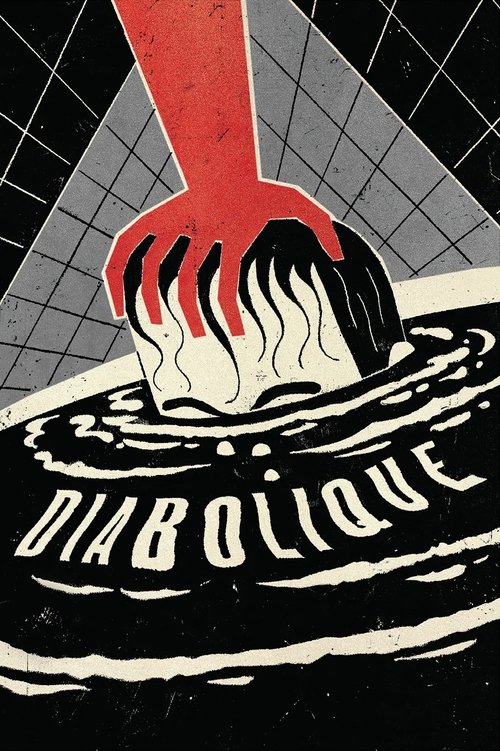
Diabolique (1955)
Directed by Henri-Georges Clouzot
No — Diabolique is not woke, scoring 10 out of 100 on our wokeness meter.
Henri-Georges Clouzot's Les Diaboliques arrives from 1955 with a reputation as one of the great suspense machines, and it earns that reputation without asking for anything else.
Consciousness Markers
Two women unite to murder a cruel, abusive husband and lover, a proto-revenge premise, but the ending reasserts patriarchal order by exposing and imprisoning the surviving woman.
The source novel explicitly made the two conspiring women lesbian lovers, but Clouzot's adaptation deliberately removed this; scholars note a residual subtext, though the film itself suppresses it.
The cast is entirely white French performers; the sole nominally 'diverse' element is a character written as a Venezuelan immigrant, which is a plot device rather than a casting statement.
No engagement with race or racial politics whatsoever.
No environmental or climate themes present.
The film is a psychological crime thriller with no economic critique or class-based messaging.
No body-positivity themes; the frail, ailing body is used for suspense, not affirmation.
No neurodivergence themes; the protagonist's condition is a cardiac ailment, not a neurological one.
A fictional adaptation with no historical revisionism.
The film is a taut suspense machine that shows rather than tells, offering no moralizing or didactic messaging.
Why it received this score
Henri-Georges Clouzot's Les Diaboliques arrives from 1955 with a reputation as one of the great suspense machines, and it earns that reputation without asking for anything else. A cruel headmaster is drowned in a bathtub by his wife and his mistress. The body goes into a drained swimming pool and does not come back. Dread follows, long and cold, shot in medium and close frames that leave the audience nowhere to stand. The film is a trap, and it springs cleanly.
For all the talk of two women conspiring against a brutish man, the film has little appetite for a social program. The source novel made the pair lovers; Clouzot removed that, and scholars still squint at the residue. Christina is written as a Venezuelan immigrant, a detail that functions as plot furniture, granting her money, foreignness, and a weak heart, not as a statement about anything. The ending is decisive. The surviving woman is frightened to death, the schemers are exposed, and the established order closes over the wound like water. A proto-revenge reading is available here. The film declines to make it for us.
The rest of the ledger is bare. No class critique, no environmental sermon, no affirmation of the body, no neurological vocabulary, no historical revision, and no lecture. Clouzot cared about the audience's pulse, not its politics. He ends with a boy breaking a window and a slingshot returned by a dead woman, a small, mean joke that refuses to explain itself. Seven decades on, the film remains what it was: a device for making strangers grip their armrests in the dark. It has no message. That is the message.
Analysis generated by our Consciousness Algorithm


Synopsis
The cruel and abusive headmaster of a boarding school, Michel Delassalle, is murdered by an unlikely duo -- his meek wife and the mistress he brazenly flaunts. The women become increasingly unhinged by a series of odd occurrences after Delassalle's corpse mysteriously disappears.
Questions about Diabolique
Is Diabolique woke?
No — Diabolique is not woke, scoring 10 out of 100 on our wokeness meter. That earns it a verdict of Ultra Based.
Does Diabolique have any woke elements?
1 of the 10 markers register at 30 or above, led by Feminist Agenda (30). On Feminist Agenda: Two women unite to murder a cruel, abusive husband and lover, a proto-revenge premise, but the ending reasserts patriarchal order by exposing and imprisoning the surviving woman.
How does Diabolique compare to other 1955 movies?
It is the wokest of the 15 films from 1955 we've scored; their average is 3.
How is the Woke Score calculated?
An AI-assisted process researches the film and its reception, scores it 0–100 on ten markers, then combines those into one 0–100 Woke Score. It measures a specific set of 2020s cultural themes, not film quality.