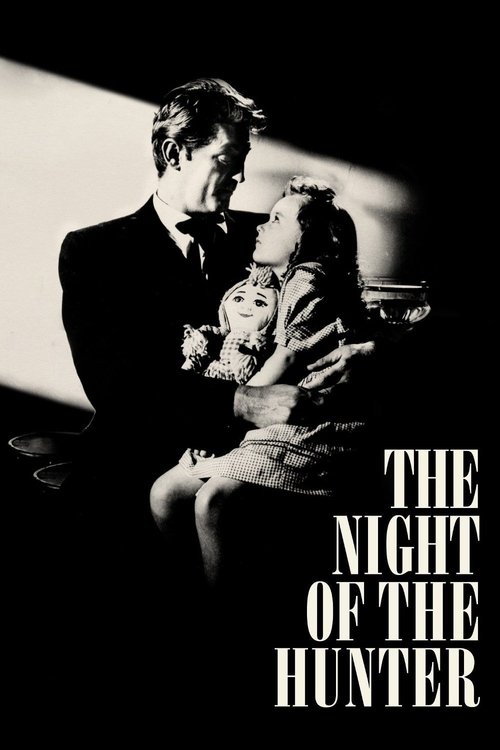
The Night of the Hunter (1955)
Directed by Charles Laughton
No · Ultra Based
How we score movies →Consciousness Markers
While Lillian Gish's character wields a shotgun and Shelley Winters shows vulnerability that could be read as subversive, the film is not consciously advancing feminist ideology. Gender roles are traditional.
The cast reflects 1950s norms with no deliberate consciousness of representation. Shelley Winters and Lillian Gish are present but not presented as a statement about female casting diversity.
The Depression-era setting and the motivation of money create some implicit critique of economic desperation, but this is incidental to the plot rather than a conscious anti-capitalist statement.
The film reflects 1950s casting practices with an entirely white cast. No racial consciousness or deliberate inclusion is evident. The Depression-era setting is not used to examine systemic racism.
The film trusts its audience to understand its moral dimensions without explicit instruction. There is minimal expository dialogue about right and wrong, making this notably low on lecture energy.
No LGBTQ+ themes, characters, or subtext whatsoever. The film is entirely heteronormative and makes no acknowledgment of sexual or gender diversity.
No environmental themes or climate messaging. The natural landscape is used for atmospheric effect, not as commentary on humanity's relationship to nature.
No body positivity messaging. All characters conform to conventional 1950s beauty standards, and the film makes no statement about body diversity or acceptance.
No representation of neurodivergence or disability. The film does not engage with these issues in any way.
The film is set in Depression-era West Virginia but makes no attempt to reframe historical narratives or challenge conventional historical understanding.


Synopsis
In Depression-era West Virginia, a serial-killing preacher hunts two young children who know the whereabouts of a stash of money.
Why it received this score
Charles Laughton's sole directorial effort remains a technical marvel of American cinema, a fever dream of expressionist shadows and moral dread that ranks among the finest thrillers ever made. Yet it is profoundly of its era, which is to say it is almost entirely untouched by the progressive sensibilities that would come to define cultural discourse seventy years hence. Robert Mitchum's predatory preacher serves as a critique of religious hypocrisy, but this critique operates within the classical humanist tradition rather than any contemporary framework of social consciousness. The film's treatment of its female characters, particularly Shelley Winters' vulnerable widow, reflects mid-century assumptions about gender that no amount of directorial genius can retroactively update.
The children at the film's center are resourceful and brave, but they are not presented as a conscious statement about youth agency or identity. Lillian Gish appears as a gun-toting matriarch, a figure of strength, yet the film does not labor the point or congratulate itself for this portrayal. There is no environmental commentary, no interrogation of economic systems, no representation consciousness, no acknowledgment of bodies beyond the conventionally attractive, no neurodivergent representation, no revisionist history, and certainly no lecture energy. The film simply tells its story with the confidence of a work that assumes a shared moral baseline rather than one that must educate its audience.
This is not a condemnation. It is simply the truth of the artifact. We are evaluating the degree to which a film exhibits the specific markers of 2020s progressive cultural sensibility, and this 1955 masterwork exhibits virtually none of them. It is a work of moral seriousness, but moral seriousness and contemporary cultural awareness are not the same thing.
Analysis generated by our Consciousness Algorithm
Critic Reviews
“This is the only film Laughton ever directed, and he packed it with a mixture of eerie chills, ingenious suspense, and absurdist humor. It's a genuine classic.”
“Laughton understood Agee's proximity to Grimm vaudeville, and fashioned the most intensely expressionistic movie of its day.”
“Part fairy tale and part bogeyman thriller -- a juicy allegory of evil, greed and innocence, told with an eerie visual poetry.”
“This start for Gregory as producer and Laughton as director is rich in promise but the completed product, bewitching at times, loses sustained drive via too many offbeat touches that have a misty effect.”