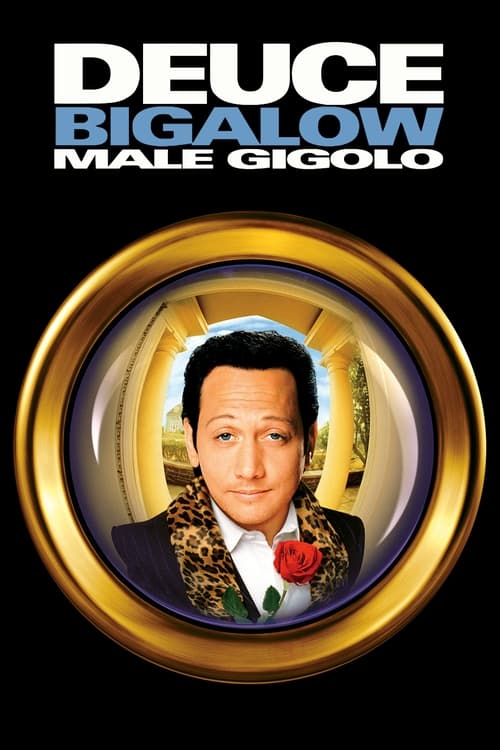
Deuce Bigalow: Male Gigolo (1999)
Directed by Mike Mitchell
No — Deuce Bigalow: Male Gigolo is not woke, scoring 13 out of 100 on our wokeness meter.
There is a loneliness to watching Deuce Bigalow: Male Gigolo now, and the film has nothing to do with it.
Consciousness Markers
The film's clients are obese, tall, narcoleptic, Tourette's-afflicted, and amputee women whom Deuce treats with unexpected kindness, and the ending insists they are worthy of affection — a crude but genuine proto-acceptance thread.
Eddie Griffin provides a prominent Black co-lead and the cast includes a few minority performers, but they exist as broad comic types rather than any deliberate diversity statement.
Narcolepsy and Tourette syndrome are depicted, but strictly as punchlines for the clients' comic quirks rather than any neurodivergence advocacy.
The premise involves a man servicing women, and the courtroom climax asserts he made them 'feel good about themselves,' but the treatment is leering rather than a feminist statement.
No LGBTQ+ characters, themes, or subtext of any kind appear in this 1999 sex comedy.
T.J. is a walking Black-pimp stereotype played for laughs; there is no racial consciousness or commentary whatsoever.
No environmental themes; the aquarium is a plot device, not a climate message.
No economic critique; the film's money troubles are purely a sitcom engine for gags.
No historical subject matter to revise.
A Happy Madison gross-out comedy with no interest in moral instruction; it never lectures its audience.
Why it received this score
There is a loneliness to watching Deuce Bigalow: Male Gigolo now, and the film has nothing to do with it. The 1999 comedy, the first Happy Madison release, concerns a timid aquarium cleaner who wrecks a gigolo's beachfront apartment and turns to male prostitution to fund the repairs. Rob Schneider plays the title role with the damp eagerness of a man who has never been told no. Eddie Griffin appears as T.J., the pimp who manages his bookings, and the film grants him real screen time and several of its better jokes. That is the extent of its inclusion. T.J. is a walking caricature of streetwise Black hustlerhood, played for laughs and never for comment, which places the film in the comic conventions of its era without a flicker of awareness.
Where the film surprises, mildly, is in its treatment of Deuce's clients. They are obese, tall, narcoleptic, Tourette's-afflicted, and, in Kate's case, an amputee, and the movie lets each of them be lonely in a way that reads as nearly tender. Deuce never sleeps with them. He listens, compliments, and the courtroom finale has them testify that he made them feel good about themselves. The gesture is genuine, if crude, and it arrives wrapped in the same leering package as everything else. Narcolepsy and Tourette syndrome exist here strictly as punchlines, conditions to be giggled at when a woman falls asleep mid-sentence or shouts an obscenity during dinner. Recognition, yes. Advocacy, no.
Elsewhere the cupboard is bare. No LGBTQ characters appear, no climate anxieties intrude, and the film's cash troubles are a sitcom engine, not an indictment of anything. The premise of a man servicing women could have gestured toward empowerment, and a late courtroom scene flirts with the idea, but the camera is too busy ogling to make an argument. Most tellingly, this is a comedy with no sermon in it. It wants you to laugh at a crossbow bolt lodging in a roast chicken, and it delivers. As a document of social progress it is inert. As a relic of 1999, it is oddly complete.
Analysis generated by our Consciousness Algorithm


Synopsis
Deuce Bigalow is a less than attractive, down on his luck aquarium cleaner. One day he wrecks the house of a gigolo and needs quick money to repair it. The only way he can make it is to become a gigolo himself, taking on an unusual mix of female clients. He encounters a couple of problems, though. He falls in love with one of his unusual clients, and a sleazy police officer is hot on his trail.
Questions about Deuce Bigalow: Male Gigolo
Is Deuce Bigalow: Male Gigolo woke?
No — Deuce Bigalow: Male Gigolo is not woke, scoring 13 out of 100 on our wokeness meter. That earns it a verdict of Ultra Based.
Does Deuce Bigalow: Male Gigolo have any woke elements?
1 of the 10 markers register at 30 or above, led by Body Positivity (35). On Body Positivity: The film's clients are obese, tall, narcoleptic, Tourette's-afflicted, and amputee women whom Deuce treats with unexpected kindness, and the ending insists they are worthy of affection — a crude but genuine proto-acceptance thread.
How does Deuce Bigalow: Male Gigolo compare to other 1999 movies?
It ranks #36 of the 103 films from 1999 we've scored; their average is 14. The wokest is Boys Don't Cry (60).
How is the Woke Score calculated?
An AI-assisted process researches the film and its reception, scores it 0–100 on ten markers, then combines those into one 0–100 Woke Score. It measures a specific set of 2020s cultural themes, not film quality.