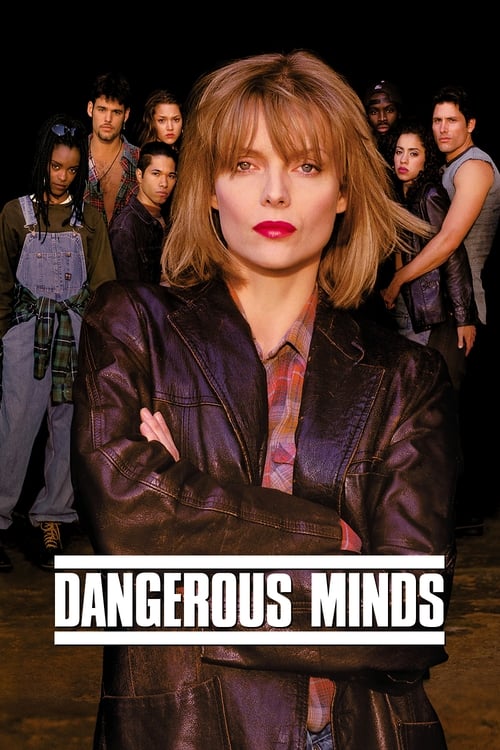
Dangerous Minds (1995)
Directed by John N. Smith
No — Dangerous Minds is not especially woke, scoring 31 out of 100 on our wokeness meter.
There is a moment in Dangerous Minds when Michelle Pfeiffer, having traded her cardigan for a leather jacket, teaches karate to a room of sullen teenagers.
Consciousness Markers
Race and class are central to the story, with explicit depictions of inner-city minority students and a white teacher's intervention, though critics noted stereotypical and white-savior framing.
Features a predominantly Black and Latino student cast, but centers a white savior narrative, limiting its modern representation impact.
The film delivers inspirational teacher speeches and moral lessons about education, but its lecture energy is mild and not tied to modern social justice messaging.
Michelle Pfeiffer's LouAnne Johnson is a strong female lead who challenges authority, but the film does not engage with feminist themes beyond her individual grit.
No LGBTQ+ characters or themes present.
No environmental or climate themes.
Critiques underfunded public education and bureaucratic indifference, but not capitalism or wealth inequality as a system.
No body positivity themes.
No neurodivergence themes.
Based on a memoir but does not revise or reinterpret historical events.
Why it received this score
There is a moment in Dangerous Minds when Michelle Pfeiffer, having traded her cardigan for a leather jacket, teaches karate to a room of sullen teenagers. It is 1995, and the inspirational teacher picture has already been worked over so thoroughly that the audience knows every beat before it arrives. LouAnne Johnson is a former Marine, the students are Black and Latino kids from East Palo Alto, and the school bureaucracy exists chiefly to be defied by a determined white woman with good intentions. The film has been assembled with competence and no small amount of craft, but it wears its contrivances openly, like a coat it refuses to take off.
The picture deserves some credit for putting a genuinely diverse cast on screen at a time when such casting was not automatic, and the young performers handle thin material with more dignity than it earns. Race and class sit at the center of the story, addressed directly and often clumsily, and critics at the time noted that the framing leans hard on the white savior arrangement. Pfeiffer's LouAnne is a forceful presence who pushes back against authority, though the screenplay never bothers to examine what her gender costs her. The moral instruction arrives through speeches about poetry and self-worth, gently sermonizing, never quite tipping into outright preaching. There is no engagement with sexuality, the environment, body image, or neurological difference, and the film's economic complaints target indifferent administrators, not the system that funds them.
Based on Johnson's memoir, the film invents and sentimentalizes where it might have observed. Roger Ebert noted that Bob Dylan replaced the rap the students actually listened to, which tells you most of what you need to know about the enterprise. It is hokum, delivered earnestly, and it made a great deal of money anyway. We have seen this film many times. We will see it again.
Note: The film is a TV series? No, it's a film.
Analysis generated by our Consciousness Algorithm


Synopsis
Former Marine Louanne Johnson lands a gig teaching in a pilot program for bright but underachieving teens at a notorious inner-city high school. After having a terrible first day, she decides she must throw decorum to the wind. When Johnson returns to the classroom, she does so armed with a no-nonsense attitude informed by her military training and a fearless determination to better the lives of her students -- no matter what the cost.
Questions about Dangerous Minds
Is Dangerous Minds woke?
No — Dangerous Minds is not especially woke, scoring 31 out of 100 on our wokeness meter. That earns it a verdict of Based.
Does Dangerous Minds have any woke elements?
3 of the 10 markers register at 30 or above, led by Racial Consciousness (55), Representation Casting (50) and Lecture Energy (30). On Racial Consciousness: Race and class are central to the story, with explicit depictions of inner-city minority students and a white teacher's intervention, though critics noted stereotypical and white-savior framing.
How does Dangerous Minds compare to other 1995 movies?
It ranks #10 of the 108 films from 1995 we've scored; their average is 12. The wokest is Total Eclipse (60).
How is the Woke Score calculated?
An AI-assisted process researches the film and its reception, scores it 0–100 on ten markers, then combines those into one 0–100 Woke Score. It measures a specific set of 2020s cultural themes, not film quality.