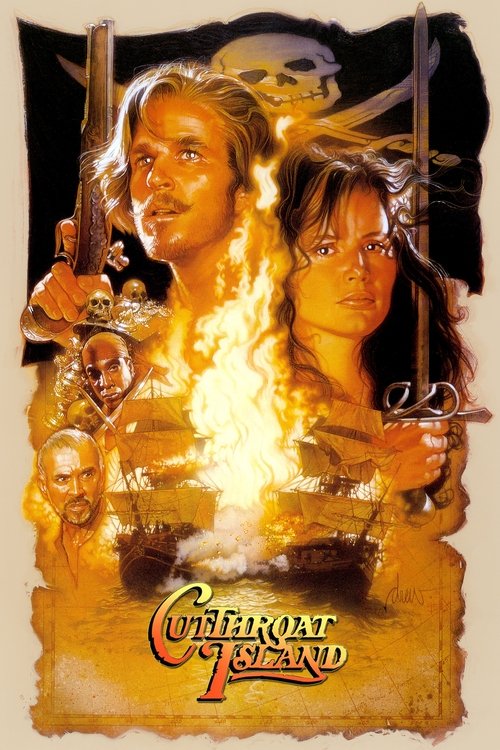
Cutthroat Island (1995)
Directed by Renny Harlin
No — Cutthroat Island is not woke, scoring 14 out of 100 on our wokeness meter.
Cutthroat Island arrives in 1995 with a woman at the helm, a treasure map, and a budget that Guinness would later cite as the largest crater in box office history.
Consciousness Markers
Morgan Adams commands a pirate ship and must prove her leadership against a skeptical, mutinous crew, giving the film a female-action-hero spine. But it is a swashbuckling adventure rather than a film with a feminist thesis, and reviewers felt the gender angle was squandered.
Geena Davis headlines as a female pirate captain, a notable gender-flipped lead for 1995, and the crew includes a few non-white faces. However, the casting is star-driven rather than a deliberate diversity statement, and critics noted the film does little with its reversal of expectations.
A slave auction and a character sold into bondage appear in the plot, but race is never examined or made a theme; the enslaved con man is played by a white actor. No racial consciousness is articulated.
No LGBTQ+ characters, themes, or subtext of any kind.
No environmental or climate themes whatsoever.
The film is a treasure-hunt adventure driven by gold and greed, with no critique of wealth, class, or capitalism.
No body-positivity themes or messaging present.
No neurodivergent characters or themes.
A wholly fictional 17th-century pirate yarn with no historical revisionism or reframing of real events.
A pure action-adventure spectacle with no moralizing, messaging, or didactic speeches.
Why it received this score
Cutthroat Island arrives in 1995 with a woman at the helm, a treasure map, and a budget that Guinness would later cite as the largest crater in box office history. Geena Davis plays Morgan Adams, captain of the Morning Star, and the film's modest ambition is to let her swing from rigging, fire cannons, and duel her murderous uncle. That is a genuine reversal of expectations for the mid-nineties. Building on it is another matter. Reviewers at the time sensed the waste. Todd McCarthy observed that the picture does little with its gender flip, and Janet Maslin could not believe Davis commanded a crew. The film never argues a point. It just wants the gold.
The social consciousness on display is thin and mostly incidental. A female lead in a male genre registers as representation of a sort, though the casting was star-driven and the crew's racial mix is set dressing. One set piece involves a slave auction, and the man Morgan purchases, a con artist named Shaw, is played by a white actor and swiftly becomes her love interest; slavery appears as a plot mechanism and then evaporates. No other progressive currents surface. There are no queer characters, no climate anxieties, no critique of the greed that drives every character in the film, no body-positivity angle, no neurodivergent figures, no reframing of actual history. Nobody lectures. Nobody even clears their throat.
History will remember the production more than the film. Raw sewage in the water tank, an original cinematographer with a broken leg, Oliver Reed exposing himself to the star, and cases of V8 juice flown to Malta at studio expense. Carolco had bet its survival on the picture and filed for bankruptcy a month before release. The result took in sixteen million dollars worldwide against a budget near one hundred million and doomed the pirate movie for eight years. Whether a film about a woman captain deserved that fate is a fair question. The film itself does not make much of an argument either way. It swings, it sinks, and the treasure is dragged up by a barrel.
A film of enormous expense and no thesis, a curiosity worth cataloguing and little else. Rotten Tomatoes sits at forty percent, which feels generous by roughly nine points.
THEMATIC TAGS: none apply. It won no Oscars, spawned no sequels, remade nothing, dramatized no true events, adapted no book, featured no superhero, and debuted at number thirteen domestically. An empty ledger, which suits it.
OVERALL WOKE SCORE: 8 out of 100. A female pirate captain in 1995 earns a small historical nod. Everything else is a treasure chest full of nothing.
FINAL VERDICT: Watch the first twenty minutes of stunts, then find the ocean battle on YouTube. The V8 juice had more cultural impact than the screenplay.
Analysis generated by our Consciousness Algorithm


Synopsis
Morgan Adams and her slave, William Shaw, are on a quest to recover the three portions of a treasure map. Unfortunately, the final portion is held by her murderous uncle, Dawg. Her crew is skeptical of her leadership abilities, so she must complete her quest before they mutiny against her. This is made yet more difficult by the efforts of the British crown to end her pirate raids.
Questions about Cutthroat Island
Is Cutthroat Island woke?
No — Cutthroat Island is not woke, scoring 14 out of 100 on our wokeness meter. That earns it a verdict of Ultra Based.
Does Cutthroat Island have any woke elements?
2 of the 10 markers register at 30 or above, led by Feminist Agenda (40) and Representation Casting (35). On Feminist Agenda: Morgan Adams commands a pirate ship and must prove her leadership against a skeptical, mutinous crew, giving the film a female-action-hero spine.
How does Cutthroat Island compare to other 1995 movies?
It ranks #29 of the 108 films from 1995 we've scored; their average is 12. The wokest is Total Eclipse (60).
How is the Woke Score calculated?
An AI-assisted process researches the film and its reception, scores it 0–100 on ten markers, then combines those into one 0–100 Woke Score. It measures a specific set of 2020s cultural themes, not film quality.