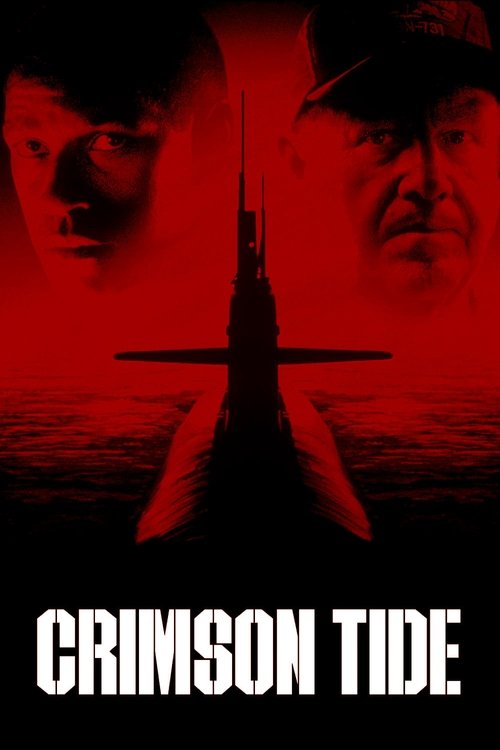
Crimson Tide (1995)
Directed by Tony Scott
No — Crimson Tide is not woke, scoring 10 out of 100 on our wokeness meter.
Crimson Tide arrives from 1995, a year when a submarine thriller could still be about a submarine.
Consciousness Markers
Denzel Washington headlines as Lt. Cmdr. Hunter, an authority figure and the film's moral center, but the casting carries no self-conscious representational framing and race is never foregrounded.
The clash of interpretations and chain-of-command debate give it some argumentative heft, but the film dramatizes its dilemma rather than lecturing the audience.
No LGBTQ+ characters or themes of any kind.
A brief girlfriend figure aside, the film is an all-male submarine drama with no feminist content or gendered critique.
Race is never addressed in the narrative; the Tarantino dialogue controversy was a behind-the-scenes matter, not on-screen racial consciousness.
The threat is nuclear war, not environmental; no climate themes.
The film is about military command and nuclear protocol, with no economic or class critique.
No body image or body positivity themes.
No neurodivergent characters or themes.
The plot parallels the Cuban Missile Crisis and Vasily Arkhipov, but it is presented as fiction, not a corrective rewriting of history.
Why it received this score
Crimson Tide arrives from 1995, a year when a submarine thriller could still be about a submarine. Tony Scott films the USS Alabama as a series of steam, red light, and men shouting over alarms. The plot concerns a launch order, a garbled follow-up transmission, and two officers who disagree about what the silence means. Gene Hackman's Captain Ramsey wants to fire. Denzel Washington's Lieutenant Commander Hunter wants to wait. The film takes this dilemma seriously and resolves it with a tribunal that declares both men right and both men wrong, which is the most diplomatic verdict ever issued by a navy.
The cast is notable chiefly because Washington commands the screen as the moral center without the screenplay ever remarking on it. His authority is simply authority. No self-conscious representational architecture surrounds him, and no moment pauses to congratulate the production for its choices. This is a casting decision that has aged into significance without having been built for it. The script, meanwhile, carries a real argumentative charge: orders, interpretation, the two-man rule, the question of whether obedience is a virtue or a hazard. The film stages that as drama. It does not turn to the audience and explain the lesson. Quentin Tarantino's uncredited dialogue adds pop-culture static, though the friction it caused lived behind the camera and never reached the screen.
Everything else is absent. There is no environmental alarm, no class critique, no inquiry into identity or the body, and the only female presence is a girlfriend glimpsed briefly. The historical parallel to the Cuban Missile Crisis and Vasily Arkhipov sits in the bones of the plot, offered as fiction and not as a correction to the record. We are left with a taut, well-made thriller about procedure and nerve, a relic from a period when a movie could put two men in a room and let them argue about nuclear war for two hours. The closing card informs us that only the President may authorize a launch. The audience is trusted to draw its own conclusions.
Analysis generated by our Consciousness Algorithm


Synopsis
After the Cold War, a breakaway Russian republic with nuclear warheads becomes a possible worldwide threat. U.S. submarine Capt. Frank Ramsey signs on a relatively green but highly recommended Lt. Cmdr. Ron Hunter to the USS Alabama, which may be the only ship able to stop a possible Armageddon. When Ramsey insists that the Alabama must act aggressively, Hunter, fearing they will start rather than stop a disaster, leads a potential mutiny to stop him.
Questions about Crimson Tide
Is Crimson Tide woke?
No — Crimson Tide is not woke, scoring 10 out of 100 on our wokeness meter. That earns it a verdict of Ultra Based.
Does Crimson Tide have any woke elements?
Very few. None of the 10 markers reaches 30, the level where a marker counts as present; the highest is Lecture Energy at 20.
How does Crimson Tide compare to other 1995 movies?
It ranks #41 of the 108 films from 1995 we've scored; their average is 12. The wokest is Total Eclipse (60).
How is the Woke Score calculated?
An AI-assisted process researches the film and its reception, scores it 0–100 on ten markers, then combines those into one 0–100 Woke Score. It measures a specific set of 2020s cultural themes, not film quality.