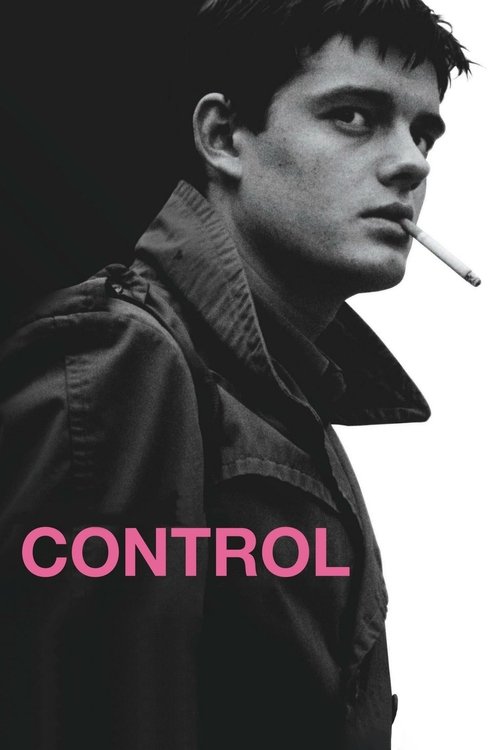
Control (2007)
Directed by Anton Corbijn
No — Control is not woke, scoring 10 out of 100 on our wokeness meter.
Anton Corbijn's Control arrives in black and white, fitting for a film with almost no interest in the color of anything, least of all its cast.
Consciousness Markers
Ian Curtis's epilepsy, its seizures, and the mood-altering side effects of his medication are central to the film, along with his depression and suicidal ideation, though the film treats these as a tragic medical condition rather than a neurodivergence-advocacy framework.
The screenplay is adapted from Deborah Curtis's memoir and gives Samantha Morton's Deborah substantial screen time and interiority, but the film offers no feminist thesis or critique of patriarchy.
There are faint punk-ethos gestures against the music industry (Factory Records, record contracts), but no sustained eat-the-rich or anti-capitalist argument.
The film is a conventional biopic drawn from a widow's memoir; band members disputed its factual accuracy, but it makes no attempt to re-narrate history through a modern ideological lens.
Control is a restrained, atmospheric character portrait that shows rather than tells; it contains essentially no didactic or preachy address to the audience.
The cast is entirely white, portraying the real white British figures of Joy Division and their circle; there is no color-conscious or diversity-driven casting to speak of.
No LGBTQ+ characters, themes, or subtext appear anywhere in the film.
Race is entirely absent as a subject; the film is a period portrait of the white Manchester post-punk scene.
No environmental or climate themes are present.
No body-positivity themes or messaging appear in the film.
Why it received this score
Anton Corbijn's Control arrives in black and white, fitting for a film with almost no interest in the color of anything, least of all its cast. The ensemble is drawn entirely from the real white Mancunian figures of the late 1970s post-punk scene, and no effort is made to diversify the historical record. Race never surfaces as a subject. This is a period portrait of a specific milieu, and it stays inside that milieu without apology. Questions of sexuality go unraised. The environment does not come up at all. A small punk sneer at the record industry flickers past, a blood-signed contract, a manager's bluster, but it never builds into an argument about capital. The film is too busy watching a man fall apart.
That man is Ian Curtis, and the film's emotional engine is his epilepsy, the seizures, and the phenobarbital haze that dulls him into a stranger. The screenplay treats this as medicine and tragedy. It does not recast his condition as a celebration of neurological difference, and it does not lecture about it. Samantha Morton's Deborah, drawn from her own memoir, is granted real interiority and screen time, but no thesis about patriarchy arrives with her. She is a woman watching her husband vanish, and that is the whole of it. The punk ethos glances at Factory Records and the machinery of touring, then goes quiet.
Corbijn is a photographer, and he shows rather than tells. This is the rare music biopic with no sermon in its pocket. It bends facts, as the surviving band members have grumbled, but it bends them toward mood, not toward a modern ideological reading of the past. No address is made to the audience. No moral is delivered from the wings. Nobody tries to make 1980 speak in the vocabulary of the present. We watch a young man who cannot control his body, his marriage, or his future, and a camera patient enough to hold still while he loses all three. A somber, well-made picture. The cultural syllabus will survive without it.
Analysis generated by our Consciousness Algorithm


Synopsis
The story of Joy Division’s lead singer Ian Curtis, from his schoolboy days in 1973 to his suicide on the eve of the band's first American tour in 1980.
Questions about Control
Is Control woke?
No — Control is not woke, scoring 10 out of 100 on our wokeness meter. That earns it a verdict of Ultra Based.
Does Control have any woke elements?
1 of the 10 markers register at 30 or above, led by Neurodivergence (35). On Neurodivergence: Ian Curtis's epilepsy, its seizures, and the mood-altering side effects of his medication are central to the film, along with his depression and suicidal ideation, though the film treats these as a tragic medical condition rather than a neurodivergence-advocacy framework.
How does Control compare to other 2007 movies?
It ranks #80 of the 201 films from 2007 we've scored; their average is 12. The wokest is Like Stars on Earth (92).
How is the Woke Score calculated?
An AI-assisted process researches the film and its reception, scores it 0–100 on ten markers, then combines those into one 0–100 Woke Score. It measures a specific set of 2020s cultural themes, not film quality.