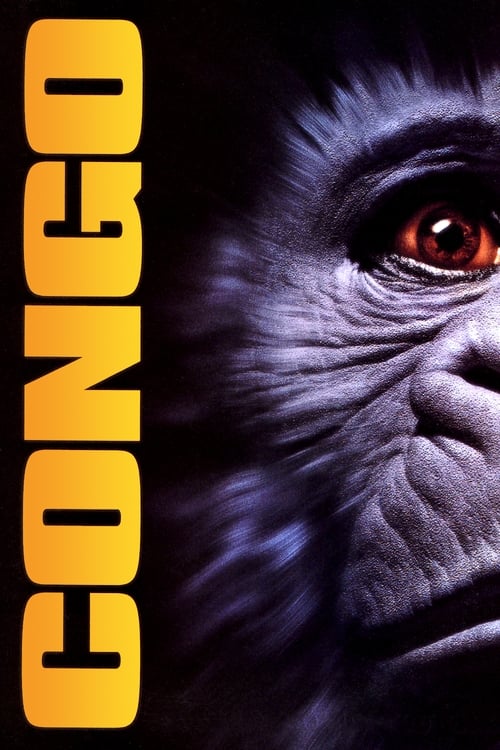
Congo (1995)
Directed by Frank Marshall
No — Congo is not woke, scoring 11 out of 100 on our wokeness meter.
Congo is an artifact of late twentieth-century pulp cinema, a spectacle of lush jungle environments and predictable corporate malfeasance.
Consciousness Markers
TraviCom's CEO values a diamond over his own son, and Homolka's greed leads to disaster, but the critique targets individual greed rather than capitalism as a system.
Ernie Hudson as Monroe Kelly and African supporting roles provide some diversity, but the casting is not framed as a deliberate inclusivity statement. The principal cast remains mostly white in a 1995 studio adventure.
Laura Linney's Karen Ross is a capable ex-CIA operative and expedition leader, but the film does not advance a feminist argument. Her competence is genre-standard rather than agenda-driven.
No LGBTQ+ characters, relationships, or themes are present.
The African setting and native characters are used as adventure backdrop, not as a vehicle for racial consciousness or social critique.
No climate change or environmental crusade themes are present.
No body positivity themes or messaging are present.
Amy the gorilla communicates via sign language, but this is not framed as human neurodivergence or neurodiversity advocacy.
The lost City of Zinj is fictional pulp adventure material, not a revisionist historical narrative.
The film is a jungle adventure with no preachy or lecture-like messaging.
Why it received this score
Congo is an artifact of late twentieth-century pulp cinema, a spectacle of lush jungle environments and predictable corporate malfeasance. It presents a sweeping adventure narrative, but its engagement with modern progressive sensibilities is remarkably muted. We find a competent ex-CIA operative, Laura Linney, leading the expedition. Her competence is genre standard, not a deliberate statement on gender equality. The representation of casting remains mostly conventional, focusing on a white lead navigating a foreign setting. The film serves as a backdrop for a story about human greed, which is certainly present, but its anti-capitalist undertones are limited to the downfall of a single avaricious CEO. The systemic issues of late twentieth-century corporate exploitation are treated as individual character flaws, a rather simplistic approach to socio-economic critique.
Beyond the obvious genre elements, the film exhibits a total absence of contemporary cultural commentary. There are no substantive discussions of environmental crises or global climate anxiety. The handling of non-human characters, such as the primate Amy, remains strictly within the bounds of a zoological curiosity, eschewing any meaningful exploration of neurodivergence. The setting of the Congo is utilized purely for its exotic geography, offering no genuine racial consciousness or social critique. This is pure adventure cinema, a self-contained mechanism for high stakes survival and treasure hunting. The narrative energy is consistently focused on the immediate peril of the lost city and the imminent threat of the volcanic activity.
In essence, Congo functions as a high-budget homage to the classic exploration genre. It provides thrills and exotic locations, but it does so without attempting to engage with the complex social and political themes that define contemporary progressive sensibilities. It is a diversion that requires no deep cultural analysis. The film is fundamentally about survival and the pursuit of rare diamonds, offering a straightforward escapist experience that respects its own limitations.
Analysis generated by our Consciousness Algorithm
Part of


Synopsis
Eight people embark on an expedition into the Congo, a mysterious expanse of unexplored Africa, where human greed and the laws of nature have gone berserk.
Questions about Congo
Is Congo woke?
No — Congo is not woke, scoring 11 out of 100 on our wokeness meter. That earns it a verdict of Ultra Based.
Does Congo have any woke elements?
Very few. None of the 10 markers reaches 30, the level where a marker counts as present; the highest is Eat the Rich at 25.
How does Congo compare to other 1995 movies?
It ranks #33 of the 108 films from 1995 we've scored; their average is 12. The wokest is Total Eclipse (60).
How is the Woke Score calculated?
An AI-assisted process researches the film and its reception, scores it 0–100 on ten markers, then combines those into one 0–100 Woke Score. It measures a specific set of 2020s cultural themes, not film quality.