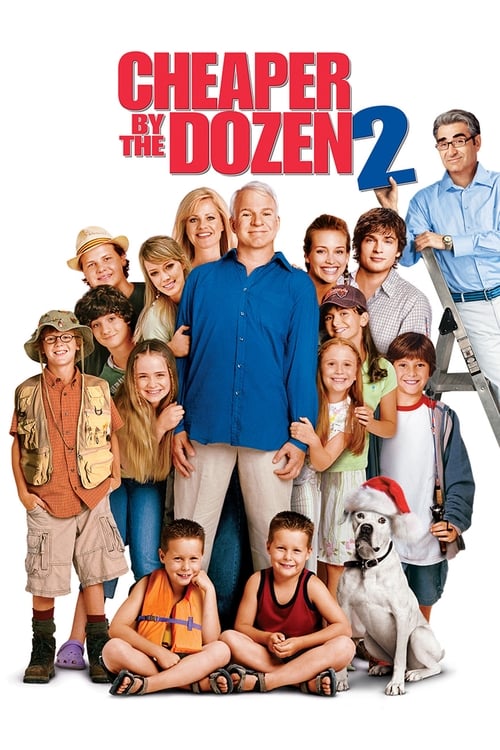
Cheaper by the Dozen 2 (2005)
Directed by Adam Shankman
No — Cheaper by the Dozen 2 is not woke, scoring 6 out of 100 on our wokeness meter.
Cheaper by the Dozen 2 is a sequel to a remake, a lineage that invites a certain melancholy before the opening credits finish.
Consciousness Markers
The wealthy rival Jimmy Murtaugh flaunts his money and success, and the film mildly favors the scrappier Baker family, but this is a parenting-styles rivalry rather than any systemic critique of wealth.
The film gestures at a warm message about family togetherness and looser parenting, but it is delivered through slapstick and sentiment rather than preachy sermonizing.
Women exist in the story (Kate as matriarch, Lorraine's magazine internship, Nora's pregnancy), but the film reinforces traditional gender roles, including a literal 'trophy wife' character, without any feminist critique.
The cast is overwhelmingly white, with the Baker and Murtaugh families drawn from a conventional 2000s studio-comedy pool. No meaningful diverse casting or representation is present.
There are no LGBTQ+ characters, themes, or subtext anywhere in the film.
Race is never addressed or thematized; the film is entirely unconcerned with racial dynamics.
No environmental or climate themes appear; the lake setting is purely a vacation backdrop.
No body-positivity themes; critics in fact noted the film's harsh treatment of actresses' appearances.
No neurodivergent characters or themes are present.
The film makes no historical claims and engages in no historical revisionism.
Why it received this score
Cheaper by the Dozen 2 is a sequel to a remake, a lineage that invites a certain melancholy before the opening credits finish. The Baker family, twelve children strong, retreats to a Wisconsin lake for one last summer, where they collide with the Murtaughs, a wealthier brood of eight presided over by Eugene Levy. Golf carts are crashed. Fireworks are detonated. A canoe race settles the Annual Labor Day Family Cup. The film's cultural footprint is faint, and its casting is drawn from a very conventional 2005 studio pool. Race, sexuality, and the natural world go entirely unremarked, which is at least efficient.
The women occupy familiar stations. Kate frets and narrates. Lorraine interns at a fashion magazine. Nora is pregnant and largely horizontal. Carmen Electra appears, without irony, as a trophy wife, and the film leaves her there. Critics of the day were unkind about the actresses' appearances in ways that reveal more about the era than the picture, though the picture offers no resistance. There is a mild suggestion that Jimmy Murtaugh's money has not made him happy, since his prosperity is set against the Bakers' scrappier warmth. This is not a critique of wealth. It is a critique of a man who brags at a lake.
The message, such as it is, concerns family togetherness and the perils of over-scheduling children. It arrives through slapstick, a shoplifting subplot, and a hospital dash during a canoe race. Nobody is lectured. Nobody is asked to examine a structure. The film ends with everyone tanned, reconciled, and mildly improved. It is warm, it is harmless, and it is close to inert. Roger Ebert found a good feeling in it. The Razzie voters found two nominations. Both parties were correct.
Analysis generated by our Consciousness Algorithm


Synopsis
The Baker family, while on vacation, find themselves in competition with a rival family of eight children.
Questions about Cheaper by the Dozen 2
Is Cheaper by the Dozen 2 woke?
No — Cheaper by the Dozen 2 is not woke, scoring 6 out of 100 on our wokeness meter. That earns it a verdict of Ultra Based.
Does Cheaper by the Dozen 2 have any woke elements?
Very few. None of the 10 markers reaches 30, the level where a marker counts as present; the highest is Eat the Rich at 12.
How does Cheaper by the Dozen 2 compare to other 2005 movies?
It ranks #112 of the 181 films from 2005 we've scored; their average is 13. The wokest is The Constant Gardener (72).
How is the Woke Score calculated?
An AI-assisted process researches the film and its reception, scores it 0–100 on ten markers, then combines those into one 0–100 Woke Score. It measures a specific set of 2020s cultural themes, not film quality.