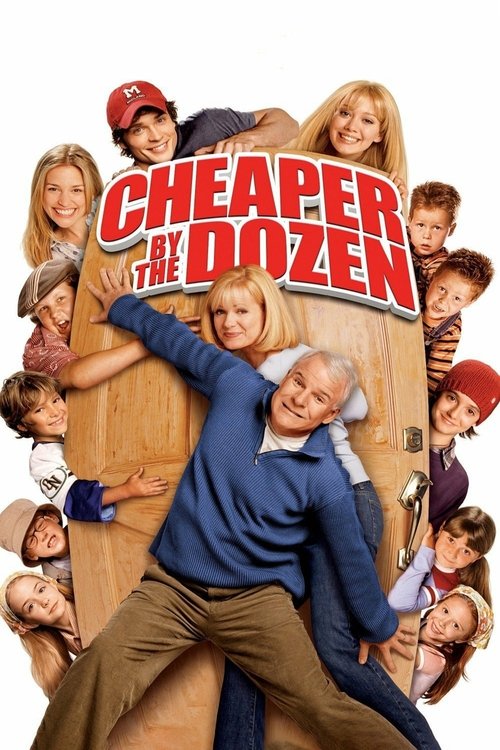
Cheaper by the Dozen (2003)
Directed by Shawn Levy
No — Cheaper by the Dozen is not woke, scoring 11 out of 100 on our wokeness meter.
Cheaper by the Dozen arrives from 2003, directed by Shawn Levy, with Steve Martin as a football coach who relocates twelve children and one patient wife to Evanston for a job at his alma mater.
Consciousness Markers
Kate has a writing career and a national book tour, and Tom ultimately steps back from coaching to support the family, but the film frames this as conventional work-life-balance comedy rather than a feminist statement.
The film delivers gentle family-first moralizing about parents prioritizing children, but it is sentimental rather than preachy or issue-driven.
No deliberate inclusive casting; the Baker family and principal cast are uniformly white, and minor minority roles are incidental.
No LGBTQ+ characters, themes, or subtext are present.
No racial themes, commentary, or consciousness are present.
No environmental or climate-related themes appear.
No critique of capitalism, wealth, or class structures is present.
No body-positivity themes or messaging are present.
No neurodivergence themes or representation are present.
The film is a loose remake of a family comedy and does not engage in historical revisionism.
Why it received this score
Cheaper by the Dozen arrives from 2003, directed by Shawn Levy, with Steve Martin as a football coach who relocates twelve children and one patient wife to Evanston for a job at his alma mater. It is a remake of a 1950 film, itself drawn from a semi-autobiographical book by the Gilbreth siblings, though the resemblance extends about as far as the title and the headcount. Half a century of source material has been politely misplaced.
The film's social conscience is of the mildest vintage. Kate Baker writes a book, departs on a national tour, and returns when the household collapses. Tom eventually resigns his coaching post to spend more time at home. A viewer determined to locate a statement about working mothers could construct one, but the film offers scheduling problems, not an argument. The Baker family is entirely white, and the film has no interest in commenting on that. There is no racial consciousness, no environmental anxiety, no class critique, no engagement with body image or neurodivergence. The minority performers in supporting parts, a publisher here, a teacher there, arrive without comment and depart without consequence. The only sermon on offer is the soft, family-first variety: parents should prioritize their children. Sentiment carries it, not a raised finger.
All of this places the film in a comfortable, unremarkable register. It is a studio comedy that wants to be liked, and audiences largely obliged, critics less so, with a twenty-five percent approval and a collective shrug. Ashton Kutcher earned a Razzie nomination for his trouble. The cultural footprint is modest and the ideological one smaller still. As a specimen of its era's social awareness, it sits in the cellar, not from any hostility toward progressive ideas but from a complete absence of them. There is nothing here to argue with and nothing to celebrate. We file it accordingly.
Analysis generated by our Consciousness Algorithm


Synopsis
The Baker brood moves to Chicago after patriarch Tom gets a job coaching football at Northwestern University, forcing his writer wife, Kate, and the couple's 12 children to make a major adjustment. The transition works well until work demands pull the parents away from home, leaving the kids bored -- and increasingly mischievous.
Questions about Cheaper by the Dozen
Is Cheaper by the Dozen woke?
No — Cheaper by the Dozen is not woke, scoring 11 out of 100 on our wokeness meter. That earns it a verdict of Ultra Based.
Does Cheaper by the Dozen have any woke elements?
Very few. None of the 10 markers reaches 30, the level where a marker counts as present; the highest is Feminist Agenda at 15.
How does Cheaper by the Dozen compare to other 2003 movies?
It ranks #58 of the 150 films from 2003 we've scored; their average is 12. The wokest is Mona Lisa Smile (60).
How is the Woke Score calculated?
An AI-assisted process researches the film and its reception, scores it 0–100 on ten markers, then combines those into one 0–100 Woke Score. It measures a specific set of 2020s cultural themes, not film quality.