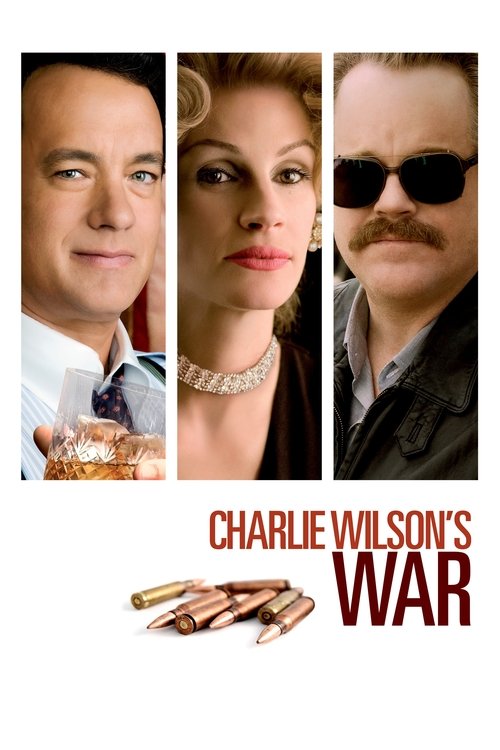
Charlie Wilson's War (2007)
Directed by Mike Nichols
No — Charlie Wilson's War is not woke, scoring 9 out of 100 on our wokeness meter.
Mike Nichols closed out a distinguished career with a film about a Texas congressman who discovers a conscience somewhere between the whiskey and the belly dancers.
Consciousness Markers
Sorkin's script carries a mild moralizing coda about American blowback and disengagement from Afghanistan, but it is understated rather than preachy.
The cast is overwhelmingly white, with Om Puri as Pakistan's Zia-ul-Haq and a handful of South Asian and Middle Eastern actors filling regional roles naturally. There is no casting-as-statement here, just period-appropriate faces.
Julia Roberts' Joanne Herring is a forceful socialite-diplomat, but the film's framing of Wilson's office as a harem of 'Charlie's Angels' and its womanizing protagonist keep this firmly pre-feminist.
Afghan refugees are humanized in a moving camp sequence, but the story is told entirely through the lens of American power brokers rather than any racial-justice consciousness.
The film takes liberties with the historical record (Stinger timing, the softened ending), but its revisionism is dramatic license rather than a progressive reframing of history.
No LGBTQ characters, themes, or subtext of any kind appear in this Cold War political drama.
No environmental or climate themes are present in this 1980s-set geopolitical narrative.
The film concerns covert military funding and Cold War strategy, not class warfare or anti-capitalist critique.
No body-positivity themes or messaging appear in the film.
No neurodivergent characters or themes are depicted.
Why it received this score
Mike Nichols closed out a distinguished career with a film about a Texas congressman who discovers a conscience somewhere between the whiskey and the belly dancers. Charlie Wilson's War is a nimble, well-acted piece of Beltway comedy, and Tom Hanks plays the title role with a lazy charm that almost conceals how little the man ever questions himself. Aaron Sorkin's script crackles, as his scripts tend to, and Philip Seymour Hoffman walks off with every scene he enters as a CIA operative with a grudge and a vocabulary.
On the matter of social consciousness, the film keeps its ambitions modest. Julia Roberts brings a steely authority to Joanne Herring, a Houston socialite who pushes Wilson toward Afghanistan, though the movie frames his office as a harem of attractive young women and treats his womanizing as an endearing quirk. That is a pre-feminist posture, delivered without apology. The cast is overwhelmingly white, with Om Puri and a scattering of South Asian and Middle Eastern performers filling regional roles as the period requires. Afghan refugees get one genuinely affecting camp sequence, but the camera stays fixed on the Americans who fund them. Nobody here is making a statement about representation.
The picture's real ideological freight is a mild, Sorkin-flavored sigh about blowback. A closing warning about the crazies rolling into Kandahar lands softly, an understated moral rather than a sermon. Where the film bends history, it does so for drama, not for doctrine, and it never reaches for the environmental, economic, or identity arguments that a later era might have demanded. We are left with a smart, cynical, faintly wistful movie about a man who won a war and forgot to pay for the peace. It is entertaining. It is not, by any measure this ledger recognizes, a crusade.
It is worth clarifying, for the record, that no climate lament, no class uprising, no body-acceptance subplot, and no neurodivergent arc intrudes upon the proceedings. This is a Cold War story told by men in suits, about men in suits, and it has the decency not to pretend otherwise. The film's conscience is real but narrow: it grieves for a country left in ruins and then changes the subject. A restrained entry in the archive, and a welcome one. The ledger records it without much exertion and moves on to the next screening, where the coffee has gone cold and the projector hums its patient, indifferent hum.
THEMATIC_TAGS: ["true_story", "book_adaptation"]
Analysis generated by our Consciousness Algorithm
Part of


Synopsis
A Texas congressman sets a series of events in motion when he conspires with a CIA operative to aid Afghan mujahideen rebels fighting the Soviets.
Questions about Charlie Wilson's War
Is Charlie Wilson's War woke?
No — Charlie Wilson's War is not woke, scoring 9 out of 100 on our wokeness meter. That earns it a verdict of Ultra Based.
Does Charlie Wilson's War have any woke elements?
Very few. None of the 10 markers reaches 30, the level where a marker counts as present; the highest is Lecture Energy at 20.
How does Charlie Wilson's War compare to other 2007 movies?
It ranks #86 of the 201 films from 2007 we've scored; their average is 12. The wokest is Like Stars on Earth (92).
How is the Woke Score calculated?
An AI-assisted process researches the film and its reception, scores it 0–100 on ten markers, then combines those into one 0–100 Woke Score. It measures a specific set of 2020s cultural themes, not film quality.