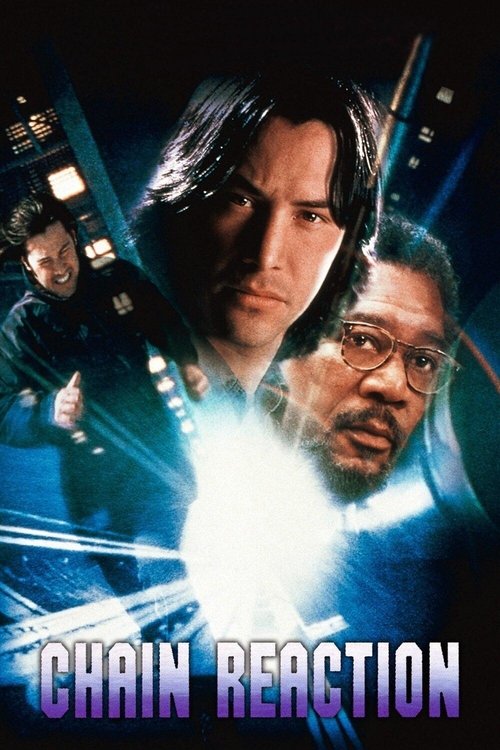
Chain Reaction (1996)
Directed by Andrew Davis
No — Chain Reaction is not especially woke, scoring 20 out of 100 on our wokeness meter.
There is a particular kind of 1996 studio thriller that arrives with a stern face and a folder full of grievances, and Chain Reaction is that film.
Consciousness Markers
The central conspiracy is that a private company and government suppress free energy to protect oil-company profits and avoid economic disruption — a clear anti-corporate, eat-the-rich premise.
A 1996 studio thriller with a reasonably mixed cast — Morgan Freeman in a major role and Tzi Ma in support — but no commentary on representation and no deliberate diversity agenda.
Rachel Weisz plays a competent physicist and co-lead, but she functions as a standard damsel-in-peril companion; no feminist thesis is advanced.
Some exposition about free-energy suppression and corporate greed, but delivered as plot mechanics rather than sermonizing; the film is a chase thriller first.
The plot revolves around a clean, waste-free fusion energy source, but the framing is about corporate suppression of technology, not climate advocacy in the modern sense.
Morgan Freeman and Tzi Ma appear in prominent roles, but race is never a subject of the film; the casting is colorblind rather than racially conscious.
No LGBTQ+ characters, themes, or subtext of any kind.
No body-positivity themes or messaging present.
No neurodivergent characters or themes.
A wholly fictional conspiracy thriller with no historical revisionism.
Why it received this score
There is a particular kind of 1996 studio thriller that arrives with a stern face and a folder full of grievances, and Chain Reaction is that film. Andrew Davis, fresh from the elevated train, turns his attention to a fusion reactor at the University of Chicago. Keanu Reeves plays a machinist who stumbles onto a stabilizing frequency, Rachel Weisz plays the physicist who flees beside him, and Morgan Freeman hovers with the ambiguous gravity of a man who has read the third act. The reactor is destroyed, the pair is framed, and the chase begins. Somewhere in the rubble sits a genuine thesis: a private contractor and its friends in government bury a limitless clean energy source to protect oil revenue and prevent economic upheaval. That is an eat-the-rich premise, stated plainly, though the film treats it as plot machinery instead of a sermon. The greed is a mechanism, not a moral.
The casting is agreeable without ever announcing itself. Freeman commands a major role, Tzi Ma gets a substantial supporting part, and Weisz holds her own as a working scientist rather than a decorative one. Race is not a subject here. Neither is gender, beyond the fact that the woman can do the math and still needs rescuing from a construction lift. The clean-energy device gestures at environmental concern, but the anxiety is corporate, not ecological. Nobody mentions a warming planet. The tension is about who owns the patent.
What the film lacks is instructive. No queer lives, no body politics, no neurodivergent interiority, no reworking of the historical record. It lectures only briefly, and mostly about hydrogen. The whole enterprise is a chase picture wearing a lab coat, and it was nominated for a Razzie rather than an Oscar, opened in fourth place, and remains a curious artifact of a moment when a movie could be mildly angry at corporations and call that sufficient. It is not sufficient. It is, however, honest about its limits, which is more than most.
Analysis generated by our Consciousness Algorithm


Synopsis
At the University of Chicago, a research team that includes brilliant student machinist Eddie Kasalivich experiences a breakthrough: a stable form of fusion that may lead to a waste-free energy source. However, a private company wants to exploit the technology, so Kasalivich and physicist Dr. Lily Sinclair are framed for murder, and the fusion device is stolen. On the run from the FBI, they must recover the technology and exonerate themselves.
Questions about Chain Reaction
Is Chain Reaction woke?
No — Chain Reaction is not especially woke, scoring 20 out of 100 on our wokeness meter. That earns it a verdict of Based.
Does Chain Reaction have any woke elements?
2 of the 10 markers register at 30 or above, led by Eat the Rich (42) and Representation Casting (32). On Eat the Rich: The central conspiracy is that a private company and government suppress free energy to protect oil-company profits and avoid economic disruption — a clear anti-corporate, eat-the-rich premise.
How does Chain Reaction compare to other 1996 movies?
It ranks #14 of the 93 films from 1996 we've scored; their average is 11. The wokest is Bound (60).
How is the Woke Score calculated?
An AI-assisted process researches the film and its reception, scores it 0–100 on ten markers, then combines those into one 0–100 Woke Score. It measures a specific set of 2020s cultural themes, not film quality.