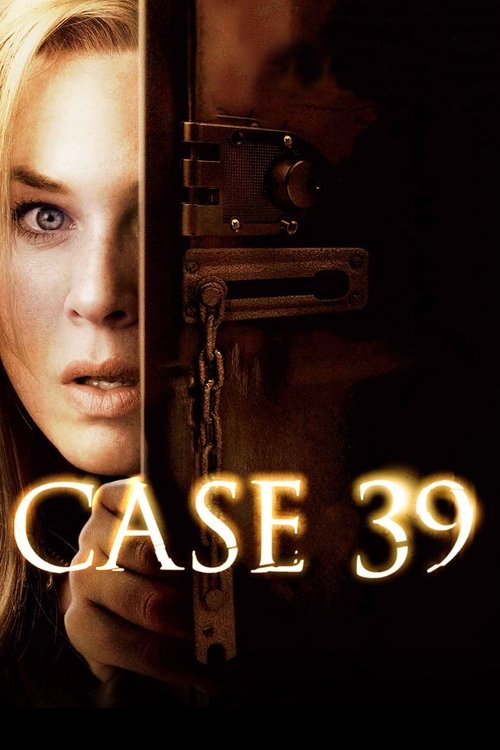
Case 39 (2009)
Directed by Christian Alvart
No — Case 39 is not woke, scoring 8 out of 100 on our wokeness meter.
Case 39 arrives from 2009 like a sealed specimen jar, containing a supernatural thriller in which a social worker named Emily rescues a ten-year-old girl from abusive parents and discovers, too late, that the child is a demon who feeds on fear.
Consciousness Markers
The cast is overwhelmingly white, with Adrian Lester as Detective Barron being the lone notable exception; his presence is unremarked and incidental to the plot.
A female social worker anchors the story, but her gender is never framed as a statement; she is a conventional horror protagonist, not a vehicle for feminist messaging.
No LGBTQ+ characters, themes, or subtext appear anywhere in the film.
Race is never addressed or thematized; the film has no racial commentary whatsoever.
No environmental or climate themes are present.
The film contains no economic critique or class commentary; its antagonist is a demon, not a system.
No body-positivity themes; the film's treatment of bodies is purely horror-oriented.
Mental illness appears only as a plot device (the parents committed to an asylum), not as neurodivergent representation or advocacy.
The film is a fictional supernatural thriller with no historical subject matter to revise.
This is a straightforward demon-child horror film with no preachy or didactic messaging.
Why it received this score
Case 39 arrives from 2009 like a sealed specimen jar, containing a supernatural thriller in which a social worker named Emily rescues a ten-year-old girl from abusive parents and discovers, too late, that the child is a demon who feeds on fear. The film was panned, delayed, and ultimately sank at the box office, and it carries almost none of the cultural markers that would later preoccupy the industry. It is a demon-child picture, plain and simple, channelling The Omen and the Japanese ring cycle without a single aspiration beyond the next jump scare.
The cast is almost entirely white, with Adrian Lester appearing as Detective Barron, a presence so incidental that the film never pauses to acknowledge it. Emily is a woman, and she anchors the narrative, but her gender is never framed as a statement; she is a conventional horror protagonist who happens to carry a caseload. Mental illness surfaces only as a plot mechanism, the parents committed to an asylum after they attempt to roast their daughter alive. There is no economic critique here. The antagonist is a demon, not a system, and the film has no interest in class, climate, or the redistribution of anything except fear.
What remains is a lean, nasty, and thoroughly unenlightened piece of genre filmmaking. It lectures no one. It represents no one, beyond the minimum casting requirements of its era. It simply sets a small girl on fire, drowns her in a car, and rolls credits. For the purposes of classification, this is a vintage of almost pure neutrality, a film that predates the cultural conversation entirely and seems grateful for it.
Analysis generated by our Consciousness Algorithm
Part of


Synopsis
In her many years as a social worker, Emily Jenkins believes she has seen it all, until she meets 10-year-old Lilith and the girl's cruel parents. Emily's worst fears are confirmed when the parents try to harm the child, and so Emily assumes custody of Lilith while she looks for a foster family. However, Emily soon finds that dark forces surround the seemingly innocent girl, and the more she tries to protect Lilith, the more horrors she encounters.
Questions about Case 39
Is Case 39 woke?
No — Case 39 is not woke, scoring 8 out of 100 on our wokeness meter. That earns it a verdict of Ultra Based.
Does Case 39 have any woke elements?
Very few. None of the 10 markers reaches 30, the level where a marker counts as present; the highest is Representation Casting at 15.
How does Case 39 compare to other 2009 movies?
It ranks #123 of the 230 films from 2009 we've scored; their average is 14. The wokest is Home (79).
How is the Woke Score calculated?
An AI-assisted process researches the film and its reception, scores it 0–100 on ten markers, then combines those into one 0–100 Woke Score. It measures a specific set of 2020s cultural themes, not film quality.