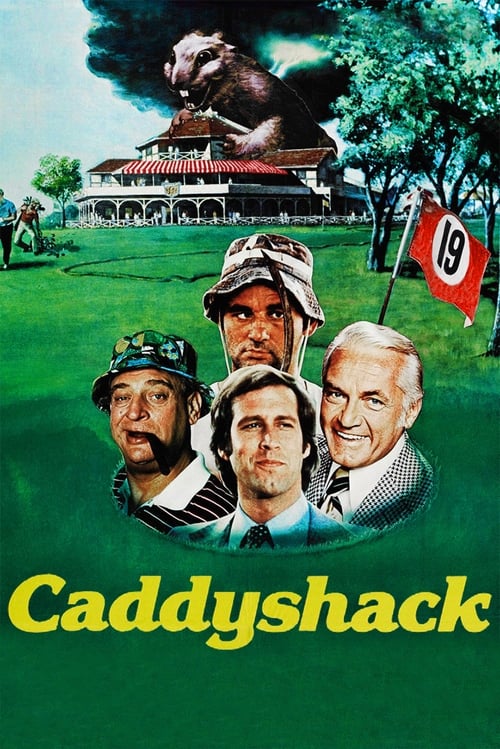
Caddyshack (1980)
Directed by Harold Ramis
No — Caddyshack is not woke, scoring 5 out of 100 on our wokeness meter.
Caddyshack comes to us from 1980, a year in which a comedy could still be assembled from loose sketches, improvised dialogue, and the ambient cocaine of a Florida production schedule.
Consciousness Markers
The film's 'slob vs. snob' structure pits the nouveau riche Czervik against the elitist Judge Smails, offering mild class friction, but it celebrates wealth rather than critiquing capitalism.
The cast is almost entirely white, with women relegated to decorative or romantic roles; there is no deliberate or notable diverse casting to speak of.
No LGBTQ+ characters, themes, or subtext appear anywhere in the film.
The film is aggressively crude and juvenile, treating women as sex objects (Lacey's seduction of Danny, the improvised massage scene); it is the opposite of a feminist text.
Race is entirely absent as a subject; the class conflict is framed strictly along wealth lines, not racial ones.
The gopher subplot involves a construction development, but it is played purely for slapstick and carries no environmental message.
No body-positivity themes; the film's humor relies on crude physical gags and conventional attractiveness.
Carl Spackler is called 'mentally unstable,' but this is a comic caricature rather than any affirmative neurodivergence representation.
The film is a contemporary comedy with no historical subject matter to revise.
Caddyshack is a loose, gag-driven comedy that preaches nothing; it has no didactic or moralizing agenda whatsoever.
Why it received this score
Caddyshack comes to us from 1980, a year in which a comedy could still be assembled from loose sketches, improvised dialogue, and the ambient cocaine of a Florida production schedule. Harold Ramis, in his directorial debut, presides over a feud at the Bushwood Country Club: the loud nouveau riche Al Czervik against the insufferable Judge Smails, with a teenage caddie named Danny caught between them, and a greenskeeper named Carl waging a private war against a gopher. It is a film of gags, not arguments. The plot wanders, the tone lurches, and nobody involved appears to have a thesis.
On the matter of representation, the cast is white and the women are decorative. Lacey exists to seduce Danny and to be doused with massage oil in a scene the actress later confirmed was improvised. Race never enters the frame. The conflict at Bushwood is drawn strictly along lines of money and manners, and the film has no interest in widening that frame. The gopher subplot brushes against a property development, which is the closest the film comes to an environmental thought, and it declines to have one. Carl is described as mentally unstable, a phrase the screenplay treats as a punchline.
What class friction exists is mild and quickly resolved in favor of the wealthy. Czervik wins his eighty thousand dollars, the crowd cheers, and the film celebrates the man instead of questioning the wager. There is no sermon here, no moral, no closing address to the audience about how to live. Caddyshack preaches nothing at all, which in this ledger is a small mercy and the reason its scores sit near the floor.
Analysis generated by our Consciousness Algorithm


Synopsis
At an exclusive country club, an ambitious young caddy, Danny Noonan, eagerly pursues a caddy scholarship in hopes of attending college and, in turn, avoiding a job at the lumber yard. In order to succeed, he must first win the favour of the elitist Judge Smails, and then the caddy golf tournament which Smails sponsors.
Questions about Caddyshack
Is Caddyshack woke?
No — Caddyshack is not woke, scoring 5 out of 100 on our wokeness meter. That earns it a verdict of Ultra Based.
Does Caddyshack have any woke elements?
Very few. None of the 10 markers reaches 30, the level where a marker counts as present; the highest is Eat the Rich at 15.
How does Caddyshack compare to other 1980 movies?
It ranks #20 of the 37 films from 1980 we've scored; their average is 10. The wokest is Nine to Five (42).
How is the Woke Score calculated?
An AI-assisted process researches the film and its reception, scores it 0–100 on ten markers, then combines those into one 0–100 Woke Score. It measures a specific set of 2020s cultural themes, not film quality.