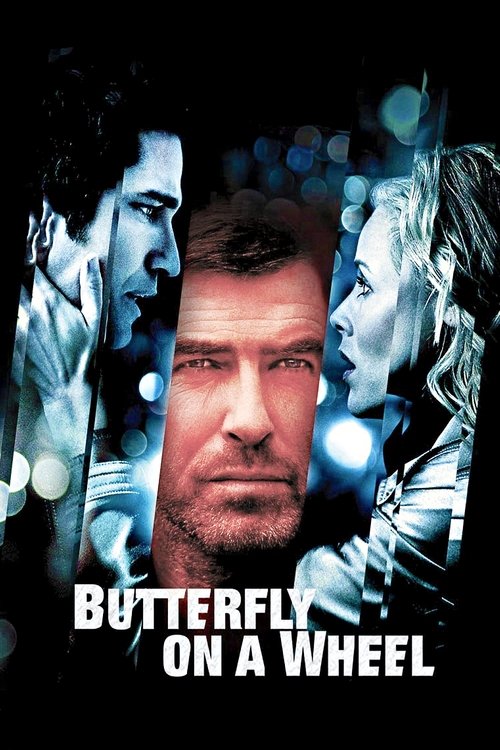
Butterfly on a Wheel (2007)
Directed by Mike Barker
No — Butterfly on a Wheel is not woke, scoring 8 out of 100 on our wokeness meter.
A Chicago couple with a beautiful daughter and a beautiful mortgage watch a stranger named Tom Ryan dismantle their beautiful life over the course of a single day.
Consciousness Markers
The twist reveals the wife orchestrated an elaborate revenge on her unfaithful husband, giving her agency, but it is framed as personal betrayal rather than a feminist statement.
The film dismantles a wealthy couple's 'American dream' and burns their money, but this serves personal revenge rather than any systemic critique of capitalism.
The film delivers its moral about infidelity through plot mechanics rather than explicit preaching, keeping didacticism minimal.
The cast is overwhelmingly white (Brosnan, Bello, Butler) with no meaningful diverse representation or commentary on casting.
No LGBTQ+ characters, themes, or subtext appear anywhere in the film.
No engagement with race, racism, or racial identity; the story is a domestic thriller with no racial dimension.
No environmental or climate themes whatsoever.
No body positivity themes; the film's only body-related moment is a coercive dress-change used as humiliation.
The antagonist is labeled 'sociopathic,' but this is a stock villain trope, not neurodivergence representation or advocacy.
No historical events or figures are reinterpreted; the plot is entirely fictional and contemporary.
Why it received this score
A Chicago couple with a beautiful daughter and a beautiful mortgage watch a stranger named Tom Ryan dismantle their beautiful life over the course of a single day. He does not want their money. He wants their composure, their small dignities, their sense of being the sort of people to whom nothing happens. Pierce Brosnan plays the intruder with the weary courtesy of a man who has read the script and found it adequate. Maria Bello and Gerard Butler suffer attractively. The whole apparatus is sleek, competent, and cool to the touch, a thriller assembled from parts that were lying around in 2007 and have not improved with storage.
The film's final turn reveals that the wife was complicit all along, exacting a day of measured torment upon her unfaithful husband. This grants her a certain operational agency, though the movie frames it as domestic grievance settled by private means, not as a statement about anything larger. The wealthy are humbled and their cash is burned and cast into a river, which gestures toward a critique of comfortable lives without ever bothering to construct one. The money is a prop. The revenge is personal. Nobody in the film pauses to explain what any of it means, which is the closest it comes to restraint.
What we have, then, is a tidy machine for the production of unease, running on infidelity, a kidnapped child who was never kidnapped, and the reliable spectacle of well-dressed people being made to feel bad. The cast is white, the concerns are marital, and the moral is delivered through plot mechanics instead of speeches, which keeps the sermonizing to a minimum. It is a film about a man learning a lesson. He learns it. The river takes the money. Everyone goes home. We have seen this before, and we will see it again, and the wheel turns regardless of who is broken upon it.
Analysis generated by our Consciousness Algorithm


Synopsis
A sociopathic kidnapper methodically pushes a desperate pair of parents to their absolute breaking point.
Questions about Butterfly on a Wheel
Is Butterfly on a Wheel woke?
No — Butterfly on a Wheel is not woke, scoring 8 out of 100 on our wokeness meter. That earns it a verdict of Ultra Based.
Does Butterfly on a Wheel have any woke elements?
Very few. None of the 10 markers reaches 30, the level where a marker counts as present; the highest is Feminist Agenda at 18.
How does Butterfly on a Wheel compare to other 2007 movies?
It ranks #93 of the 201 films from 2007 we've scored; their average is 12. The wokest is Like Stars on Earth (92).
How is the Woke Score calculated?
An AI-assisted process researches the film and its reception, scores it 0–100 on ten markers, then combines those into one 0–100 Woke Score. It measures a specific set of 2020s cultural themes, not film quality.