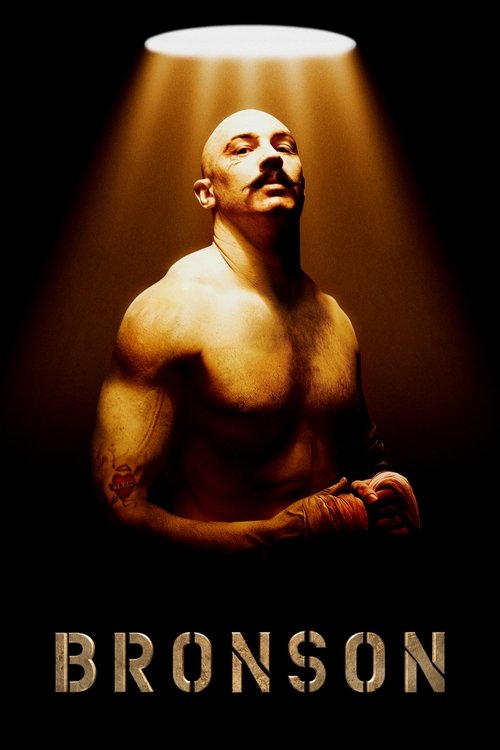
Bronson (2009)
Directed by Nicolas Winding Refn
No — Bronson is not woke, scoring 0 out of 100 on our wokeness meter.
Nicolas Winding Refn's Bronson arrives with a moustache, a bare-knuckle physique, and a stage.
Consciousness Markers
The cast is almost entirely white British actors, with Tom Hardy leading as Michael Peterson; no deliberate diverse or inclusive casting is present.
There are no LGBTQ+ characters, relationships, or themes anywhere in the film.
Female characters (mother, wife, lover) exist only as peripheral figures in Bronson's life; the film advances no feminist perspective or critique.
Race is entirely absent as a subject; the film is a stylized study of one white British prisoner with no racial commentary.
No environmental or climate themes appear in the film whatsoever.
The film has no economic critique or eat-the-rich messaging; it is a character study of violence and institutional confinement.
The film fixates on Hardy's hyper-muscular physique as a tool of intimidation, the opposite of body-positivity messaging.
Psychiatric hospitalization appears as a plot event, but the film explicitly refuses to diagnose or advocate for mental-health/neurodivergence framing, treating Bronson's behavior as inexplicable.
It is a stylized biopic of a real prisoner, but it does not reinterpret history through a modern ideological lens or revise established narratives for political ends.
Refn deliberately avoids moralizing or explaining Bronson's behavior; the film is theatrical and amoral rather than preachy.
Why it received this score
Nicolas Winding Refn's Bronson arrives with a moustache, a bare-knuckle physique, and a stage. Tom Hardy plays Michael Peterson, later Charles Bronson, Britain's most expensive prisoner, and he plays him as a music hall turn, narrating his own legend to an imagined audience in a velvet-curtained theatre. The film has no thesis. It refuses to diagnose, excuse, or explain. Refn stages the violence as performance and the performance as violence, and when the credits roll we know nothing more about the man than we did at the start. That refusal is the point, and it is also the reason the film scans clean on every index of contemporary social concern.
The women here (a mother, a wife, a lover) drift through the margins and vanish. Race is not a subject. Class is present as texture, not argument. The prison is a machine for producing spectacle, not a metaphor for capitalism, and the film has no interest in proposing reforms. Hardy's body is treated as a weapon and a costume, which is the opposite of any wellness-forward philosophy of self-acceptance. Psychiatric care appears as a plot event, and the film declines to convert it into advocacy. There are no speeches. There is no lesson. The whole enterprise is amoral in the oldest sense, and it is bracing for exactly that reason.
Bronson is a 2008 film that behaves like a 1971 film, and it has aged into a curiosity: a biopic with no civic agenda, a star vehicle with no message, a study of a man who cannot be fixed and will not be explained. We are left with Hardy's jaw, the Magritte gag, and the sound of a cell door. It scores a zero, and it earns it honestly.
Analysis generated by our Consciousness Algorithm


Synopsis
A young man who was sentenced to 7 years in prison for robbing a post office ends up spending 30 years in solitary confinement. During this time, his own personality is supplanted by his alter ego, Charles Bronson.
Questions about Bronson
Is Bronson woke?
No — Bronson is not woke, scoring 0 out of 100 on our wokeness meter. That earns it a verdict of Ultra Based.
Does Bronson have any woke elements?
No. All 10 markers score zero.
How does Bronson compare to other 2009 movies?
It ranks #208 of the 230 films from 2009 we've scored; their average is 14. The wokest is Home (79).
How is the Woke Score calculated?
An AI-assisted process researches the film and its reception, scores it 0–100 on ten markers, then combines those into one 0–100 Woke Score. It measures a specific set of 2020s cultural themes, not film quality.