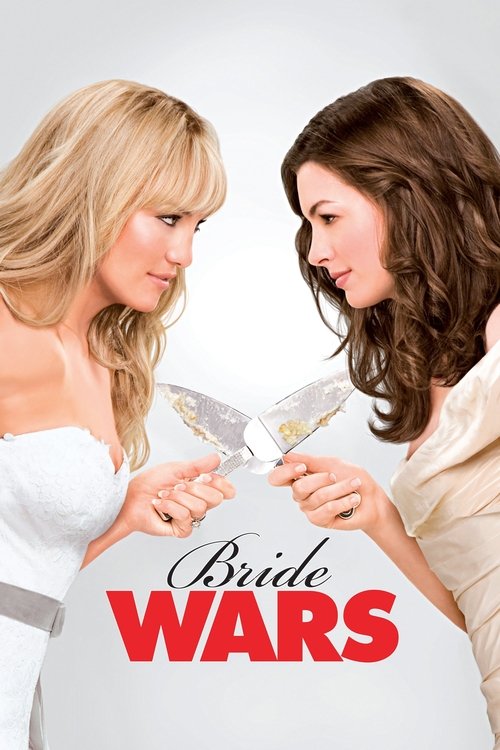
Bride Wars (2009)
Directed by Gary Winick
No — Bride Wars is not woke, scoring 8 out of 100 on our wokeness meter.
Bride Wars arrives from 2009 with a premise of admirable economy: two lifelong friends, one Plaza Hotel, one clerical error, and a summer of sabotage.
Consciousness Markers
Though centered on two women, the film frames their lives around weddings and reduces their conflict to bridezilla sabotage; the only mild feminist beat is Emma leaving her controlling fiancé, undercut by the overall wedding-industry fantasy.
The principal cast is overwhelmingly white; a few ethnically diverse performers appear in minor supporting roles (e.g., Hettienne Park as a friend), but race is never a thematic element.
The film is a broad comedy with no overt preaching; the only faint message is Emma's self-confidence awakening, delivered lightly rather than as a lecture.
No LGBTQ+ characters or themes appear; the plot is entirely built around heterosexual weddings, and the lesbian subtext noted by one critic exists only in her imagination.
The film engages with no racial themes or dynamics whatsoever.
There is no environmental or climate content in this romantic comedy.
The film celebrates rather than critiques conspicuous consumption, luxury goods, and the wedding-industrial complex, offering no anti-capitalist argument.
The candy-so-the-dress-won't-fit sabotage and spray-tan gags reinforce appearance and body-size anxiety rather than any body-positive message.
No neurodivergent characters or themes are present.
Nothing in the film revises or reinterprets historical events.
Why it received this score
Bride Wars arrives from 2009 with a premise of admirable economy: two lifelong friends, one Plaza Hotel, one clerical error, and a summer of sabotage. Gary Winick directs the material as a broad farce of escalating pettiness, and the film commits to that register with a conviction the script does not otherwise earn. What it does not do is reach for any larger social argument. The wedding industry is presented as an aspirational destination, its gowns and registries and Tiffany boxes treated as the natural rewards of adult life. There is no critique buried in the fondling of the merchandise. The camera loves the consumption too much to indict it.
The film's two leads are women, and one of them, Emma, eventually walks away from a controlling fiance. That is the movie's single gesture toward self-possession, delivered in the final reel with a tackle and a raised voice. The surrounding ninety minutes reduce both heroines to schemers whose grievances are measured in hair dye and spray tan. The body gags run on the assumption that a bride's worth is her silhouette, which is the opposite of any modern instruction on the subject. Race does not enter the frame. Neither does class, environment, neurodivergence, or history. A critic once mused that the opening scenes hinted at a lesbian reading. They do not. That reading lives in her review alone.
What is left is a comedy of friendship turned feral, briefly charming, mostly shrill, and entirely uninterested in instructing anyone about anything. The sermon, such as it is, amounts to a whisper about confidence. We have graded it accordingly, and the ledger is nearly blank.
Analysis generated by our Consciousness Algorithm


Synopsis
Two best friends become rivals when their respective weddings are accidentally booked for the same day.
Questions about Bride Wars
Is Bride Wars woke?
No — Bride Wars is not woke, scoring 8 out of 100 on our wokeness meter. That earns it a verdict of Ultra Based.
Does Bride Wars have any woke elements?
Very few. None of the 10 markers reaches 30, the level where a marker counts as present; the highest is Feminist Agenda at 15.
How does Bride Wars compare to other 2009 movies?
It ranks #123 of the 230 films from 2009 we've scored; their average is 14. The wokest is Home (79).
How is the Woke Score calculated?
An AI-assisted process researches the film and its reception, scores it 0–100 on ten markers, then combines those into one 0–100 Woke Score. It measures a specific set of 2020s cultural themes, not film quality.