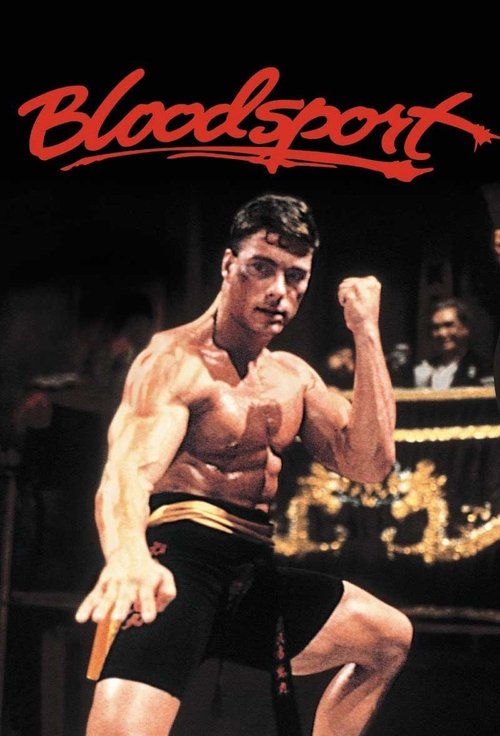
Bloodsport (1988)
Directed by Newt Arnold
No — Bloodsport is not woke, scoring 6 out of 100 on our wokeness meter.
Bloodsport arrives from 1988 with the confidence of a film that has no interest in being anything other than a man kicking other men in a warehouse.
Consciousness Markers
The film features a diverse supporting cast, including Asian actors in prominent roles and Forest Whitaker as a military agent, though this reflects the Hong Kong setting rather than a modern diversity initiative.
No LGBTQ+ characters, themes, or subtext are present.
The female lead is a journalist and love interest, but the film contains no feminist critique or agenda.
The film is set in Hong Kong and features Asian characters, but it does not engage with racial consciousness or systemic racism.
There is no environmental or climate-related content.
The underground tournament setting is not used to critique capitalism or wealth inequality.
The film focuses on athletic, muscular fighters and does not promote body positivity or diverse body types.
No neurodivergent characters or themes are present.
The film was marketed as a true story based on Frank Dux's disputed claims, but this is not a progressive revisionist history.
The film is a straightforward action drama with no preachy or lecture-like messaging.
Why it received this score
Bloodsport arrives from 1988 with the confidence of a film that has no interest in being anything other than a man kicking other men in a warehouse. Jean-Claude Van Damme plays Frank Dux, an Army captain who abandons his post to fly to Hong Kong and enter an outlawed tournament, and the film treats this decision with the gravity of a man choosing a sandwich. The screenplay was drawn from claims that its own co-writer later described as fabrication, which lends the whole enterprise the texture of a tall tale told with total sincerity. Nothing in the runtime pauses to instruct the audience on how to live.
The supporting cast is genuinely international. Roy Chiao and Philip Chan appear as Hong Kong figures of authority, Bolo Yeung glowers as the villain, and Forest Whitaker turns up as a military investigator. This is a function of shooting entirely on location in Hong Kong, not of any deliberate program of inclusion, and the film makes no comment on the arrangement. It simply is. The female lead is a journalist who exists to be concerned about the protagonist, and the film offers no critique of that arrangement either.
Elsewhere the ledger is blank. There is no environmental content. The underground tournament is not framed as an indictment of capital, merely as a venue with a great deal of concrete. The bodies on display are uniformly chiseled and the film prefers them that way. No character is marked as neurodivergent, no same-sex anything occurs, and the disputed true-story framing is a matter of personal aggrandizement, not historical revision in any ideological direction. It lectures no one. It is, in the end, a Cannon Films product about a man doing the splits, and it has the decency not to pretend otherwise.
Analysis generated by our Consciousness Algorithm
Part of


Synopsis
An American Army Major goes AWOL to Hong Kong for an outlawed martial arts contest called the Kumite.
Questions about Bloodsport
Is Bloodsport woke?
No — Bloodsport is not woke, scoring 6 out of 100 on our wokeness meter. That earns it a verdict of Ultra Based.
Does Bloodsport have any woke elements?
Very few. None of the 10 markers reaches 30, the level where a marker counts as present; the highest is Representation Casting at 15.
How does Bloodsport compare to other 1988 movies?
It ranks #38 of the 73 films from 1988 we've scored; their average is 10. The wokest is Stand and Deliver (58).
How is the Woke Score calculated?
An AI-assisted process researches the film and its reception, scores it 0–100 on ten markers, then combines those into one 0–100 Woke Score. It measures a specific set of 2020s cultural themes, not film quality.