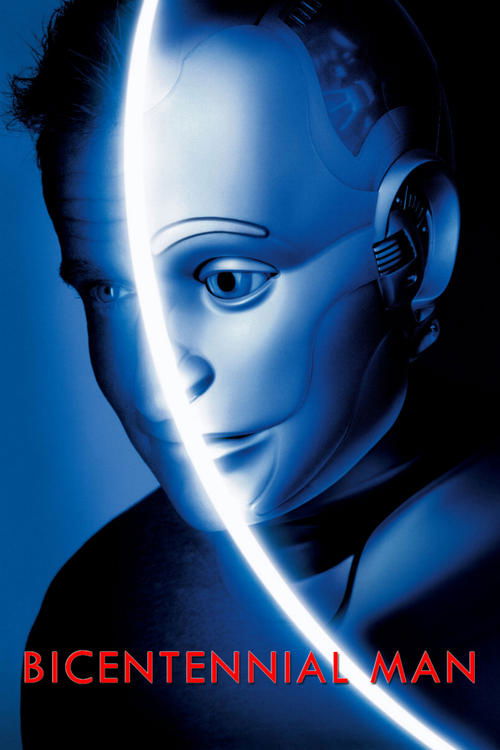
Bicentennial Man (1999)
Directed by Chris Columbus
No — Bicentennial Man is not woke, scoring 7 out of 100 on our wokeness meter.
Bicentennial Man arrives in 1999 with the solemn gait of a film that believes it is saying something about the human soul.
Consciousness Markers
The film periodically pauses for philosophical musings on the nature of humanity, rights, and mortality, and the World Congress scenes carry a mild sermonizing quality, but the sentimentality is more greeting-card than lecture.
The cast is overwhelmingly white, with Lynne Thigpen as the World Congress Speaker being the only notable non-white presence, and she exists naturally in the story without comment. No deliberate representation-casting agenda is evident.
NorthAm Robotics' CEO is briefly portrayed as callous for wanting to scrap Andrew, and Andrew's lack of legal rights is noted, but the film celebrates his accumulation of wealth and never mounts a systemic anti-capitalist argument.
The android-rights storyline can be read as a generic civil-rights allegory, but it is framed around personhood and mortality rather than race, and no racial consciousness is articulated.
Portia and Amanda are given some agency, but the film is fundamentally a male android's journey toward humanity, with women largely serving as emotional touchstones across generations. No feminist thesis is advanced.
There are no LGBTQ+ characters, themes, or subtext anywhere in the film.
Environmental themes are entirely absent from the film.
No body-positivity themes or messaging appear in the film.
Andrew's emotional awakening is framed as a robot becoming human, not as neurodivergence, and no neurodivergent representation is present.
The film is a straightforward adaptation of Asimov's fiction with no revisionist reframing of historical events.
Why it received this score
Bicentennial Man arrives in 1999 with the solemn gait of a film that believes it is saying something about the human soul. Chris Columbus directs Robin Williams as Andrew, an NDR android who spends two centuries carving figurines, acquiring a fortune, and petitioning the World Congress for legal personhood. The production is earnest and well upholstered, and the makeup nomination is the only Oscar acknowledgment the material received. We are asked to watch a household appliance become a man, and the film asks for patience.
The social ledger is mostly blank. The cast is overwhelmingly white; Lynne Thigpen appears as the World Congress Speaker and the film lets her exist without comment, which is the minimum. No LGBTQ currents disturb the narrative. Portia and Amanda have moments of agency, but they function as emotional touchstones across generations while Andrew does the real becoming. The android-rights story can be read as a generic civil rights allegory, though the film frames it around personhood and mortality and never articulates a racial consciousness. NorthAm Robotics CEO briefly looks callous when he suggests scrapping Andrew, but Andrew builds a fortune and the film enjoys the pile too much to mount an argument against capital.
The climate, body-positivity, neurodivergence, and revisionist-history aisles remain empty. The remainder is a mild sermon: the World Congress scenes and Andrew's musings on rights and death carry a greeting-card philosophy, sentimental instead of sharp. Roger Ebert called it a cornball drone of greeting-card sentiment, and the diagnosis holds. The film is less a provocative Asimov adaptation than a long, polished fable about a robot who wants to die with dignity. We leave respecting the ambition and wishing the script had more bite.
Analysis generated by our Consciousness Algorithm


Synopsis
Richard Martin buys a gift, a new NDR-114 robot. The product is named Andrew by the youngest of the family's children. "Bicentennial Man" follows the life and times of Andrew, a robot purchased as a household appliance programmed to perform menial tasks. As Andrew begins to experience emotions and creative thought, the Martin family soon discovers they don't have an ordinary robot.
Questions about Bicentennial Man
Is Bicentennial Man woke?
No — Bicentennial Man is not woke, scoring 7 out of 100 on our wokeness meter. That earns it a verdict of Ultra Based.
Does Bicentennial Man have any woke elements?
Very few. None of the 10 markers reaches 30, the level where a marker counts as present; the highest is Lecture Energy at 22.
How does Bicentennial Man compare to other 1999 movies?
It ranks #64 of the 103 films from 1999 we've scored; their average is 14. The wokest is Boys Don't Cry (60).
How is the Woke Score calculated?
An AI-assisted process researches the film and its reception, scores it 0–100 on ten markers, then combines those into one 0–100 Woke Score. It measures a specific set of 2020s cultural themes, not film quality.