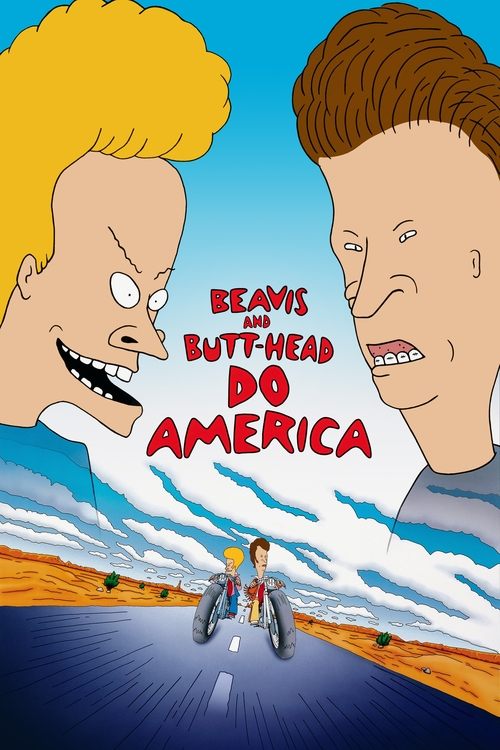
Beavis and Butt-Head Do America (1996)
Directed by Mike Judge
No — Beavis and Butt-Head Do America is not woke, scoring 13 out of 100 on our wokeness meter.
We approach this 1996 animated outing with the requisite solemnity, though the subject matter makes such gravity difficult to sustain.
Consciousness Markers
The film satirizes consumerism and the absurdity of the American security state, but this is done through crude comedy rather than deep political critique.
The film satirizes American political figures and events, which constitutes a mild form of historical commentary, but it is not a deep revisionist work.
Female characters are primarily used as plot devices or objects of crude desire, offering only a minimal, non-critical presence in the narrative.
The film features a diverse supporting cast, but the central characters are archetypal white slackers, offering minimal progressive representation.
There are no discernible LGBTQ+ themes, representation, or positive messaging within the film's narrative or humor.
The film offers no meaningful commentary on race or systemic racial issues, relying instead on broad, stereotypical American settings.
Environmental concerns are entirely absent from the plot and thematic material of the film.
The characters are defined by their slovenliness and lack of hygiene, and there is no exploration or celebration of diverse body types.
Beavis's hallucinations are a plot device for comedic effect and do not explore neurodivergence as a condition.
The film is a chaotic comedy and satire, lacking any didactic or progressive social commentary.
Why it received this score
We approach this 1996 animated outing with the requisite solemnity, though the subject matter makes such gravity difficult to sustain. This film, a chaotic road trip across the American landscape, attempts to engage with contemporary culture, but its efforts are consistently hampered by a lack of progressive nuance. The social consciousness present in Beavis and Butt-Head Do America is, at best, a crude parody of American excess. While the central duo serves as effective conduits for broad satire, they offer almost no meaningful exploration of systemic issues. The commentary on the American security apparatus is present, yet it is delivered through a lens of extreme vulgarity rather than genuine critical depth.
The film’s limited scope regarding diverse perspectives is apparent. The supporting cast is diverse, but the narrative weight rests upon archetypal figures who provide little progressive representation. The film fails to address issues of gender or identity with any serious intent. Female characters function almost entirely as plot mechanisms or objects of juvenile desire, rarely existing outside of those narrow functions. Similarly, environmental concern is absent, and attempts at revisionist historical commentary remain light, functioning more as a punchline than a profound statement. The film is a study in low-stakes mayhem, fundamentally uninterested in anything beyond the immediate impulses of its two leads.
This is a piece of cultural history, certainly, but its progressive sensibilities are severely underdeveloped. The central premise relies on anarchic humor and adolescent slovenliness, neither of which lends itself to a mature engagement with the cultural fault lines of our current era. We find ourselves observing a product of its time, one that satirizes consumerism but does so without the requisite intellectual muscle. It is a heavy, low-effort satire that leaves us feeling neither enlightened nor significantly challenged.
Analysis generated by our Consciousness Algorithm
Part of


Synopsis
Slacker duo Beavis and Butt-Head wake to discover their TV has been stolen. Their search for a new one takes them on a clueless adventure across America, during which they manage to accidentally become America's most wanted.
Questions about Beavis and Butt-Head Do America
Is Beavis and Butt-Head Do America woke?
No — Beavis and Butt-Head Do America is not woke, scoring 13 out of 100 on our wokeness meter. That earns it a verdict of Ultra Based.
Does Beavis and Butt-Head Do America have any woke elements?
1 of the 10 markers register at 30 or above, led by Eat the Rich (40). On Eat the Rich: The film satirizes consumerism and the absurdity of the American security state, but this is done through crude comedy rather than deep political critique.
How does Beavis and Butt-Head Do America compare to other 1996 movies?
It ranks #26 of the 93 films from 1996 we've scored; their average is 11. The wokest is Bound (60).
How is the Woke Score calculated?
An AI-assisted process researches the film and its reception, scores it 0–100 on ten markers, then combines those into one 0–100 Woke Score. It measures a specific set of 2020s cultural themes, not film quality.